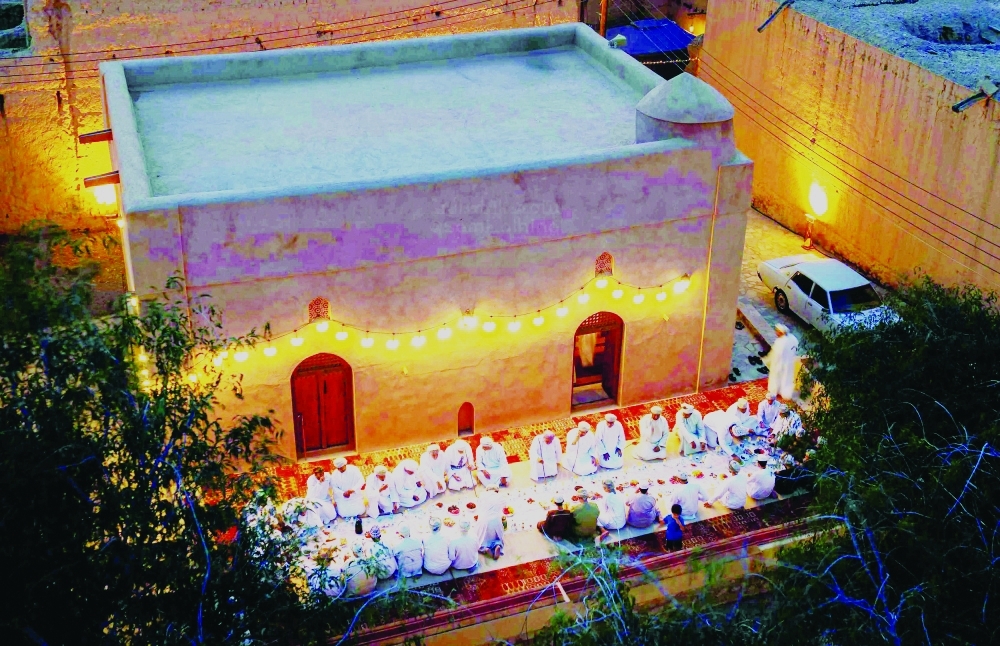





Before Ramadhan arrives, Omani society has already taken a step ahead. In the old alleyways, in the courtyards of houses, and on the outskirts of villages and neighbourhoods, small groups of people form and gathered around delicious food, spontaneous conversation and hearts psychologically prepared to welcome the month of fasting. This is called 'Al Darna'.
"The custom is widespread in some governorates of the Sultanate of Oman, such as Al Dakhiliyah, some wilayats of Muscat and perhaps Dhofar and is absent from many wilayats of Al Batinah North, Musandam and Al Buraimi," said Younis al Maamari, a researcher in sociology.
Al Darna is not just a custom that precedes Ramadhan, but an intense social moment that rearranges the distances between people, and reminds them that Ramadhan is not welcomed individually, but collectively.
"In this quiet gathering, the unique attributes of Omani society are revealed as they are in their essence: close-knit, supportive/combined, simple in appearance, and profound in meaning. It is as if the gathering is an unwritten declaration that the bonds are still stronger than the fast pace of life, and that the preparation for the holy month begins with reviving the connection between people. In Islamic culture, worship is not understood in isolation from the community; the gathering/collective spirit is a religious value before it is a social one, and Al Darna represents a popular translation of this spirit," he said.
What happens in Al Darna is that families or neighbours gather for a meal, usually a large and varied meal, for lunch or any time during the day, consisting of rice with fish, chicken, meat, and other various dishes of pastries, salads, appetisers, and so on, and they eat from it until they are feeling full.
“The food is prepared together by family members, young and old, and it is special because it is the last meal they will eat during the daytime before Ramadhan. In the past, Al Darna also played social roles, as families shared food with other families or neighbours. It is a kind of continuous social solidarity in Omani society,” Al Maamari pointed out.
The tradition of the Al Darna, as he added, may differ within the wilayats, in its timing (it may be on the last day or the last days before Ramadhan), the food served, and the place of gathering, but they all share the characteristic of being a happy and joyful custom to welcome the fasting month.
Social media has helped spread the culture of Al Darna in some wilayats; where it was not present, even in a simple way, as he explained, “Even if the custom is not actually practised, these platforms have helped spread knowledge about it. Some members of the community have confirmed that this custom has begun to fade in some wilayats and increase in others based on the level of social change in each of them,” he shared.
The form of the gathering may change, and the city may shorten it or communication technologies may reshape it, but what remains constant is humanity;ss need to come together. For Al Darna, in its deepest sense, is not a fleeting ritual, but rather an annual reminder that when a community gathers voluntarily, it renews its unwritten moral contract to remain cohesive and to prepare to welcome the holy month with a collective heart.
Oman Observer is now on the WhatsApp channel. Click here