




Even before the lightning-quick U.S. raid on Venezuela’s capital, President Donald Trump had made a crucial decision about what would happen once the country’s leader, Nicolás Maduro, was out of the picture.
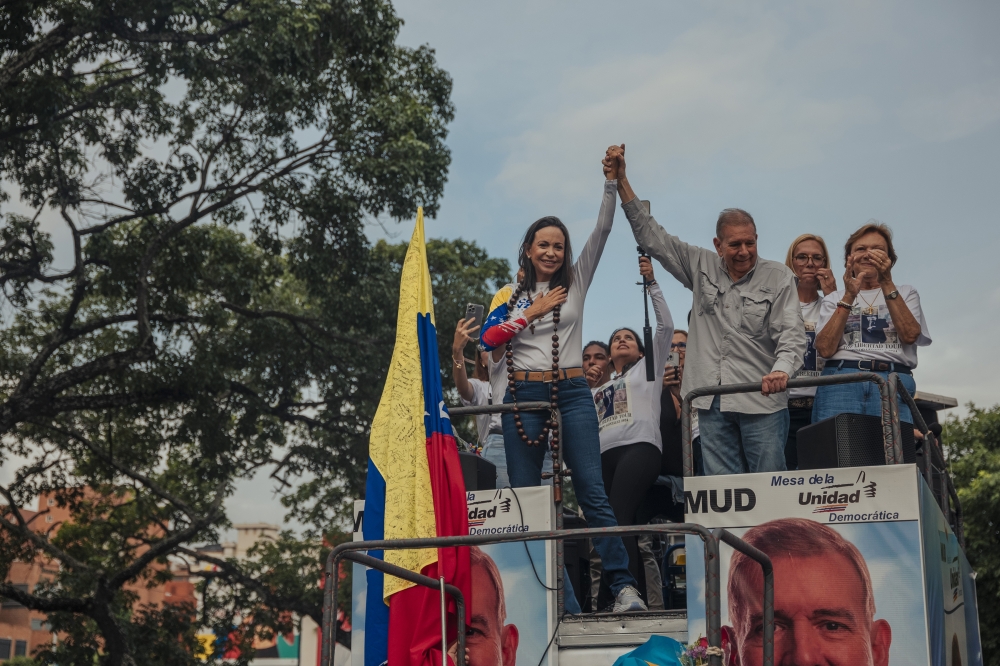
Trump would not be throwing his support behind María Corina Machado, the opposition leader who led a successful election campaign against Maduro in 2024 and had the greatest popular legitimacy to lead the nation.
Behind the scenes, Trump came to his conclusion based on several crucial factors, including U.S. intelligence that suggested the opposition would have trouble leading the government, and a souring relationship between Machado and top Trump officials, according to five people with knowledge of his decision-making.
“I think it would be very tough for her to be the leader,” Trump said over the weekend, after the mission ended with Maduro in U.S. custody. “She doesn’t have the support within, or the respect within, the country. She’s a very nice woman, but she doesn’t have the respect.”
Instead, Trump settled on Maduro’s vice president to take the helm.
For Machado, Trump’s comments landed like a gut punch, and it represented a public break for the United States with a leader who had spent more than a year trying to ingratiate herself to Trump — so much so that when Machado was awarded the Nobel Peace Prize, which he covets, she dedicated it to him.
The president had been persuaded by arguments from senior officials, including Secretary of State Marco Rubio, who said that if the United States tried to back the opposition, it could further destabilize the country and require a more robust military presence inside the country. A classified CIA intelligence analysis reflected that view, as well, according to a person familiar with the document.
For Trump, the focus in Venezuela is oil, not promoting democracy.
And even though Machado has gone out of her way to please Trump, in reality her relationship with the White House had been fraying for months. Senior U.S. officials had grown frustrated with her assessments of Maduro’s strength, feeling that she provided inaccurate reports that he was weak and on the verge of collapse. They also grew skeptical of her ability to seize power in Venezuela.
Representatives for Machado did not respond to requests for comment.
In fact, she had been a source of friction inside the Trump administration since soon after the president returned to office last January.
Shortly before a visit to the capital, Caracas, in January, Richard Grenell, Trump’s envoy, met with Machado’s representatives in the Waldorf Astoria hotel in Washington. Grenell asked them to arrange an in-person meeting with Machado in Caracas and for a list of political prisoners they wanted liberated.
But the in-person meeting never happened. Machado, despite promises from the American delegation that she would be protected, refused to meet with Grenell. Instead, a phone call was arranged during his visit, according to multiple people briefed on the call.
The phone call was cordial. But over time the relationship deteriorated, according to people briefed on the interactions. Machado and her team ignored the request for a list of political prisoners, out of apparent desire to avoid accusations of favoritism, or of intimating that her movement is taking part in the negotiations.
Grenell repeatedly pressed Machado to outline her plan for putting her surrogate candidate, Edmundo González, into office after she was barred from running. He grew frustrated when she expressed no concrete ideas of how to put the democratically elected government into power, according to people briefed on the conversations.
For her part, Machado was also upset that Grenell, unlike Rubio, did not forcefully denounce Maduro as illegitimate. Grenell told colleagues that such a statement, while true, would undercut his diplomatic outreach.
Grenell declined to comment.
For now, Trump and Rubio have said they are focused on working with the interim president of Venezuela, Delcy Rodríguez, a vice president under Maduro.
“We are dealing with the immediate reality,” Rubio said Sunday on NBC’s “Meet the Press.” “The immediate reality is that, unfortunately and sadly, but unfortunately the vast majority of the opposition is no longer present inside of Venezuela. We have short-term things that have to be addressed right away.”
Freddy Guevara, a former Venezuelan congress member living in exile in New York and a member of Machado’s coalition, said that he did not know why the White House had chosen to move forward with Rodríguez, but his best guess was that it was the easiest path for now.
“I think the Americans are not betting on revolution, but on reforms,” he said.
He and fellow opposition members are now focused on pushing first for the release of political prisoners in Venezuela, and then for the ability to return to Venezuela and compete in open elections.
“We’re going to keep organizing people and doing our thing inside Venezuela,” Guevara said. “But the one who’s holding the gun now is the American government. And we hope that these guys learn that the Americans are not playing, and that now there’s a credible threat if they don’t comply.”
Trump’s embrace of Rodríguez is also forcing some Republicans, who have been staunch supporters of Machado, into difficult positions. Miami’s three Republican members of Congress faced repeated questions in a news conference Saturday night about why Trump had dismissed Machado.
One of the lawmakers, Rep. Mario Diaz-Balart, took offense at any suggestion that he or his colleagues no longer backed Machado. They reiterated their strong support for her but did not venture any explanations for Trump’s words.
“I’m convinced that when there are elections, whether there are new elections or there’s a decision to take the old elections, the last elections, that the next democratically elected president of Venezuela is going to be María Corina Machado,” Diaz-Balart said.
Machado, a scion of a conservative magnate, had built strong connections in the Republican Party over the decades spent in Venezuelan politics, but she appeared little prepared for the transformation of the party into a transactional, ideologically agnostic political machine under Trump.
Categorical rejection of any talks or contact with Maduro’s government has been a bedrock of Machado’s political strategy, a strategy that has earned her the respect and support of a majority of Venezuelan people, but it has crippled her ability to build a broader coalition capable of enabling her bid for power.
Machado’s unequivocal support of sanctions has destroyed her relations with Venezuela’s business elite, which had built a modus vivendi with Maduro to continue working in the country after a quarter-century of his government’s rule.
Machado’s economic advisers have argued that every dollar going into Venezuela was a dollar for Maduro, a radical stance that had alienated many members of Venezuela’s civil society working to improve living conditions in the country. Her message had increasingly begun to mirror the views of the diaspora and deviated from the realities of people who remained in Venezuela.
As Trump tightened his economic sanctions over Venezuela in recent months, Machado remained largely silent, reducing her statements to the praise of Trump and publicizing the suffering of the hundreds of Venezuelan political prisoners.
She has not issued a comment on the cancellation of most flights into Venezuela, the deportation of tens of thousands of Venezuelan migrants from the United States, the skyrocketing inflation in the country or the collapse of oil revenues, which finance the import of basic goods into the country.
Instead, members of Machado’s team and allies in exile took to social media to attack and discredit public figures whose work deviated from their views.
These actions cost Machado the support of members of the Democratic Party and many American and Venezuelan businesspeople who had interests in Venezuela and influence in Trump’s orbit.
Orlando J. Pérez, a professor of political science at the University of North Texas at Dallas, said Trump’s comment on Saturday about Machado shocked him.
“The statement that she is not respected inside, I think is, is not true on the face of it,” he said. “She clearly is the most popular opposition leader. She clearly has the legitimacy that the Nobel Peace Prize gives her.”
But Pérez said Trump’s comment reflected the infeasibility of Machado’s taking power without a significant U.S. military presence.
“They don’t have the levers of power,” he said of Machado and González.
Trump’s comments were also widely noticed among Venezuelans in South Florida, who tend to feel deep affection for Machado.
“We were a little surprised by what he said about María Corina,” said Nelson Jiménez, 55, who left Venezuela in 2020.
Jiménez said Trump might be “ill-informed” about how much support Machado has in Venezuela. “I think he’s wrong,” he said.
This article originally appeared in The New York Times.
Oman Observer is now on the WhatsApp channel. Click here