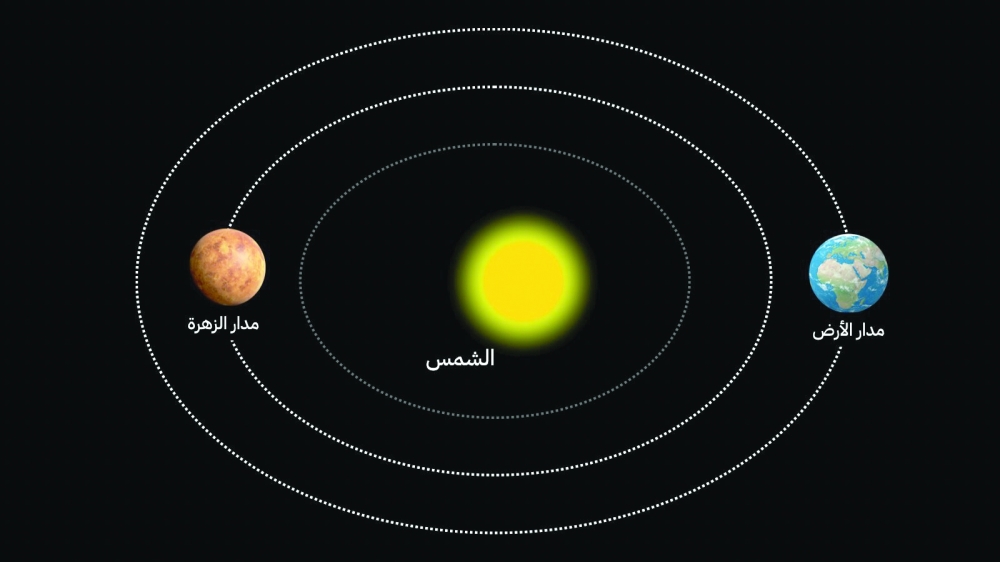





MUSCAT: Venus will reach superior conjunction with the Sun on Tuesday at precisely 9:10 pm Oman time, passing almost directly behind the Sun from Earth's perspective in an alignment where the Sun lies between Earth and Venus.
Wisal bint Salim al Hinaiyah, Vice-Chair of the Community Communication Committee at Oman Astronomical Society, confirmed the timing based on astronomical calculations.
She said that a superior conjunction marks the point in Venus's orbit where it is farthest from Earth, at an estimated distance of 255.8 million kilometres. In this celestial arrangement, the order is Earth, the Sun, and then Venus, placing the planet on the opposite side of the Sun from our view.
Venus, an inner planet similar in size and composition to Earth, is known for its exceptional brightness, ranking as the third brightest object in the sky after the Sun and Moon. Its appearance as a morning or evening star depends on its orbital position, and like the Moon, it exhibits phases observable through telescopes, providing clear proof of its revolution around the Sun.
Al Hinai noted that after shining prominently as a morning star for much of 2025, Venus began fading from view in late November as it moved closer to the Sun's glare. It is now at its closest apparent proximity to the solar disk, rendering it unobservable to the naked eye or standard telescopes.
She said that following the conjunction, Venus will gradually move westward away from the Sun. Its angular separation will increase daily, allowing it to re-emerge in the evening sky after sunset by mid-February, where it will later become the night sky's brightest object after the Moon for several months.
Al Hinai emphasised that this superior conjunction is a key transition in Venus's regular 584-day cycle, marking its shift from a morning to an evening star. While not directly observable, the event offers significant scientific and educational insight into the relative motions of the inner planets and their changing positions. She encouraged astronomy enthusiasts to watch for Venus's return to the evening sky in the coming weeks. — ONA
Oman Observer is now on the WhatsApp channel. Click here