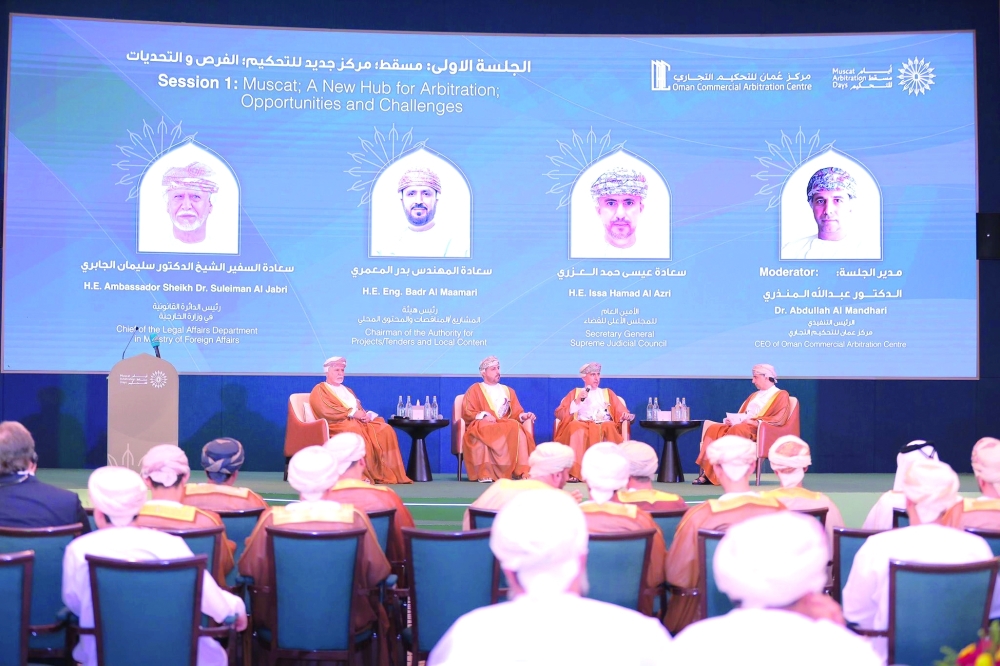





MUSCAT: The “Muscat Arbitration Days” conference, organized last week by the Oman Commercial Arbitration Centre (OAC), brought together legal and commercial experts to discuss the evolving arbitration landscape in Oman. One of its panels, titled “Muscat: A New Hub for Arbitration – Opportunities and Challenges,” explored the factors shaping Muscat’s potential as a regional center for commercial arbitration. The panel addressed several themes related to legal frameworks, institutional readiness, and dispute-resolution mechanisms, offering insights into the opportunities and challenges within Oman’s growing arbitration ecosystem.
Issa bin Hamad Al Azri, Secretary-General of the Supreme Judicial Council, explained that Oman has recently modernized its legislative framework through the issuance of key laws, including the Foreign Capital Investment Law and the Law of Partnership between Public and Private Sectors (the PPP Law). He stated that the establishment of the Oman Commercial Arbitration Centre forms part of this development, aiming to institutionalize arbitration and enhance its effectiveness in the Sultanate.
He noted that the Supreme Judicial Council has adopted a strategic direction to expand alternative dispute-resolution mechanisms—such as arbitration, mediation, and reconciliation committees—emphasizing that arbitral awards become enforceable once issued in accordance with the arbitration law and its procedures for challenge.
He added that Oman’s longstanding diplomatic neutrality has contributed to shaping a legal identity grounded in impartiality. He highlighted that the Oman Commercial Arbitration Centre represents an opportunity to attract distinguished legal talent and to strengthen the country’s capabilities in resolving an increasing number of disputes.
Ambassador Shaikh Dr. Suleiman Al Jabri, Chief of the Legal Affairs Department in the Ministry of Foreign Affairs, stated that Oman is emerging as a leading destination for investment, noting that this requires a clear and coherent legislative framework that strengthens investor confidence. He explained that high costs and slow procedures remain among the main challenges in international arbitration, highlighting the importance of establishing a cost-effective arbitration center in Oman.
He added that the Oman Commercial Arbitration Centre has the essential capabilities to serve as an efficient platform for commercial arbitration, bringing together experts and specialists to ensure effective and professional dispute resolution.
He further noted that Oman has made significant progress in developing an institutional and legislative environment for arbitration, supported by a flexible legal system and clear dispute-resolution procedures that reassure investors.
He emphasized that the international agreements and economic partnerships to which Oman is a party enhance this framework and reinforce the country’s standing in dispute resolution. He concluded that these elements collectively position Oman as a credible and competitive choice for international commercial arbitration.
Eng. Badr Al Maamari, Chairman of the Authority for Projects, Tenders and Local Content, explained that the current phase involves large-scale projects with complex technical requirements, necessitating advanced management tools. He noted that incorporating arbitration clauses in contracts has become essential for accelerating project execution, enhancing governance, and ensuring a clear balance between the contractor, the consultant, and the project owner.
He added that arbitration offers a fast and effective means of resolving disputes, alongside the growing use of mediation as a supportive tool, while ongoing efforts aim to establish a clear and streamlined mechanism for resorting to arbitration whenever disagreements arise.
Oman Observer is now on the WhatsApp channel. Click here