




MUSCAT, DEC 3
Two Netherlands-based green fuel technology firms have joined hands to introduce an innovative hydrogen carrier that could help overcome many of the technological, safety and cost-related hurdles associated with existing green hydrogen storage and transport solutions — a development of particular relevance to emerging producers such as the Sultanate of Oman.
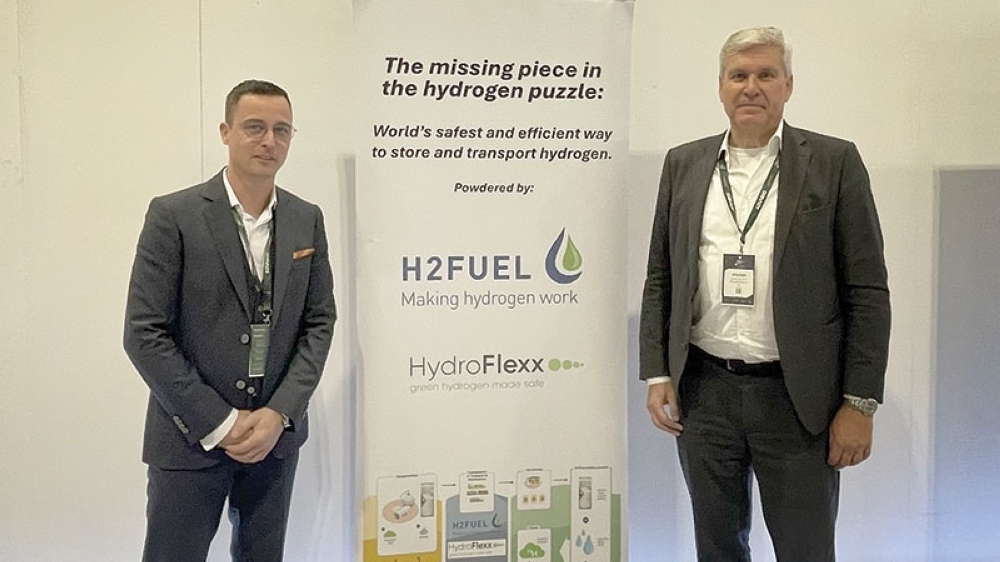
H2-Fuel and HydroFlexx showcased their new powder-based hydrogen storage and transport medium, branded ‘H2Easy’, during the Green Hydrogen Summit Oman (GHSO) 2025 at the Oman Convention and Exhibition Centre (OCEC). At the summit, Koos-Jan van Brouwershaven, CEO of H2-Fuel and Sander Castel, CEO of HydroFlexx, also announced plans for a full merger of their two companies effective January 1, 2026, to accelerate the commercialisation of what they described as a potentially game-changing hydrogen carrier.
At the core of the H2Easy concept is sodium borohydride, a well-known industrial chemical that offers significant advantages as a hydrogen carrier. With its high hydrogen density, the compound enables compact, stable, solid-state storage that is safer and easier to handle than compressed or liquefied hydrogen. Sodium borohydride can release hydrogen on demand through controlled hydrolysis, while its chemical stability and non-volatility allow for long-term storage with minimal safety or logistical complications.
According to the partners, H2Easy enables hydrogen to be stored and transported at ambient temperatures in a non-flammable, non-toxic powder, representing a major step forward in safety and handling. The system is fully circular: once hydrogen is released, the residual powder — known as H2Spent — can be regenerated into fresh carrier material using the company’s patented recycling technology.
Because the carrier is stable and solid, it can be shipped using conventional container vessels, avoiding the need for costly specialised hydrogen tankers. After hydrogen is extracted at the destination, the H2Spent material can be shipped back — for example, to Oman — where it can be regenerated into sodium borohydride. Although energy-intensive, the regeneration process could be powered by Oman’s abundant renewable energy resources, enhancing cost and carbon efficiency.
Van Brouwershaven noted that the H2Easy platform tackles several of the most pressing barriers to global hydrogen trade, including safety risks, energy losses and carrier inefficiencies. “With a stable powder that releases hydrogen through our patented process and can be fully regenerated, we offer a practical pathway to move green hydrogen from production hubs like Oman to demand centres worldwide”, he said.
HydroFlexx CEO Sander Castel added that the company’s regeneration technology delivers efficient hydrogen extraction at the point of use and enables the circular reuse of the carrier. “By industrialising this technology, we open the door to safe, scalable hydrogen logistics for maritime, industrial and remote-power markets — from early pilots to gigaton-scale deployment”, he stated.
According to the developers, the H2Easy carrier could be 30–40% cheaper than many competing hydrogen carriers. Unlike compressed hydrogen, liquid hydrogen, ammonia, methanol, or liquid organic hydrogen carriers (LOHCs), H2Easy combines high volumetric and gravimetric performance with everyday, user-friendly handling characteristics.
Both companies are now seeking strategic investors and partnerships within Oman’s fast-growing green hydrogen ecosystem, including project developers, offtakers and infrastructure providers. Potential near-term collaboration areas include pilot projects in Oman and GCC export corridors, maritime and port-based hydrogen bunkering, industrial decarbonisation and distributed power systems; and the establishment of large-scale regeneration and powder production facilities.
Oman Observer is now on the WhatsApp channel. Click here