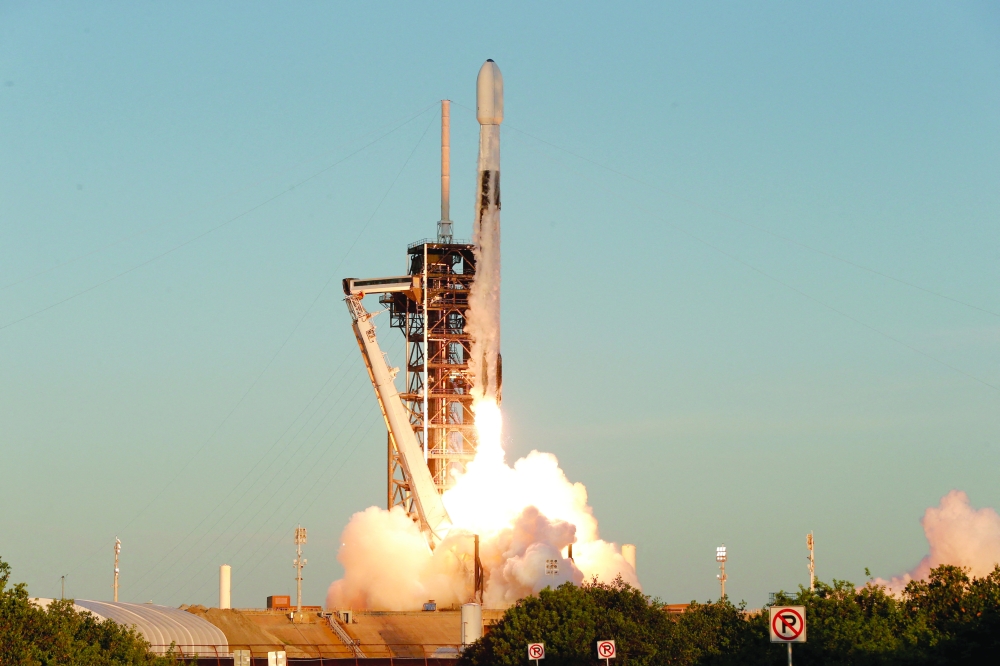





WASHINGTON: The United States launched three spacecraft on Wednesday in an effort to better monitor space weather such as solar storms, which can interfere with technology and power systems on Earth. The three probes blasted off from Florida's Kennedy Space Center aboard a Falcon 9 rocket, built by the private company SpaceX.
Once in space, the probes will begin a long journey to reach the Lagrange 1 point — a spot approximately 1.5 million kilometers from the Sun that offers a stable vantage point for observation. The "Interstellar Mapping and Acceleration Probe" (IMAP) will use its instruments to study the Sun's high-energy particles and the protective magnetic bubble surrounding our solar system known as the heliosphere, data that can offer insight into space weather and cosmic radiation.
Solar storms are high-radiation events caused by flares on the Sun's surface, and are very difficult to predict. They can impact activities on Earth, including aviation, mobile communications and power grids — and potentially endanger astronauts and satellites in space. The Space Weather Follow-on (SWFO-L1) spacecraft, operated by the National Oceanic and Atmospheric Administration (NOAA), aims to detect the weather patterns in advance. — AFP
Oman Observer is now on the WhatsApp channel. Click here