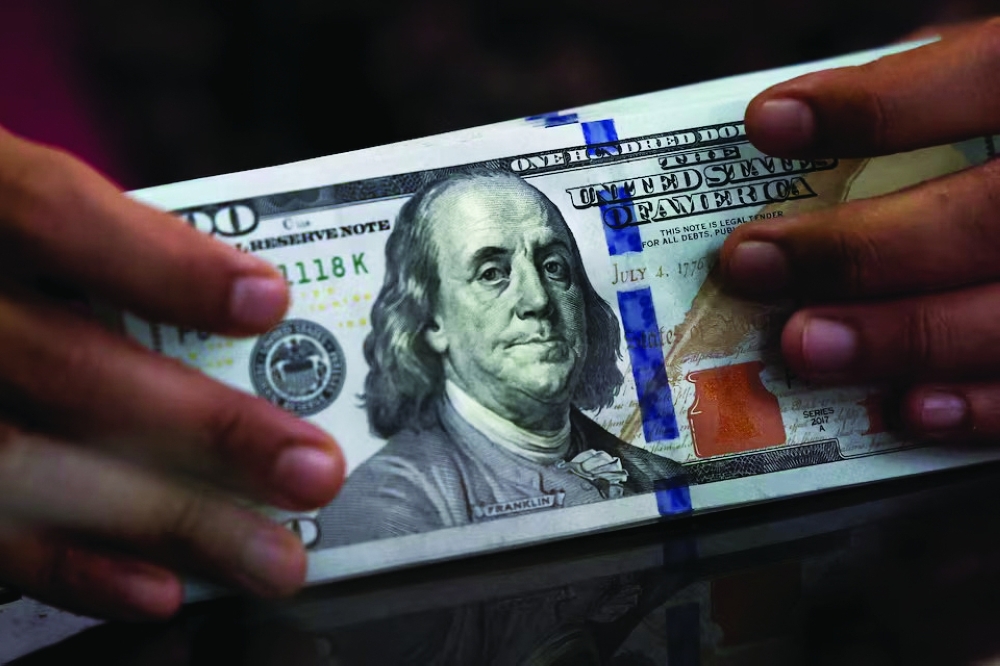





NEW YORK: The US dollar has steadied since a record slide earlier this year, but many currency market players still view the greenback as locked in a bearish trend and are bracing themselves for further losses.
The dollar index fell about 11% in the six months through June in one of its steepest declines on record.
The greenback has steadied in recent weeks along with a sharp pullback in bearish futures bets. As of last week, speculators’ net short dollar position was at $5.7 billion, near the smallest since mid-April. That was down sharply from about $21 billion in late June, CFTC data show.
Many investors view this as a pause in the selling rather than a reversal. Worries include twin US fiscal and trade deficits, chances that a slow job market may prompt more aggressive rate cuts from the Federal Reserve, and the view that global fund managers may be in the process of rethinking their FX hedging practices as they look to reduce their exposure to the US dollar.
“The dollar is in the process of declining, and there's more to go,” Francesca Fornasari, head of currency solutions at Insight Investment, said. “It's messy and it's probably going to be pretty noisy,” she added.
Many of the forces that drove the dollar’s slide remain in place. These include a rethink of US exceptionalism, worries about economic growth due to President Donald Trump's protectionist trade stance, and persistent twin-deficit concerns.
Soft jobs data give the Fed scope to cut rates more aggressively, which would erode the yield advantage for the greenback.
“The markets are now starting to think about the degree to which the US economy is going to weaken ... how weak will the labor market get going forward and what does that mean for Fed monetary policy,” said Paresh Upadhyaya, director of fixed income and currency strategy at Amundi, Europe’s biggest asset manager.
The Fed will likely resume cutting short-term rates next week and continue on for the rest of the year.
Upadhyaya, who started the year bearish on the greenback and has been adding to short dollar positions, sees little reason to change course now.
Global investors face hedging headache Years of US outperformance have left global investors heavily exposed to American assets. April’s tariff turbulence prompted some to trim positions and reassess hedges, but the repositioning is far from complete, investors said.
With foreign holdings of US assets in the trillions, according to banks including Deutsche Bank, any paring of exposure could weigh on the dollar.
“The next big drop in the dollar could be if foreign investors decide they want to now start reducing their US allocation,” Amundi’s Upadhyaya said.
The dollar's poor first-half performance has already prompted a pick-up in hedging activity by asset managers. Slower-acting market participants could join the fray over the next three to six months, Insight Investment’s Fornasari noted.
Hedging flows typically involve selling dollars via forwards or swaps, adding supply that can pressure the greenback. Lower US interest rates relative to overseas rates reduce the cost of popular hedging instruments and can make hedging more attractive.
“It is stating the obvious that additional Fed cuts from here would increase incentives to hedge dollar assets by foreign investors,” George Saravelos, Global Head of FX Research at Deutsche Bank, said.
Dollar bulls are unlikely to find support from the Trump administration, investors said, as the “America First” agenda and plans to revive US manufacturing work against a stronger currency.
“They still believe in a strong dollar, king dollar, but a little bit weaker than the very elevated level (at the start of the year),” Thanos Bardas, managing director at Neuberger Berman, said.
“There is no way they can bring manufacturing back to the US with the dollar index at 110,” Bardas added, noting he expects the index to stay in the 95 to 100 range in the near term. On Wednesday the index was at 97.72.
“I don't think the US wants to necessarily signal its desire for a weaker dollar, but it's not going to stand in the way of a weaker dollar,” said Shaun Osborne, chief FX strategist at Scotiabank. Osborne sees the dollar falling another 5% to 7% over the next year against major peers.
Many say dollar is still overvalued There is still some chance that the dollar finds support, given how much it has already fallen this year and the extent of Fed easing already priced in by markets.
One risk to the weaker-dollar view is an unexpected brightening in the US economic growth outlook, Bardas noted.
The economy expanded faster than first estimated in the second quarter, helped by business investment in intellectual property such as artificial intelligence, though import tariffs kept the outlook cloudy.
Still, the dollar remains expensive relative to many currencies, discouraging potential buyers in FX markets, which are known for prolonged periods where currencies overshoot in both directions.
“We're just barely getting to what I would consider neutral levels for the dollar,” Amundi’s Upadhyaya said, noting that the dollar is far from undervalued.
“We have more of the dollar bear market still to come.” — Reuters
Oman Observer is now on the WhatsApp channel. Click here