




President Donald Trump signed an executive order Monday extending a trade truce between the United States and China for another three months, providing a reprieve from the threat of escalating tariffs and export controls that have rocked the global economy.
The extension, until Nov. 10, provides the two countries more time to work out their differences and sets the stage for a potential summit between Trump and President Xi Jinping, China’s leader, later this year. Trump suggested Monday that negotiations were making progress.
“They’ve been dealing quite nicely — the relationship is very good with President Xi and me,” Trump said at the White House.
Top economic officials had been working to finalize a provisional agreement to extend the truce that was reached during meetings in Sweden last month. The deadline for the truce to expire was Tuesday.
After the Sweden talks, U.S. officials were optimistic that the president would sign off on the arrangement, though in dramatic fashion, Trump waited until the final hours before the deadline to extend the pause. Had the tariffs snapped back into place, they risked escalating a trade war between the world’s two largest economies that rattled global markets this year.
With the clock ticking, Trump on Sunday night called on China to quadruple its purchases of American soybeans and noted that doing so would help reduce America’s trade deficit with China.
“China is worried about its shortage of soybeans,” Trump wrote on Truth Social in a message directed to Xi. “Our great farmers produce the most robust soybeans.”
The United States and China have held three formal rounds of trade talks this year, after Trump started ratcheting up tariffs on Chinese imports. U.S. tariffs on Chinese goods ultimately reached 145%, and China curbed the exports of rare earth magnets that are critical to American manufacturers. To de-escalate the tension, a 90-day truce was reached under which the U.S. reduced its China tariffs to 30% while China lowered its tariffs on U.S. goods to 10% and agreed to export the magnets.
After talks in Sweden in late July, Trump’s economic advisers exuded optimism that another 90-day extension would be granted. Jamieson Greer, the U.S. trade representative, said U.S. tariffs on Chinese imports could increase to 80% in the absence of an agreement, but Treasury Secretary Scott Bessent downplayed that possibility, suggesting that only technical details needed to be addressed.
The scope of the talks has broadened beyond tariffs. Bessent has said he was pressing his Chinese counterparts on U.S. concerns about China’s excess manufacturing capacity and its purchases of oil from Russia and Iran.
U.S. and Chinese officials have been negotiating over U.S. export controls of microchips that China needs to power artificial intelligence systems.
Despite the Trump administration’s national security concerns over the trade in semiconductors and other products, it has taken a transactional approach to negotiations. Nvidia and Advanced Micro Devices are expected to pay the United States 15% of the money they generate from selling AI chips to China, as part of a highly unusual financial agreement with the Trump administration.
The trade talks with China have been on a separate track from the negotiations that the Trump administration has been having with other trading partners. This month, the United States announced a flurry of trade deals, with Japan, South Korea, and the European Union making big U.S. investment commitments in exchange for lower tariff rates.
At the same time, Trump continues to deploy tariffs as a tool to address virtually any diplomatic issue. Last week, he doubled tariffs on goods from India to 50%, in part because India refused to curb purchases of Russian oil. The Trump administration has so far refrained from imposing such tariffs on China, which also buys Russian crude.
Vice President JD Vance said on Fox News on Sunday that tariffs on China linked to Russian oil purchases are “on the table” but that Trump has yet to decide on the matter because of the complexity of the relationship.
Washington and Beijing reached a broad trade agreement during Trump’s first term that included commitments from China to buy billions of dollars' worth of U.S. farm products. However, China didn’t follow through on that agreement as the COVID-19 pandemic set in, and relations between the two countries frayed.
Trump has maintained that he is open to meeting with Xi but said last week that he would only do so if the two countries reached a trade pact.
“He asked for a meeting, and I’ll end up having a meeting before the end of the year most likely, if we make a deal,” Trump said of Xi on CNBC last week. “If we don’t make a deal, I’m not going to have a meeting.”
This article originally appeared in The New York Times.
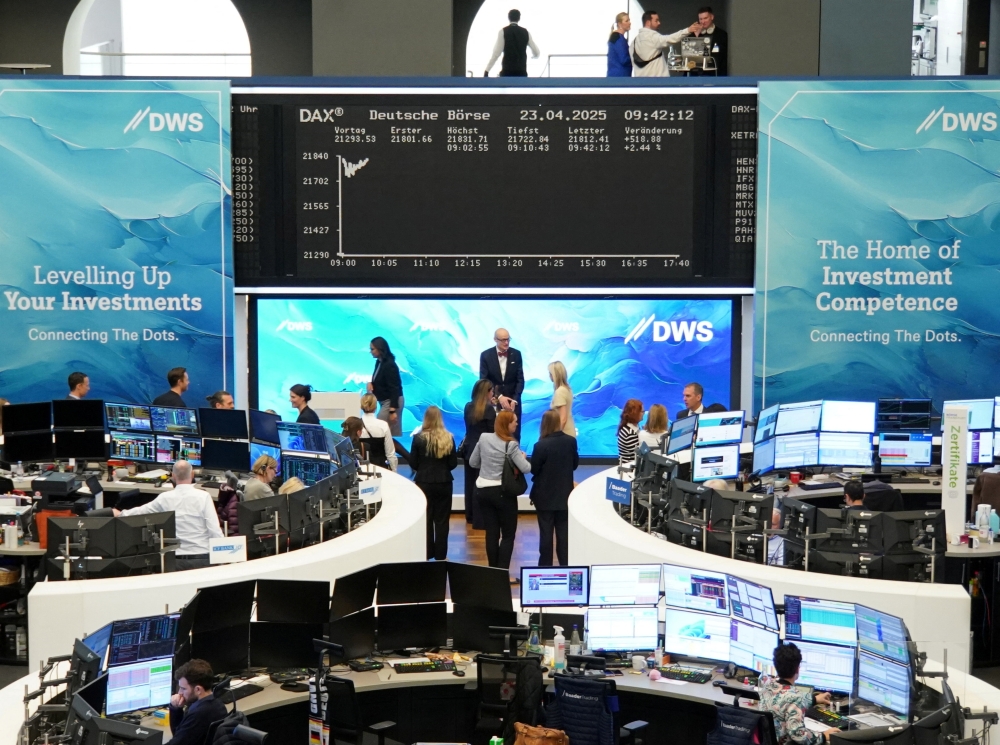
Asian markets mostly rose Tuesday, with Tokyo hitting a record, as investors welcomed the extension of a China-US tariff truce but looked ahead apprehensively to the release of key US inflation data later in the day.
Donald Trump's widely expected trade announcement avoids the reimposition of sky-high levies and allows officials from Washington and Beijing to continue talking into November to settle their standoff.
In an executive order, the White House reiterated its position that there are "large and persistent annual US goods trade deficits" and they "constitute an unusual and extraordinary threat to the national security and economy of the United States".
However, William Yang, an analyst at the International Crisis Group, said: "Beijing will be happy to keep the US-China negotiation going, but it is unlikely to make concessions."
Oman Observer is now on the WhatsApp channel. Click here