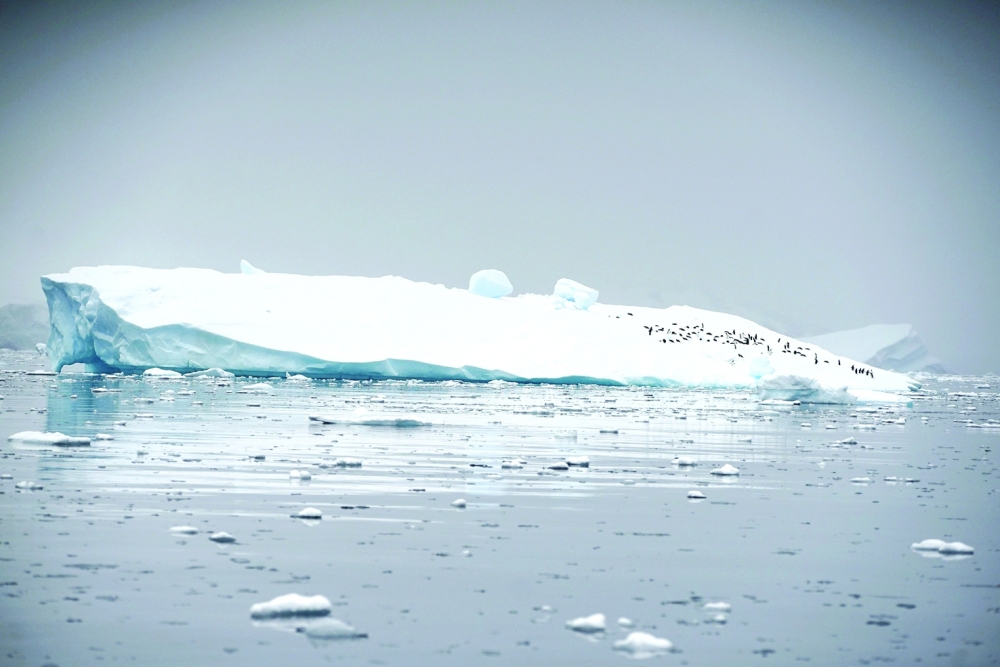





PARIS: Ocean tides can trigger city-sized icebergs to break off from Antarctic ice shelves, scientists said on Thursday, offering a potential way to predict these dramatic events in the future. It is not normally possible to forecast when icebergs break free, or calve, although the timing is important because these behemoths change the shape of ice sheets and affect global sea levels.
Yet when a chunk of ice the size of Greater London suddenly broke off the Brunt Ice Shelf in 2023 and started drifting away, glaciologist Oliver Marsh was not surprised.
Marsh said he had predicted that a huge iceberg breaking off was “imminent within the next weeks to months”.
The British Antarctic Survey researcher had spent years studying the huge crack that would create the 550-square-kilometre iceberg named A81. As Marsh had anticipated, the calving occurred at the peak of spring tide, when there is the biggest difference between the ocean’s high and low tide.
New research led by Marsh, published in the journal Nature Communications on Thursday, used modelling to show that the calving was triggered by the tide, along with high winds and stress on the ice.
After A81 broke off, Marsh visited the ice shelf to see how open water had replaced what had previously been “ice as far as you could see”.
“It was sad to see it go, in a way,” he said. A81 is currently drifting up the eastern side of the Antarctica Peninsula towards the Weddell Sea.
It remains to be seen whether it will come close to South Georgia island, which is an important breeding ground for penguins, seals and other animals. — AFP
PARIS: Ocean tides can trigger city-sized icebergs to break off from Antarctic ice shelves, scientists said on Thursday, offering a potential way to predict these dramatic events in the future. It is not normally possible to forecast when icebergs break free, or calve, although the timing is important because these behemoths change the shape of ice sheets and affect global sea levels.
Yet when a chunk of ice the size of Greater London suddenly broke off the Brunt Ice Shelf in 2023 and started drifting away, glaciologist Oliver Marsh was not surprised.
Marsh said he had predicted that a huge iceberg breaking off was “imminent within the next weeks to months”.
The British Antarctic Survey researcher had spent years studying the huge crack that would create the 550-square-kilometre iceberg named A81. As Marsh had anticipated, the calving occurred at the peak of spring tide, when there is the biggest difference between the ocean’s high and low tide.
New research led by Marsh, published in the journal Nature Communications on Thursday, used modelling to show that the calving was triggered by the tide, along with high winds and stress on the ice.
After A81 broke off, Marsh visited the ice shelf to see how open water had replaced what had previously been “ice as far as you could see”.
“It was sad to see it go, in a way,” he said. A81 is currently drifting up the eastern side of the Antarctica Peninsula towards the Weddell Sea.
It remains to be seen whether it will come close to South Georgia island, which is an important breeding ground for penguins, seals and other animals. — AFP
Oman Observer is now on the WhatsApp channel. Click here