







The Hague: The International Criminal Court on Tuesday issued arrest warrants for two senior Taliban leaders, accusing them of crimes against humanity for persecuting women and girls.
Judges said there were "reasonable grounds" to suspect Taliban Supreme Leader Hibatullah Akhundzada and chief justice Abdul Hakim Haqqani of committing gender-based persecution.
"While the Taliban have imposed certain rules and prohibitions on the population as a whole, they have specifically targeted girls and women by reason of their gender, depriving them of fundamental rights and freedoms," the court said in a statement.
Afghanistan's Taliban authorities rejected the International Criminal Court's arrest warrants and called the move "nonsense".
"Such nonsense announcements won't affect the strong commitment and dedication to sharia (Islamic law)" of Taliban authorities, spokesman Zabihullah Mujahid said in a statement, adding that the Taliban government does not recognise the court.
The Taliban had "severely deprived" girls and women of the rights to education, privacy and family life and the freedoms of movement, expression, thought, conscience and religion, ICC judges said.
The court said the alleged crimes had been committed between August 15, 2021, when the Taliban seized power, and continued until at least January 20, 2025.
Taliban authorities did not immediately reply to a request for comment.
The ICC, based in The Hague, was set up to rule on the world's worst crimes, such as war crimes and crimes against humanity.
It has no police force of its own and relies on member states to carry out its arrest warrants — with mixed results.
In theory, this means anyone subject to an ICC arrest warrant cannot travel to a member state for fear of being detained.
After sweeping back to power in August 2021, the Taliban authorities pledged a softer rule than their first stint from 1996 to 2001.
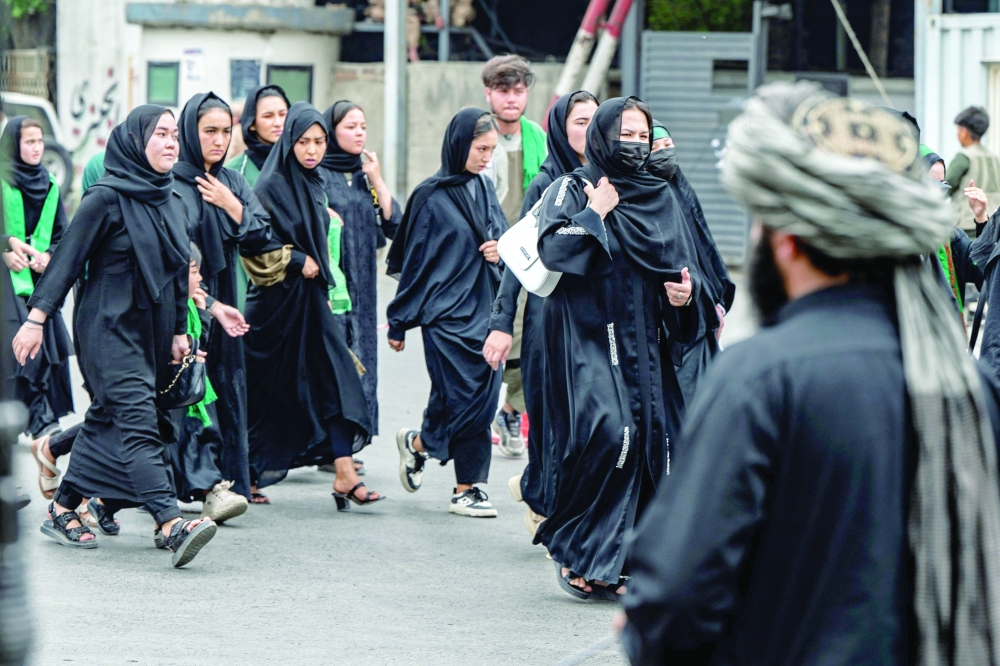
But they quickly imposed restrictions on women and girls that the United Nations has labelled "gender apartheid".
Edicts in line with their interpretation of Islamic law handed down by Akhundzada, who rules by decree from the movement's birthplace in southern Kandahar, have squeezed women and girls from public life.
The Taliban government barred girls from secondary school and women from university in the first 18 months after they ousted the US-backed government, making Afghanistan the only country in the world to impose such bans.
Authorities imposed restrictions on women working for non-governmental groups and other employment, with thousands of women losing government jobs -- or being paid to stay home.
Beauty salons have been closed and women blocked from visiting public parks, gyms and baths as well as travelling long distances without a male chaperone.
A "vice and virtue" law announced last year ordered women not to sing or recite poetry in public and for their voices and bodies to be "concealed" outside the home. — AFP
Oman Observer is now on the WhatsApp channel. Click here


