




The mangroves of Oman have a crucial role to play in the environment of the country.
Oman has several marine-protected areas managed by the Environment Authority. One of them is right in the middle of the capital city in Al Qurum.
The others include the Daymaniyat Islands, Bar Al Hikman in Al Wusta Governorate, and Jabal Samhan in the Dhofar Governorate which is partially terrestrial and the other half stretching into the sea. Also included in the protected marine areas are the creeks and Dhofar has nine of them.
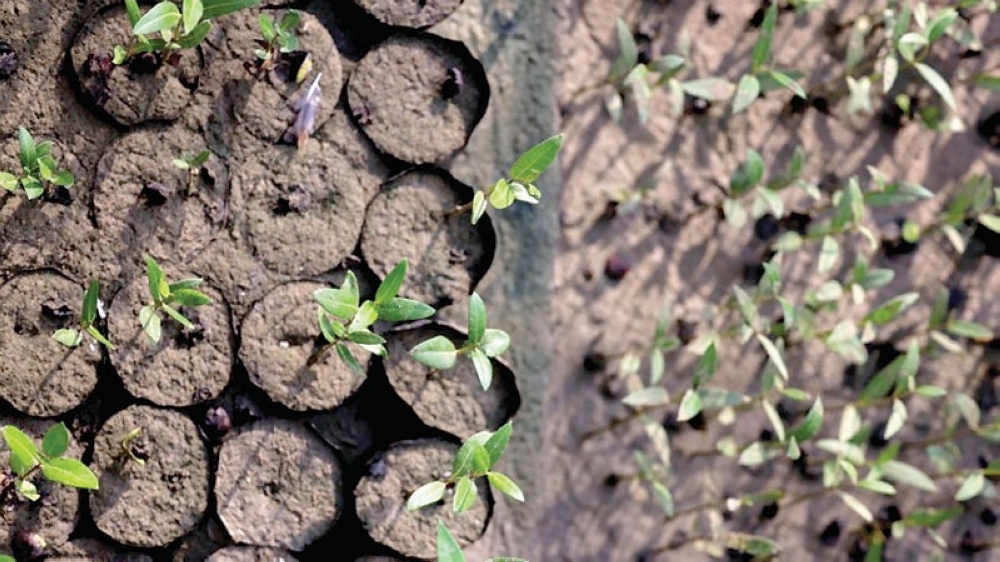
Mangroves are known for their role in tackling climate change. Afforestation measures have been taken by the Environment Authority to expand the mangrove areas in Oman.
“The Environment Authority believes that mangroves act as buffer between the sea and land. Today we are also looking for carbon credits. So it has been an important step to encourage the local communities help the Environment Authority to transplant the seedlings of mangrove trees,” said Dr Mona al Tarshi, Environmental Ecosystem Specialist, Environment Authority.
The only mangrove species that is seen in Oman is Avicennia marina.
“We have transplanted them in all lagoons after monitoring the health of the lagoons by taking samples of the water and sediments to check the hydrocarbon level, presence of heavy metals, salinity, pH, etc. If the status of the lagoon is good; we proceed with the planting of saplings,” explained Dr Mona.
"The results can be seen in Haffri and Al Sawadi," she added, “You can see in Al Sawadi and Harmul the afforested mangrove area. It is not natural like Al Qurum, Qurayat and Shinas. Harmul is just behind the industrial area of Suhar and is a perfect example of a man-made mangrove forest. In Al Sifa, it is a combination of both.”
Sur is also known for its mangroves and Al Duqm has a large area of mangroves with 10 lagoons.
Some of the mangrove trees in Al Sawadi are more than 10 metres high, with the width of the trunk being 4 to 5 metres. The habitat supports crabs, shrimps, snails and birds. The Environment Authority has established a list of birds living in the natural and man-made mangrove forests.
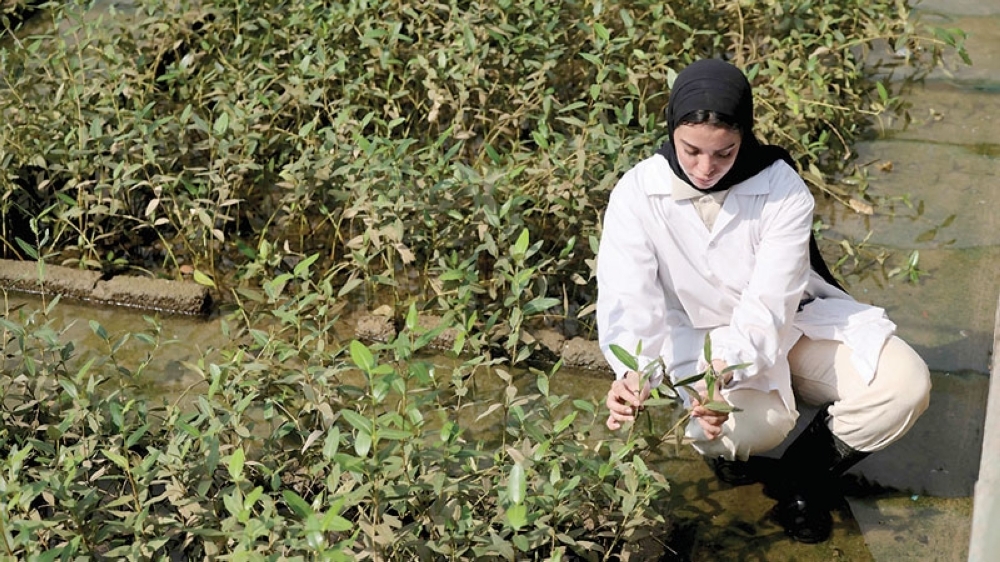
“There is no difference between the natural and man-made forests, except maybe in the structure of the mangrove because in the natural ones we can see the canals are open to the sea, but in the areas of afforestation, we monitor to ensure there is a flow of water to the forest,” she pointed out.
Dr Mona has published three papers on mangroves in Oman. One of the scientific papers had looked into determining the marine litter because mangroves are also known as a sink for the marine litter.
“I found microplastic in the sediment and water. We consider the snails as the bioindicator for the microplastics because it could give the indication of microplastics over time,” she explained.
Dr Mona also studied the microbial community in the mangrove habitat by studying the water, sediments and snail gut. “The study is important because certain bacteria can degrade the microplastics,” she noted.
The microplastics can be from land or the marine activities, but according to Dr Mona, “It is predominantly from the marine activities because once the litter comes into the lagoons, due to the complex structure of the roots of the mangrove trees, the litter is trapped and can never go back to the sea.”
She explained that this is why many campaigns have been held to clean the lagoons. These campaigns are between the Environment Authority and local communities, NGOs, schools, colleges and universities.
As per the directives of the Environment Authority, it is completely forbidden to cut down mangrove trees.
“We have observed that the local communities now understand the benefits of mangrove trees. When we have campaigns for transplanting seedlings, students from schools and colleges are eager to participate,” she said.
Are there challenges?
“The challenge, if any, is the cleaning part because of the structure of the mangrove roots. It is difficult to go through the roots and branches, but we have been successful,” Dr Mona said with pride.
Most importantly, we have to protect the sea from litter.
Oman Observer is now on the WhatsApp channel. Click here