




Anyone who has sat through a third-grade science class knows there are three primary states of matter: solid, liquid and gas.
Microsoft now says it has created a new state of matter in its quest to make a powerful machine, called a quantum computer, that could accelerate the development of everything from batteries to medicines to artificial intelligence.
On Wednesday, Microsoft’s scientists said they had built what is known as a “topological qubit” based on this new phase of physical existence, which could be harnessed to solve mathematical, scientific and technological problems.
With the development, Microsoft is raising the stakes in what is set to be the next big technological contest, beyond today’s race over artificial intelligence. Scientists have chased the dream of a quantum computer — a machine that could exploit the strange and exceedingly powerful behaviour of subatomic particles or very cold objects — since the 1980s.
The push heated up in December when Google unveiled an experimental quantum computer that needed just five minutes to complete a calculation that most supercomputers could not finish in 10 septillion years — longer than the age of the known universe.
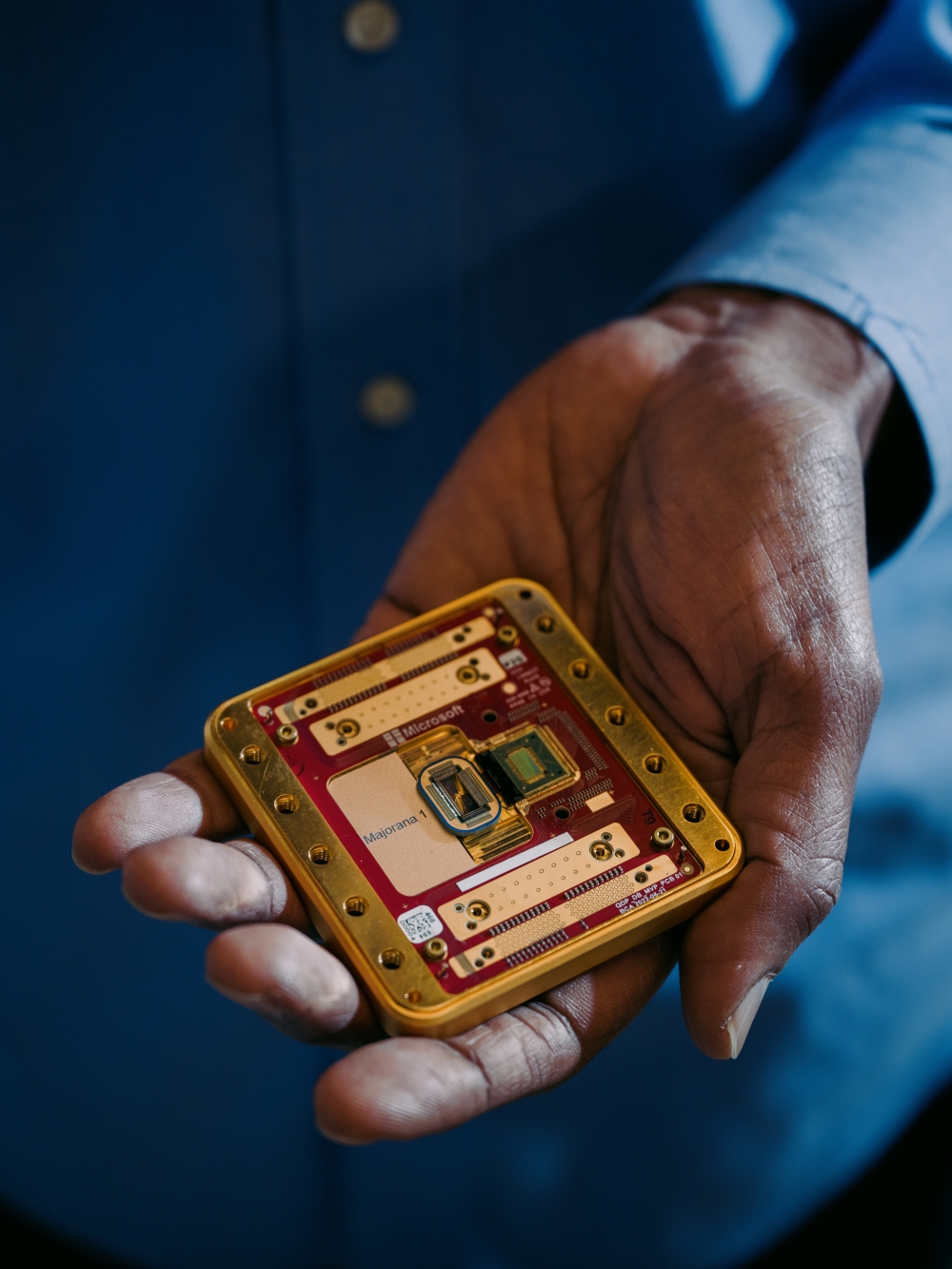
Microsoft’s quantum technology could leapfrog the methods under development at Google. As part of its research, the company built multiple topological qubits inside a new kind of computer chip that combines the strengths of the semiconductors that power classical computers with the superconductors that are typically used to build a quantum computer.
When such a chip is cooled to extremely low temperatures, it behaves in unusual and powerful ways that Microsoft believes will allow it to solve technological, mathematical and scientific problems that classical machines never could. The technology is not as volatile as other quantum technologies, the company said, making it easier to exploit its power.
“We view this as something that is years away, not decades away,” said Chetan Nayak, a Microsoft technical fellow who led the team that built the technology.
Microsoft’s technology adds new impetus to a race that could reshape the technological landscape. In addition to accelerating progress across many technological and scientific fields, a quantum computer could be powerful enough to break the encryption that protects national secrets.
Any advances are set to have geopolitical implications. Even as the US explores quantum computing primarily through corporations like Microsoft and a wave of start-ups, the Chinese government has said it is investing $15.2 billion in the technology. The European Union has committed $7.2 billion.
Quantum computing, which builds on decades of research into a type of physics called quantum mechanics, is still an experimental technology. But after recent strides by Microsoft, Google and others, scientists are confident that the technology will eventually live up to its promise.
To understand quantum computing, it helps to know how a traditional computer works. A smartphone, laptop or desktop PC relies on tiny chips made from semiconductors, which are materials that conduct electricity in some but not all situations. These chips store and process numbers, adding them, multiplying them and so on. They perform these calculations by manipulating “bits” of information. Each bit holds either a 1 or a 0.
A quantum computer operates differently. A quantum bit, or qubit, relies on the curious behaviour of subatomic particles or exotic materials cooled to extremely low temperatures.
When it is either extremely small or extremely cold, a single object can behave like two separate objects at the same time. By harnessing that behaviour, scientists can build a qubit that holds a combination of 1 and 0. This means that two qubits can hold four values at once. And as the number of qubits grows, a quantum computer becomes exponentially more powerful.
Companies use a variety of techniques to build these machines. In the US most, including Google, build qubits using superconductors, which are materials that conduct electricity without losing the energy they are transmitting. They create these superconductors by cooling metals to extremely low temperatures.
Microsoft has bet on an approach that few others are taking: combining semiconductors with superconductors. The basic principle — along with the name topological qubit — was first proposed in 1997 by Alexei Kitaev, a Russian American physicist.
The company has now created a single device that is part indium arsenide (a type of semiconductor) and part aluminium (a superconductor at low temperatures). When it is cooled to about 400 degrees below zero, it exhibits a kind of otherworldly behaviour that might make quantum computers possible.
Philip Kim, a physics professor at Harvard University, said Microsoft’s new creation was significant because topological qubits could accelerate the development of quantum computers. “If everything works out, Microsoft’s research could be revolutionary,” he said.
But Jason Alicea, a professor of theoretical physics at the California Institute of Technology, questioned whether the company had actually built a topological qubit, saying the behaviour of quantum systems is often hard to prove.
“A topological qubit is possible in principle, and people agree it is a worthwhile goal,” Alicea said. “You have to verify, though, that a device behaves in all the magical ways that theory predicts it should; otherwise, the reality may turn out to be less rosy for quantum computing. Fortunately, Microsoft is now set up to try.” — The New York Times
Oman Observer is now on the WhatsApp channel. Click here