




Almost all automakers are going to feel a pinch from the new tariffs imposed by President Donald Trump on Saturday on goods imported from Canada, Mexico, and China.
Auto manufacturers ship tens of billions of dollars worth of finished automobiles, engines, transmissions, and other components each week across the U.S. borders with Canada and Mexico. Billions of dollars more are imported from parts manufacturers in China.
The tariffs, which are set to take effect at 12:01 a.m. Tuesday, are widely expected to raise the prices that American consumers pay for new automobiles. And the tariffs come at a time when new cars and trucks are already selling for near-record prices.
General Motors, the largest U.S. automaker, will probably be most affected.
GM produces many more vehicles in Mexico than any other manufacturer — over 842,000 in 2024, according to MarkLines, an auto-industry data provider. And some of those vehicles are the most important in the company’s lineup.
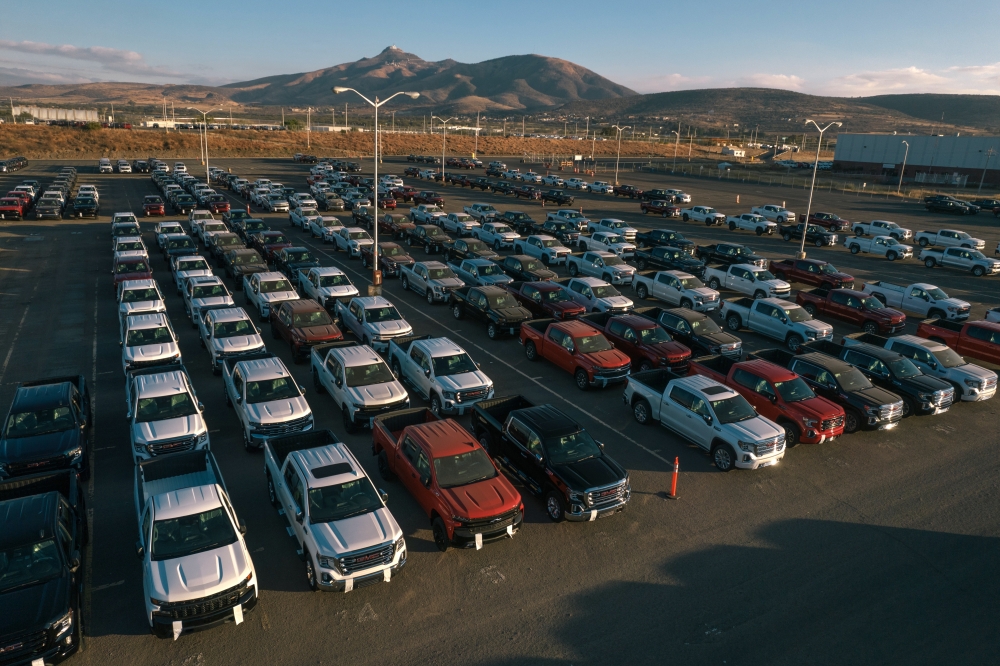
All of the Chevrolet Equinox and Blazer SUVs that GM sells in the United States come from Mexico. The Chevrolet Silverado pickup truck, a top-selling model, and the similar GMC Sierra pickup generate huge profits for the company. Of the more than 1 million of those trucks built last year, nearly half were produced in Canadian and Mexican plants, data from MarkLines shows.
All told GM plants in Canada and Mexico produced nearly 40% of all vehicles the company made last year in North America, the region where it gets most of its revenue and almost all of its profits.
Several other automakers, including Stellantis, Toyota, and Honda, also make about 40% of their North American cars and trucks in Canada and Mexico but they produce fewer vehicles than GM. So most automakers may not feel the impact of the tariffs as acutely as GM.
“Tariffs are a very, very big threat to manufacturers and to auto manufacturing states,” said Patrick Anderson, CEO of Anderson Economic Group, a consulting firm based in Michigan. “And clearly, GM is more vulnerable than most automakers because of the manufacturing footprint it has in North America.”
Anderson said the most immediate impact of the tariffs will be delays and confusion at the border crossings as customs agents, shippers, and ports try to sort out how to deal with the vehicles and parts that are already on trucks and trains headed for the border.
He estimated that the tariffs could add $10,000 or more to trucks and other larger vehicles that are shipped into the United States from Canada and Mexico. “Much of that, at least in the short term, is going to get absorbed by customers and auto dealers,” he said.
Manufacturers will have to seek ways to shift and adjust production to avoid or limit the burden of the tariffs, he added.
Few automakers have spoken out about Trump’s plans. Auto executives have acknowledged that they are hesitant to say anything substantive about tariffs because they don’t want to anger Trump and invite retribution from him, his aides, and other federal officials.
The lobbying group representing the three Detroit automakers, the American Automotive Policy Council, issued a statement, saying that vehicles and parts that comply domestic and regional content rules of the United States-Mexico-Canada Agreement should be exempt from tariffs.
“Our American automakers, who invested billions in the U.S. to meet these requirements, should not have their competitiveness undermined by tariffs that will raise the cost of building vehicles in the United States and stymie investment in the American workforce,” said Matt Blunt, president of the group.
Jennifer Safavian, president and CEO of Autos Drive America, a lobbying group representing foreign-owned automakers with operations in the United States, said in a statement that “the North American auto industry is highly integrated and the imposition of tariffs will be detrimental to American jobs, investment and consumers.”
GM has been looking at several steps it could take to soften the impact of tariffs, such as increasing pickup truck production in the United States, and using its Canadian and Mexican factories to export vehicles to countries outside North America.
“We’re doing the planning and have several levers that we can pull,” the company’s CEO, Mary T. Barra, said this past week in a conference call to discuss GM’s 2024 financial results.
Mark Wakefield, global automotive market lead at AlixPartners, a consulting firm, said tariffs could lead to job losses at auto and auto parts factories across North America as manufacturers scramble to respond.
“North America has been treated as one market by the auto industry for decades now,” he said. “You’re likely to see prices go up and sales go down. Fewer vehicles would need to be built.”
The auto industry will struggle to absorb the cost of the tariffs or to move production to avoid them, Linda Hasenfratz, executive chair of auto parts company Linamar, said in a statement to The New York Times.
“If 10% or 25% tariffs are imposed on auto parts crossing the border, I think we will pretty quickly stop making vehicles in North America,” Hasenfratz said. “Auto parts are highly engineered products requiring months or years to tool up, validate, and test before being built into a vehicle. They simply can’t be substituted overnight.”
Stellantis, which owns Chrysler, Dodge, Jeep, and Ram, produces all of its Chrysler Pacifica minivans at a plant in Windsor, Ontario. It also makes the Dodge Charger muscle car, including a new electric version, there. About two-thirds of its highly profitable Ram pickups are made in the United States, but the other third comes from a factory in Saltillo, Mexico.
Stellantis did not respond to a request for comment.
Toyota and Honda rely more heavily on Canada than other manufacturers. Both make more than 1 million vehicles a year in North America and plants north of the border account for over a quarter of that.
Toyota makes some RAV4 SUVs in the United States but most come from plants in Woodstock and Cambridge, Ontario. The company also makes Lexus SUVs in Ontario. Honda is in a similar position with its Civic sedan and CR-V SUV — most are made in Alliston, Ontario.
The tariffs create a bind for some companies that do not have many plants in North America. Three of Volkswagen’s top-selling vehicles in the United States — the Jetta sedan and the Taos and Tiguan SUVs — are made in Mexico. The company has one factory in the United States, in Chattanooga, Tennessee, where it makes other SUVs. In 2024, Volkswagen sold more than 230,000 Mexican-made vehicles in the United States, about 70% of its sales in the country, the company said.
“We remain a strong advocate for free and fair trade,” Volkswagen said in a statement. “We firmly believe that open markets have been a driving force behind global economic growth and prosperity, fostering innovation and creating opportunities for businesses and communities worldwide.”
Like its rivals, Ford Motor produces some key models in Canada and Mexico. Its electric Mustang Mach-E, Maverick pickup, and Bronco Sport, a compact SUV, are assembled in Mexico. The company’s only car assembly plant in Canada was idled in May though it still makes engines at two plants in Windsor.
But Ford is less exposed than most. It made nearly 2.5 million vehicles in North America last year, and more than 82% rolled off U.S. assembly lines. All of its high-margin medium- and full-size pickups are made domestically. Only 2% of its production came from Canada and 16% from Mexico.
“Ford is the most committed to building in America among the major automakers,” the company said in a statement in late November about why its stock had fallen less than other automakers after Trump’s election.
This article originally appeared in The New York Times.
Oman Observer is now on the WhatsApp channel. Click here