


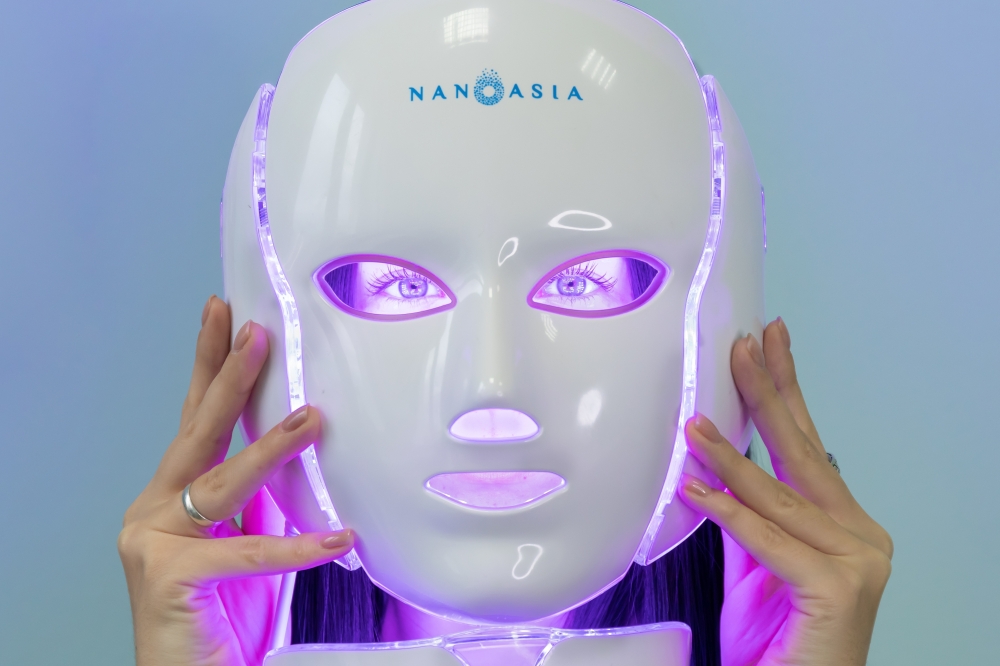





You’ve probably noticed this scene on social media: People (usually women) lounging on couches or in beds while wearing serial-killer-style face masks with colourful lights emanating from beneath them.
Typically referred to as light therapy or LED face masks, these contraptions use light-emitting diodes to shine light at specific wavelengths onto the skin for various purposes such as reducing wrinkles, firming the skin and controlling acne.
The devices, which are also available in wand form, are popular. They can also be pricey, with some costing several thousand dollars.
We asked two dermatologists and two facial plastic surgeons for their takes.
What is light therapy supposed to do?
LED masks feature eye and mouth holes and are typically held in place with straps. Hand-held wands are lightly pressed against the skin and slowly moved around. Both bathe the skin in various wavelengths of light, depending on what they’re trying to accomplish.
Many devices emit red light with wavelengths from 630 to 700 nanometers. Red light can penetrate deeply into the skin to increase the production of collagen and elastin, proteins that help to maintain skin’s strength and elasticity, said Dr Akshay Sanan, a facial plastic surgeon in Boston. By boosting those proteins, red light may minimise wrinkles and help skin appear younger. It can also “reduce inflammation and accelerate healing,” Sanan said.
Other devices emit near-infrared light, around 700 or more nanometers, which can promote wound healing and reduce chronic inflammation, Sanan said.
It’s unclear exactly how the light produces these effects, said Dr Prem B. Tripathi, a facial plastic surgeon in Alamo, California. But the thought is that skin cells absorb the light and convert it into signals that increase the production of proteins and aid in other aspects of healing.
Some devices emit blue light, usually from 400 to 490 nanometers. These shorter wavelengths are believed to penetrate less deeply into the skin, Sanan said, where they can kill some types of bacteria and reduce oil gland activity, helping to control acne.
Many products can switch between different wavelengths, depending on your needs.
Do at-home masks work?
Although research suggests that light therapy in general can benefit the skin, few controlled trials have been conducted on the types of at-home devices that are popular right now.
In one randomised controlled trial published in 2007, researchers recruited 76 people (mainly women) with facial wrinkles. Using an over-the-counter LED mask, researchers applied red light, near-infrared light, a combination of the two or sham light to the right sides of the participants’ faces. They did this for 20 minutes twice a week for four weeks. Each form of light treatment reduced the appearance of wrinkles and improved the skin’s elasticity compared with the sham treatment.
Dr Whitney Bowe, a dermatologist in New York City, said that based on her clinical observations, patients who consistently use these devices experience “noticeable” improvements in skin firmness and sometimes redness.
Even if blue light therapy turns out to be effective against acne, it may not clear it up entirely, said Dr Azadeh Shirazi, a dermatologist in San Diego. It won’t replace other, more proven topical treatments such as retinoids or in-office procedures such as intense pulsed light therapy, she said.
It’s safe to use light therapy alongside other acne treatments, such as retinol, said Dr Angela Lamb, a dermatologist at Mount Sinai Dermatology in New York City. They work in different ways, so their benefits are likely to be additive, she said.
Are some devices better than others?
Lamb recommended choosing a device that is marketed as “FDA-cleared,” meaning the company has provided information to the Food and Drug Administration demonstrating safety and effectiveness. Wands and masks can both work, but wands typically require more effort because you have to manually glide them along your face, she said.
Shirazi recommended choosing devices with bulbs that are evenly spaced so that all areas of the skin get equal treatment. Generally, the more bulbs a device has, the better, to maximize the amount of light hitting the skin, Tripathi said.
Before using any device, wash your face to help the light penetrate the skin, Shirazi said. And always use it as directed — typically 10 to 20 minutes per session, three to five times per week. And “be patient, as visible results can take several weeks of consistent use,” Shirazi said.
Although side effects are rare, they may happen, Sanan said. The light can damage your eyes, so it’s important to wear protective goggles or to close your eyes when using hand-held devices, or to use masks with eye holes or eye shields, he said. People who are taking medications that can cause light sensitivity — including some retinoids, antibiotics and antidepressants — may be at higher risk for side effects such as redness and burning. People with darker skin tones can, rarely, experience a darkening of the skin after LED therapy. Skin darkening is more likely if the treatment warms your skin — ideally, it shouldn’t, Bowe said. But if it does, you may want to stop using it.
Sanan said that people who are pregnant or who have active skin infections, conditions that make them sensitive to light, or certain autoimmune conditions should avoid using LED devices unless they have consulted a dermatologist first.
While sometimes silly-looking, these devices do seem to benefit the skin, Sanan said. But, he added, “they typically work best as part of a broader skin care regimen rather than as a stand-alone solution.”
— The New York Times
Text by Melinda Wenner Moyer
Oman Observer is now on the WhatsApp channel. Click here


