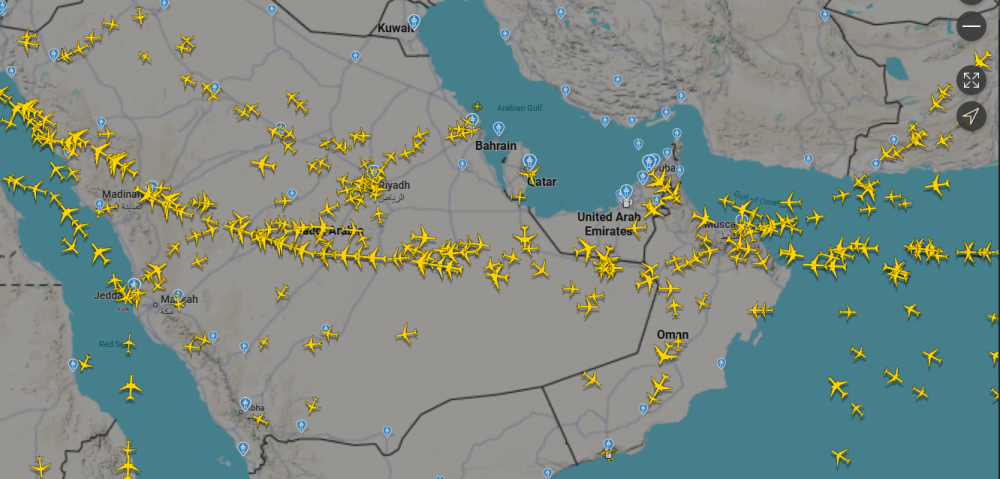





Muscat: The Middle East is a global transit hub for long-haul travel with 10 percent of all global international Revenue Passenger-Kilometers (RPK) passed through airports in the region in 2025, according to the International Air Transport Association (IATA).
In absolute terms, more than 67 million passengers connected via the Middle East last year, IATA said.
According to initial estimations of CAPA, more than 1,800 flights were cancelled across the region in a single day on February 28, while over 19,000 flights worldwide were delayed as airlines scrambled to reroute aircraft and manage crew duty constraints.
The region serves as a critical global bridge, particularly for Asia Pacific connectivity.
Of the six major route pairs that rely on the Middle East as a connecting hub, four involve Asia Pacific. Among these, traffic between Asia Pacific and Africa has the highest share of connections routed through the region’s airports, followed by Asia Pacific–Europe and Asia Pacific–Latin America and the Caribbean.
The conflict that was initiated on February 2026 has forced airlines to cancel flights to and from the Middle East at very short notice, severely disrupting connectivity across the region.
Within ten days of the first attacks, 73% of Available Seat-Kilometers (ASK) from and to the Middle East had been cancelled.
Corridors to and from Asia Pacific were most affected.
Nearly 80% of services between the region and Europe via the Middle East were cancelled. Routes to North America, and to Latin America and the Caribbean followed with capacity reductions of 75% and 74%.
This level of disruption was only seen during the covid pandemic, when 95% of the supply to and from the region was removed at short notice.
The concentration of cancellations along these routes reflects the degree to which global connectivity, in particular for Asia Pacific, depends on the Middle East’s hub function, with implications if disruptions persist over an extended period.
Meanwhile, CAPA Perspective’ report said that the disruption highlights how concentrated global connectivity in a geopolitically sensitive corridor can create potential single points of failure.
Operationally, airlines are already experiencing higher fuel burn, longer flight times and reduced aircraft utilisation as flights detours around restricted airspace. Economically, the impact extends beyond immediate cancellations.
Elevated war-risk insurance premiums, higher operating costs and disrupted network planning are placing additional pressure on long haul route economics.
Oman Observer is now on the WhatsApp channel. Click here