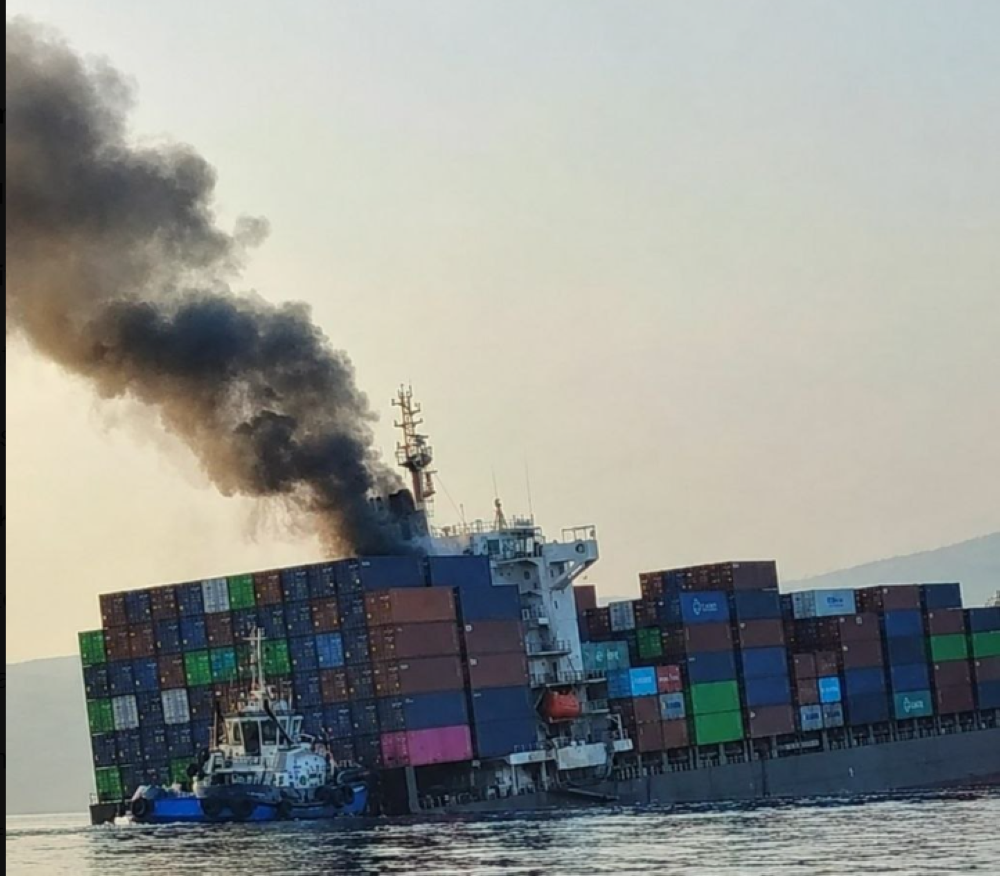





ODESSA: Ukraine claimed on Thursday to have hit Russia's flagship in the Black Sea with missiles, igniting a fire that Moscow said had "seriously damaged" the key warship, as Kyiv pushed to restart civilian evacuations from the war zone ahead of a feared major offensive.
The guided missile cruiser Moskva, previously deployed in the Syria conflict, has been leading Moscow's naval effort to pummel Ukraine's southern coasts and interior in the nearly seven-week conflict that has sparked accusations of genocide by US President Joe Biden.
Evacuations of civilians were to resume on Thursday from nine routes in Ukraine's east and south, Deputy Prime Minister Iryna Vereshchuk said after a day-long pause that Kyiv blamed on Russian shelling.
"Humanitarian corridors in the Lugansk region will be run under the condition of cessation of shelling by the occupying forces," she said.
More than 4.7 million Ukrainians have fled their country in the 50 days since Russia attacked, the United Nations said.
Russian state media made no mention of any missile strike when quoting the defence ministry as saying ammunition detonated on the Moskva after a fire broke out and "the ship was seriously damaged". It said the crew had evacuated.
Two officials in Odessa -- a critical port for Ukraine both for commerce and defence -- confirmed that Ukrainian forces had struck the ship.
"The cause of the 'serious damage' was 'Neptune' domestic cruise missiles," said Odessa military administration spokesman Sergey Bratchuk on Telegram. Odessa's governor published a similar dispatch.
Russia's defence ministry said the fire had been extinguished and the vessel "remains afloat" with its "main missile armaments" unharmed.
The flagship fire came hours after the US unveiled a new $800-million military aid package that includes heavy equipment specifically tailored to an expected major ground assault in the Ukraine's east, including howitzers, armoured personnel carriers and helicopters.
Following its pullout from northern Ukraine earlier this month after failing to take the capital of Kyiv, Russia is refocusing on the east, with Ukraine warning of bloody new clashes to come in the Donbas region.
Seizing the Donbas, where Russian-backed separatists control the Donetsk and Lugansk regions, would allow Russia to create a solid southern corridor -- including the port of Mariupol -- to occupied Crimea.
The Pentagon -- which had previously refused to send heavy equipment to Kyiv for fear of escalating the conflict with nuclear-armed Russia -- said the choice of weapons would "give them a little more range and distance."
Moscow's Black Sea fleet, led by the Moskva, has been blockading the besieged southern city of Mariupol, where on Wednesday the Russian defence ministry said its troops had full control of the port.
It announced that more than 1,000 Ukrainian soldiers in Mariupol had surrendered, as air strikes targeted the huge Azovstal iron and steel works, a claim yet to be confirmed by Ukraine.
Having initially expected to swiftly overcome its neighbour, Russia has faced fierce resistance in Ukraine and now even reprisals in its own territory -- leading Moscow on Wednesday to threaten to strike command centres in Kyiv if Kiev continues to launch attacks on Russian soil.
Currently in the crosshairs of Russian shelling is Severodonetsk -- the last easterly city still held by Ukrainian forces -- where some residents say there is "no rest" from bombardments.
The nearly empty city just kilometres from the frontline has already buried 400 civilians since the war began, according to Lugansk regional governor Sergiy Gaiday.
"There's no electricity, no water," Maria, who lives with her husband and mother-in-law, said. "But I prefer to stay here, at home. If we leave, where will we go?" "The bombings? It's like this all the time," Maria said as the sound of shelling echoed through her home.
Tamara Yakovenko, 61, had come to a meeting point outside a former cultural centre where a bus awaited evacuees. Accompanied by her 83-year-old mother, she decided to run the risk of departing the near ghost town, which before the war counted more than 100,000 inhabitants. - AFP
Oman Observer is now on the WhatsApp channel. Click here