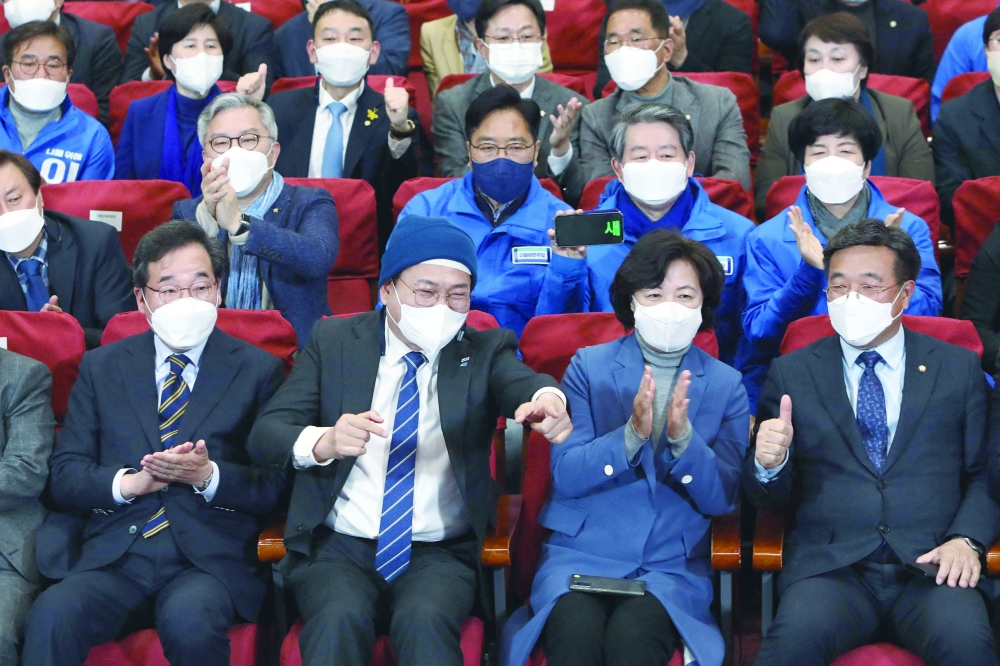





SEOUL: Polls have officially closed in South Korea's presidential election, the country's National Election Commission said late on Wednesday. Voter turnout was 77.1 per cent, with record early voting, but exit polls showed the two frontrunners, liberal Lee Jae-myung and conservative Yoon Suk-yeol, separated by less than a percentage point.
The vote was held in a tightly fought presidential election with the deciding votes set to be cast by young people, whose top concerns are economic inequality and unemployment -- not recent sabre-rattling from the nuclear-armed North.
Official figures showed high turnout of about 65 per cent by 2 pm, after record early voting, following a campaign dominated by mud-slinging between the two front runners, the incumbent Democratic Party's Lee Jae-myung and the opposition conservative People Power Party's Yoon Suk-yeol.
The pair, both so unpopular local media have branded it the "election of the unfavourables", have been neck and neck in the polls for months. Some 90 per cent of the electorate supports one or the other.
The choices of young swing voters will probably prove decisive, analysts said, adding the demographic's top concerns were skyrocketing house prices in the capital Seoul, social inequality and stubborn youth unemployment.
"I'm really worried about housing prices in Seoul and I hope the new president will focus on making people's lives easier and better," Park Ki-tae, 38, said after casting his ballot.
Both leading candidates have promised to build millions of new homes, although the left-leaning Lee relies more on public housing and the conservative Yoon on market-led solutions to the crisis.
South Korean politics is famously adversarial. Presidents serve a single term of five years and every living former leader has been jailed for corruption after leaving office.
The two parties are ideologically poles apart, and observers say the key question is whether voters will kick out incumbent Moon Jae-in's dovish liberals and usher in a new hawkish, fiscally conservative regime under Yoon.
"Young voters are not loyal to any particular political party and thus can't be defined by liberal-conservative ideology," said Shin Yul, political science professor at Myongji University. "Turnouts and choices by those in their 20s will have a significant bearing on the outcome."
Voters, wearing masks and using hand sanitiser after the country recorded a record 342,446 new Covid-19 cases on Wednesday amid an Omicron spike, lined up to cast their ballots at polling stations.
"What the country needs right now is change," 71-year-old Hong Sung-cheon said at a polling station in southern Seoul.
Polling booths opened at 6 am will shut at 6 pm. For 90 minutes after closing, Covid-positive voters will be allowed to cast their ballots.
More than a million people were isolating at home after testing positive, health authorities said. The country amended its electoral laws last month to ensure they would be able to vote. In a two-day early voting exercise last week, a record-breaking 37 per cent of the 44 million people eligible cast their ballots -- the highest number since the system was introduced in 2013. - AFP
Oman Observer is now on the WhatsApp channel. Click here