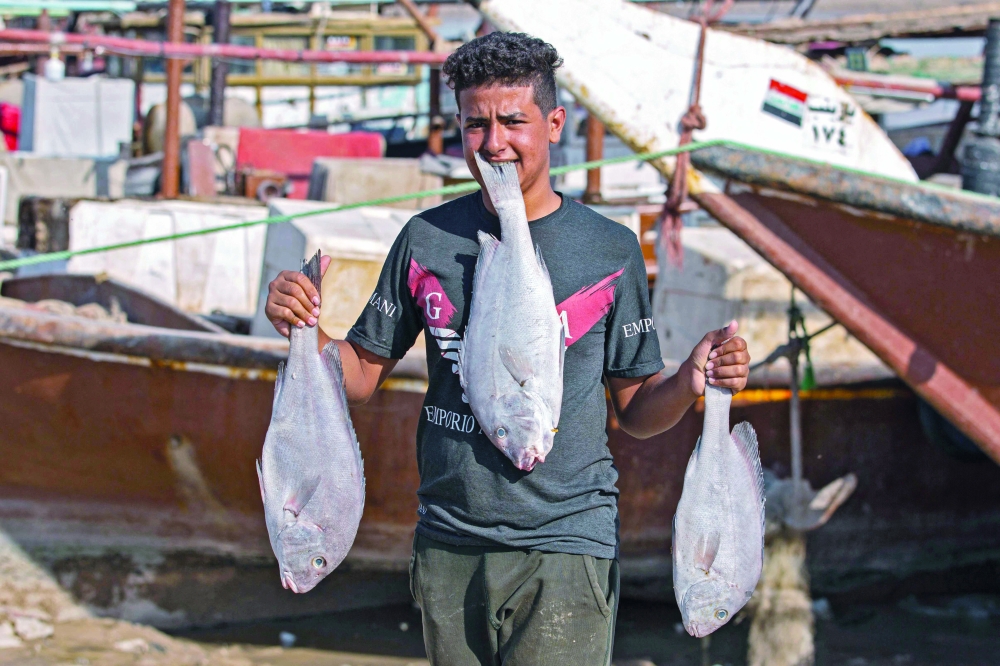





AL FAW, Iraq: On the banks of the Shatt al Arab waterway, Iraqi fishermen live in constant fear of arrest for mistakenly straying across frontiers with former enemy countries. About 15 kilometres from where the mighty Tigris and the Euphrates rivers merge and flow out to the Gulf lies the fishing port of Al Faw.
The port town has been on the front line that have shaped Iraq's modern history. On the opposite bank of the Shatt al Arab, the green-white-red flag of Iran flutters in the wind, alongside portraits of Ayatollah Khomeini, founder of the Islamic republic, and his successor as supreme guide, Ali Khamenei.
In the past, the border along the invisible median line of the Shatt al Arab has been a casus belli. In September 1980, Saddam's forces invaded after scrapping the 1975 Algiers agreement that aimed to put an end to disputes over the borderline.
Iraqi fishermen at Al Faw, such as Tareq Ziad, complain of "being harassed" by neighbouring countries. When their boats leave the Shatt al Arab and head for the open seas of the Gulf, they often find themselves in Kuwaiti and Iranian waters because of the currents.
The Iranians "put you in prison and make you pay a fine of $3,000. That is what happened to my brother a few days ago. He was arrested by an river patrol and he paid $3,000," Ziad said. The head of the fishermen's union in Al Faw, Badran al Tamimi, said they have "no support from the (Iraqi) government".
Kuwait also arrests Iraqi fishermen who "inadvertently" venture into the territorial waters of the emirate, he said. "Yesterday evening, I went to the Kuwaiti border to bring back three fishermen who were arrested. This week, I have been there three or four times," Tamimi said.
A Kuwaiti security official, on condition of anonymity, said: "People seized in the border areas are handed over, in good health, by the ground forces, in coordination with the Iraqi side." The fishermen of Al Faw also have environmental challenges to grapple with.
"We go out to sea for eight to 10 days and when we return, we've caught between 500 kilograms and one tonne, compared to three or four tonnes 20 years ago," complained fisherman Abdallah.
Fishing expeditions have become much shorter and the boundaries are closely monitored by Iraq's neighbours. In addition, the price of fuel has shot up. As Iraqi rivers dry up due to drought and the construction of dams in Iran and Turkey, so too does the amount of seasonal fish that locals relied on for food.
And while the river waters ebb to ever lower levels, the Gulf rises. "We are seeing more and more marine species in the river as the water becomes saline," said Iyad Abdelmohsen, a marine biologist at Baghdad's Al Mustansiriyah University.
And "human activities, such as sewage and waste" that end up in Iraq's waterways are causing "digestive illnesses, diarrhoea and even cholera", he said. - AFP
Oman Observer is now on the WhatsApp channel. Click here