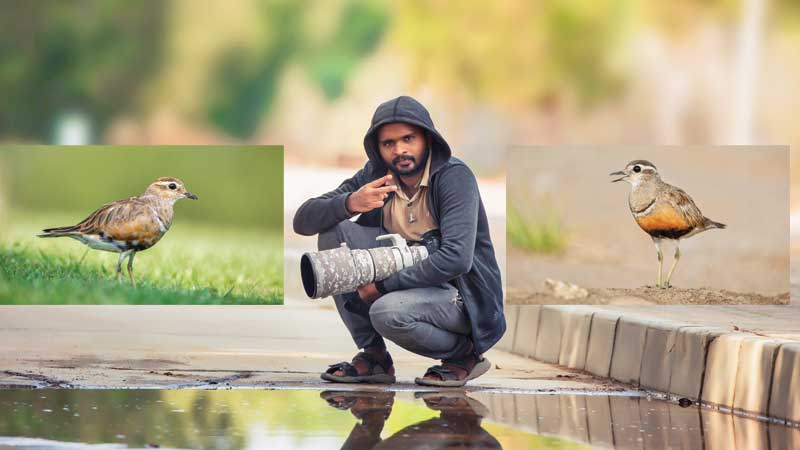





The Eurasian Dotterel, a small wader in the plover family of birds, was sighted near Muscat outskirts last week after a long gap.
Nature photographer Bavish Kizhakoodan Balan spotted this beautiful female bird while driving off the express highway beyond Al Seeb.
His initial look at the bird gave an idea of being something different. He then drove back from the roundabout and with a Canon 5DM4 and 500 mm captured it on frame.
A rare winter visitor to the Sultanate, the bird is recorded as ‘vagrant’, with less than 10 records.
The ‘vagrant’ status is based on the number of records of each species and not the number of birds likely to be seen each time a species is recorded.
Accordingly, there are 139 species in Oman which are recorded under ‘vagrant’ status and Eurasian Dotterel being one of them.
It was last sighted in Sun Farms, Suhar, Al Batinah Governorate, in January 2005 by Dominic Mitchell and recorded in eBird.
eBird is an online database of bird observations providing scientists, researchers and amateur naturalists with real-time data about bird distribution and abundance.
Belonging to the family of Charadrius under species morinellus, Eurasian Dotterel is known in Europe as just dotterel.
The small wader is a brown and black-streaked bird with a broad white eye-stripe and an orange-red chest band when in breeding plumage.
The female is more colourful than the male species and does not take part in nesting duties.
The male incubates the eggs and tends the chicks, while the female mates with several different males.
Liju Cherian
@cherianmathiker
Oman Observer is now on the WhatsApp channel. Click here