


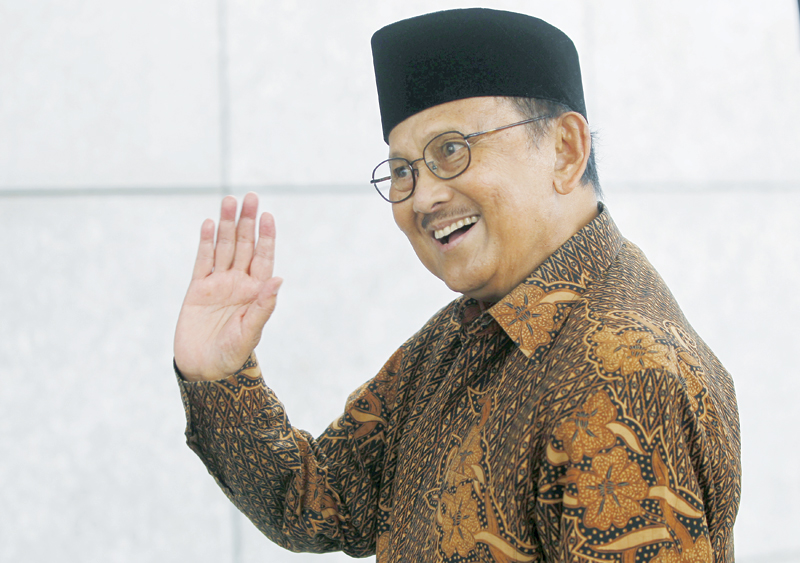





JAKARTA: Former Indonesian president Bacharuddin Jusuf Habibie died on Wednesday after being treated in a Jakarta army hospital for a heart ailment. He was 83.
“I on behalf of the people of Indonesia and the government would like to express my deep sorrow for the passing of Professor B J Habibie,”President Joko Widodo told reporters.
“Mr Habibie was a world-class scientist, the father of Indonesian technological advancement and the third president of Indonesia,” Joko said.
Last year, Habibie was admitted to the Starnberg hospital near Munich and underwent treatment for a leaky heart valve.
Habibie studied engineering and worked in Germany before he returned to Indonesia in 1976 to help build the country’s technology and industry sector under the government of then-president Suharto.
Habibie is credited with democratising Indonesia after he took office as president to replace Suharto, who resigned under pressure in 1998 amid widespread unrest at the height of the Asian financial crisis.
Habibie served as president from May 1998 to October 1999.
His time in power was marked by widespread protests by students who demanded that Suharto be brought to justice for alleged corruption and human rights abuses during the strongman’s 32-year rule.
Suharto was tried for corruption but charges were dropped after he pleaded ill health.
Habibie withdrew from the 1999 presidential election following a no-confidence motion in parliament.
During his short presidency, Habibie released political prisoners, introduced laws guaranteeing a free press and ended cultural discrimination against the ethnic Chinese. In 1999, he decided to allow a referendum on independence for East Timor, then an Indonesian province.
Pro-Jakarta militias went on a rampage before and after the UN-sponsored vote, leaving a trail of destruction in East Timor.
He held power for 17 months until the late Abdurrahman Wahid became president and his tenure was marked by his agreeing to a referendum for the people of former Portuguese colony East Timor.
Indonesian troops invaded in December 1975 and the following year annexed East Timor as its 27th province. But Habibie abruptly changed long held policy in January 1999 and said East Timor could have independence if it rejected autonomy within Indonesia. The East Timorese later voted for independence, unleashing a wave of violence.
Habibie was also known for his quest to turn Indonesia into a technological power house, including trying to develop a national aircraft industry.
President Joko Widodo, speaking at the hospital where Habibie was being treated, described Habibie as a “world-class scientist and the father of technology in Indonesia”. — Agencies
Oman Observer is now on the WhatsApp channel. Click here


