


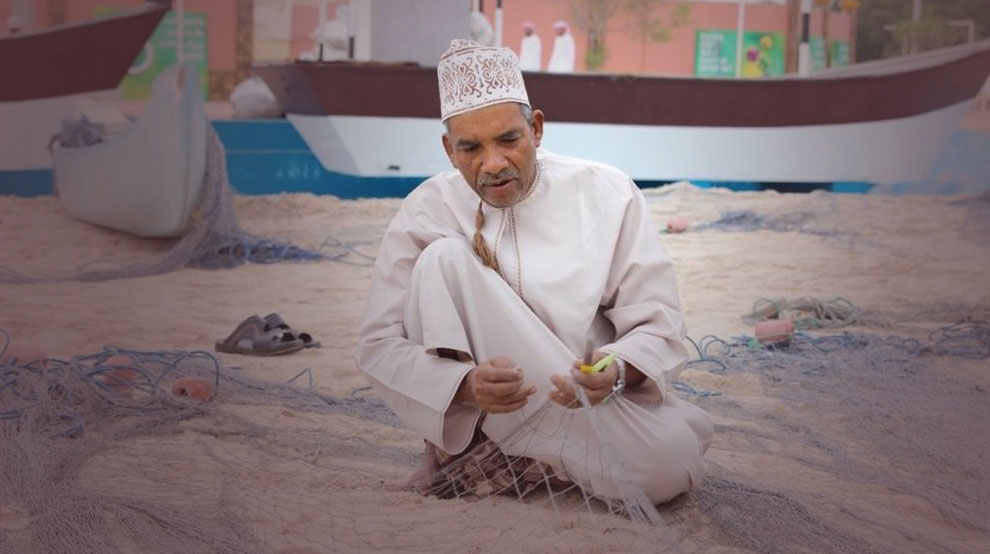





The fishing nets industry is a traditional marine craft inherited from ancestors that is still practised by the elderly and a few young people in the coastal areas of the Wilayat of Salalah.
Yousef al Barakah, one of the residents of the al Haffa region in Salalah, who has been skilled in this craft since childhood, said that the manual manufacture of fishing nets goes through several stages that start with curling yarn. This stage is often done by women as well as men through the spinning machine, which is called a “dileep”.
Al Barakah shared that after preparing the yarns, the role of the net maker comes. The stage of putting the net together is called “Washa” where a net maker goes through the different size and type as requested by his customers. For example, Al-Jarif nets are woven by approximately nine (9) individuals or more, and the process of his manufacture is called “Lakada”.
Al Barakah said that there are many types of hand-made fishing nets in Salalah, and their price varies according to their use, the type of fish to be caught, and the amount of lead metal used in the nets.

He added that one of the main differences between fishing nets is the quality of the threads used in knitting in terms of strength and durability, as well as the size and length of the nets.
He indicated that the names of fishing nets may differ from one governorate to another, indicating that the most important types of nets are al Maghdafa, al Mughawir and al Jarif, as each type of these nets has specific uses and different sizes.
He explained that al Maghdafa net is small and round in size and is used to catch small quantities of small fish from the shore or on the fishing boat, where the fisherman wraps the net around his arm and then releases it into the air to fall into the water and traps the fish in a way that requires skill and experience so that the strings don’t intertwine with each other.
While al Jarif nets are the largest ever, and their length ranges from 35 to 40 meters, with a width ranging from 10 to 15 meters, and is used to catch large quantities of sardines with the participation of a large number of fishermen Which is locally called “al Eid or al omah”.
Saeed Al Shujibi, one of the youths who have experience in the craft of fishing nets, said that Al Mughawir nets are intended for medium fishing, and this is due to the strength and durability of their threads.
As the world is evolving, this craft is threatened and might disappear due to the frequent use of modern fishing nets made of nylon strings imported from abroad, which affected the demand for the purchase of traditional fishing nets.
Oman Observer is now on the WhatsApp channel. Click here


