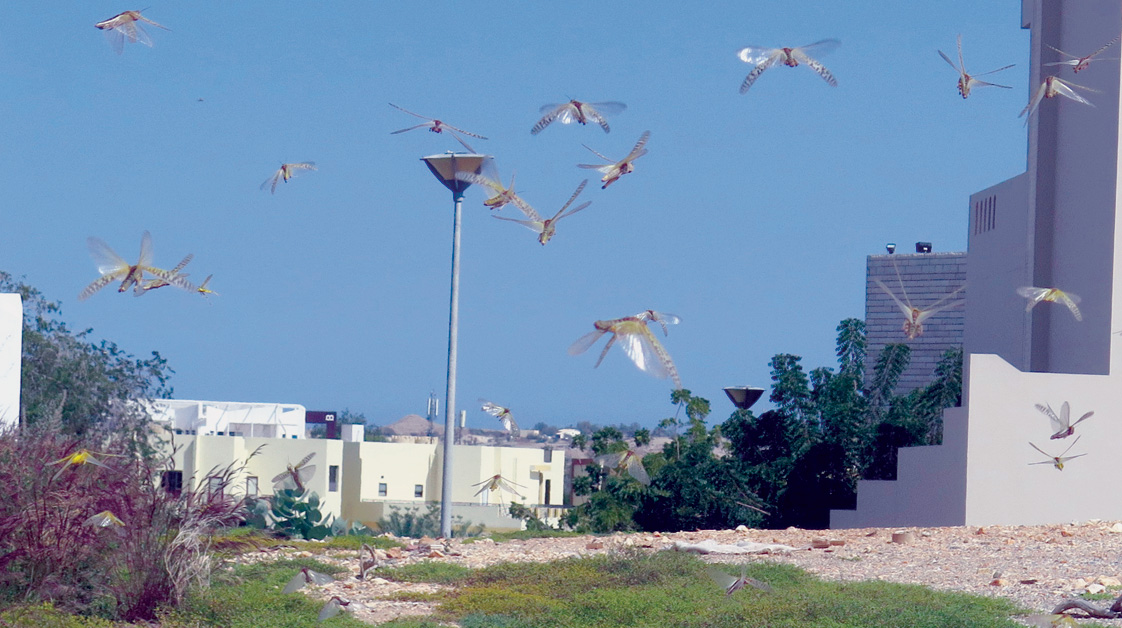





SALALAH, Feb 24 - Salalah is not conducive to locust attack mainly due to its climatic condition. The desert locusts need rain as well as dry climate for breeding. The humid condition of Salalah is not suitable for them.
This is an interesting fact about Salalah, because Dhofar, mainly suburban Salalah, figures prominently in the vegetation map of Oman as 800 plant species out of a total of 1,200 identified species in Oman are found here.
Any locust attack in Salalah, of the kind being faced in many other parts of the Sultanate, might have caused extensive damage to vegetation in the region.
It is relevant to revisit an international meeting titled ‘9th Sub-Regional Training Course on Desert Locust Survey and Control Operations’ which was held in Salalah way back in September 2015.
The joint oraganisers of the meeting were Commission for Controlling the Desert Locust in the Central Region (CRC) and the Sultanate’s Ministry of Agriculture and Fisheries.
The CRC, which is a branch of the UN Food and Agriculture Organisation (FAO), is tasked with keeping an eye on spread of locust in 16-member countries like Bahrain, Djibouti, Egypt, Eritrea, Ethiopia, Iraq, Jordan, Kuwait, Lebanon, Oman, Qatar, Saudi Arabia, Sudan, Syria, UAE and Yemen.
The meeting had deliberated upon the fact that many locations in Oman are conducive to desert locusts that pose serious threat to agriculture and cattle wealth. The locations prone to locust attack are places close to Yemen border in South Oman (Al Mazyouna etc), Thamrait, wadis in Dhahirah, Dakhiliyah and Sharqiyah governorates, Batinah South, Jammah dunes, some areas in Mahdha.
It is interesting to understand that despite being close to Yemen and Al Mazyouna, Salalah does not offer favourable condition for the desert locusts, whereas Thamrait which is just 80 kilometres away is conducive to locust swarms and subsequent attack on plants and animals.
“Fortunately proper Salalah is not conducive to locust attack mainly due to its climatic condition. The desert locusts need rain as well as dry climate for breeding. The humid condition of Salalah is not suitable for them,” said one document presented during the meeting.
Oman Observer is now on the WhatsApp channel. Click here