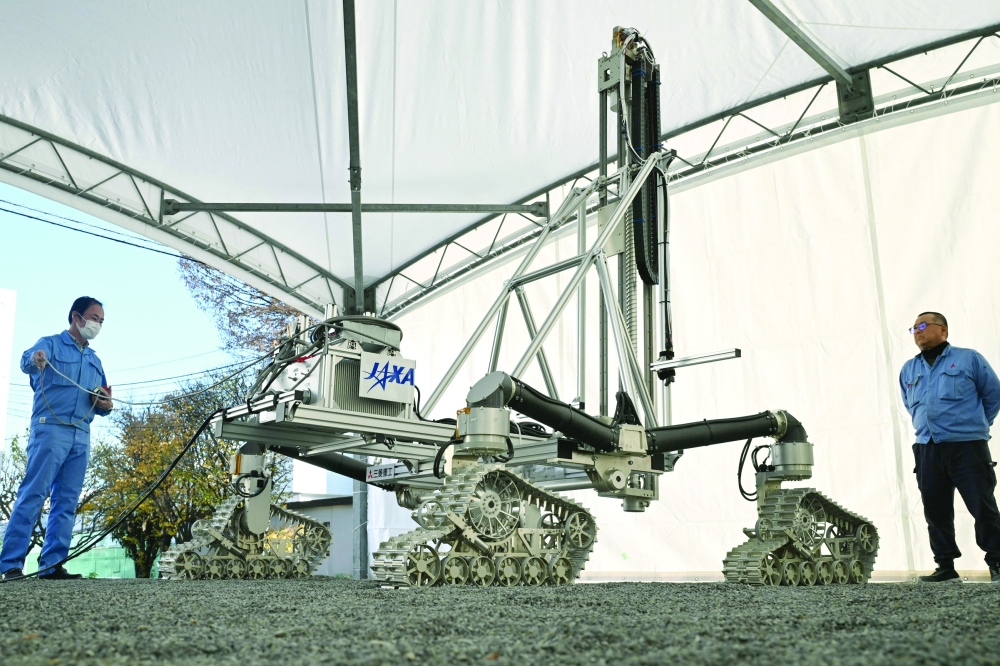





Japan's space agency unveiled on Wednesday a test model of a rover that will travel to the Moon's south pole in a search for water, which could potentially be used for rocket fuel.
Dubbed LUPEX — Lunar Polar Exploration — the mission aims to send a Japanese rover to the Moon in 2028 in collaboration with India, which successfully landed a spacecraft near the lunar south pole last year.
The Moon's polar regions contain areas known as permanent shadows, which never see sunlight, and scientists say it is highly likely that water exists there near the lunar surface.
The LUPEX team hopes the rover will gather data on the quantity and quality of the water, helping to determine if it could one day be used to make space exploration more sustainable.
"We ultimately want to use lunar water for rocket fuel," project manager Takeshi Hoshino told reporters on Wednesday.
On the International Space Station, more than 90 per cent of water is recycled. But when rockets fly by burning oxygen and hydrogen, that water produced cannot be recovered for reuse, Hoshino explained.
"That's why a key objective is to produce fuel on the Moon for future missions, whether returning to Earth or heading onward to Mars," he said.
The Japan Aerospace Exploration Agency (JAXA) unveiled the four-legged test model that will form part of the LUPEX rover to reporters in Tokyo.
Scientists have been testing its performance under a variety of conditions, including "climbing slopes using a single leg, continuous driving using two legs, and mobility trials under vacuum conditions", Hoshino said.
The rover is expected to identify potential water sources once it lands and drill into the site to collect samples, according to JAXA. — AFP
Oman Observer is now on the WhatsApp channel. Click here