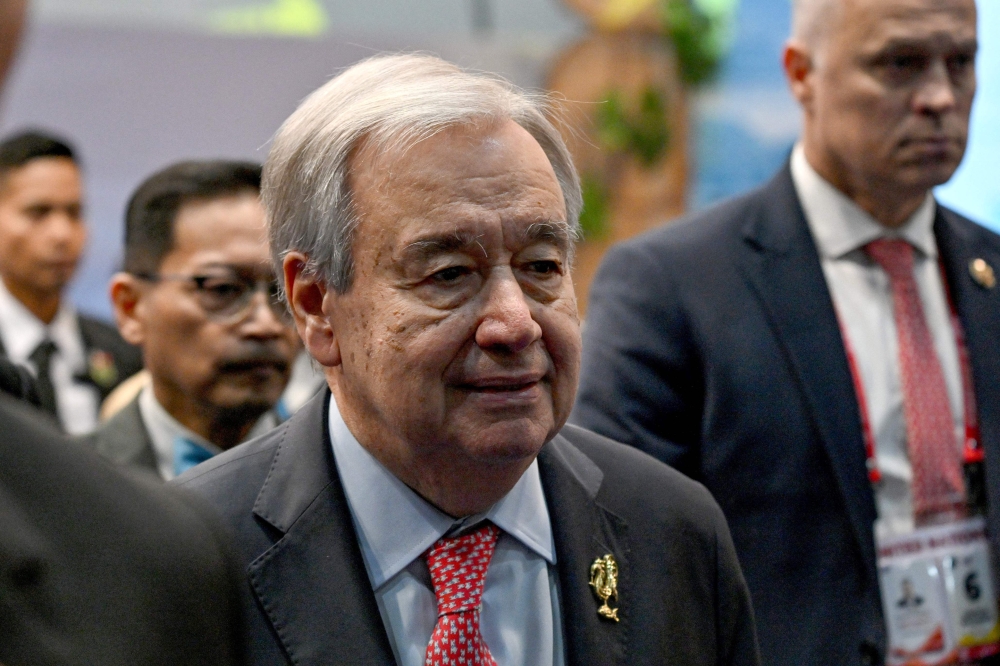


Geneva, Switzerland: The United Nations chief called on countries Monday to impose binding rules on the use of "merciless" lethal autonomous weapons systems, often dubbed "killer robots," on the battlefield.
Warfare is undergoing a radical transformation as armies seek to capitalise on artificial intelligence to boost their fighting abilities by identifying and striking targets more quickly and accurately.
Amid a chorus of warnings against handing the power of life and death to autonomous machines, country representatives have gathered for a conference at the UN in Geneva this week to debate whether to launch talks on binding rules for such weapons.
"I call on you to move towards negotiating a legally binding instrument to regulate autonomous weapon systems - including clear prohibitions and restrictions," UN chief Antonio Guterres said.
"Seize this moment," he said in a video message to the conference, urging countries to "take action to prevent the use and spread of these merciless weapons".
"We must never stop shielding civilians from the carnage and devastation of armed conflict, and preventing unnecessary suffering."
Others have also warned of the dangers inherent in fully autonomous weapons systems.
Human Rights Watch said the meeting of the UN's Review Conference of the Convention on Conventional Weapons (CCW) would leave civilians "dangerously exposed" if it failed to act decisively.
The meeting brings together 128 countries to decide whether to open negotiations on legally binding rules.
"The need to regulate autonomous weapons has taken on new urgency" with developments in artificial intelligence, said Laurent Gisel, head of the Weapons and Conduct of Hostilities Unit at the International Committee of the Red Cross (ICRC).
Russia's representative attempted Monday to block access to the discussions by observer states and civil society, which campaigners said was to dodge criticism of its own alleged use of such weapons.
Russia has reportedly used fully autonomous drones to deadly effect in Ukraine, while Kyiv's defence industry is pushing to develop autonomous "drone swarms".
- 'Carefully cultivated ambiguity' -
While many states are in favour of tighter rules, countries that have the technology are reluctant to have their hands tied.
At the UN General Assembly last month, 163 states adopted a resolution calling for negotiations on rules governing autonomous weapons.
Five countries voted against -- the United States, Russia, Belarus, Israel and North Korea, which last week boasted of a new AI-enabled torpedo system.
Nine abstained, including Iran, Saudi Arabia and China, which has maintained a "carefully cultivated ambiguity", said Laure de Roucy-Rochegonde of the French Institute of International Relations.
Washington has proposed a five?year process to develop a non?binding instrument, while NGOs and the ICRC are advocating for a one?year timeline.
In 2023, Guterres and ICRC President Mirjana Spoljaric Egger called on states to ban autonomous weapons before 2026.
The ICRC is calling for a ban on two categories of autonomous weapons: so?called "unpredictable autonomous weapons" and those designed or used to directly target humans.
But given the opposition from leading international powers, observers caution it looks unlikely agreement will be reached this week to start talks on binding rules.
Oman Observer is now on the WhatsApp channel. Click here