

Economic and investment relations between the Sultanate of Oman and the friendly Republic of Uzbekistan are witnessing an advanced stage of growth and expansion. This is driven by a growing shared political will to strengthen bilateral partnership and to leverage the economic and investment assets of both countries. Such efforts are opening new horizons for cooperation in trade, industry, transport, logistics, food security and tourism.
Diplomatic relations since 1992
Diplomatic relations between the Sultanate of Oman and the Republic of Uzbekistan were established on 22 April 1992. Relations between the two countries are founded on historical and commercial ties dating back to the Silk Road. In recent years, these ties have expanded markedly in trade, investment, industry, transport, logistics, energy and tourism. Several economic agreements have reinforced this expansion. These include the Agreement on the Avoidance of Double Taxation and the Prevention of Tax Evasion with Respect to Taxes on Income and Capital, and the Agreement on the Encouragement and Reciprocal Protection of Investments. Both were signed in Tashkent on March 30, 2009.
Trade cooperation pact
On October 5, 2009, the two countries signed a Trade and Economic Cooperation Agreement, together with an Agreement on the Foundations of Cooperation and Relations. These agreements provided an institutional framework for developing economic cooperation between the two sides. The two countries are also bound by an Air Services Agreement signed in Muscat.
The Omani Uzbek Investment Company was established as a partnership between Oman Investment Authority and the Uzbekistan Fund for Reconstruction and Development. It has a capital of RO 76.9 million (USD 200 million) and invests in sectors including industry, financial services, logistics, infrastructure, real estate and other economic sectors.
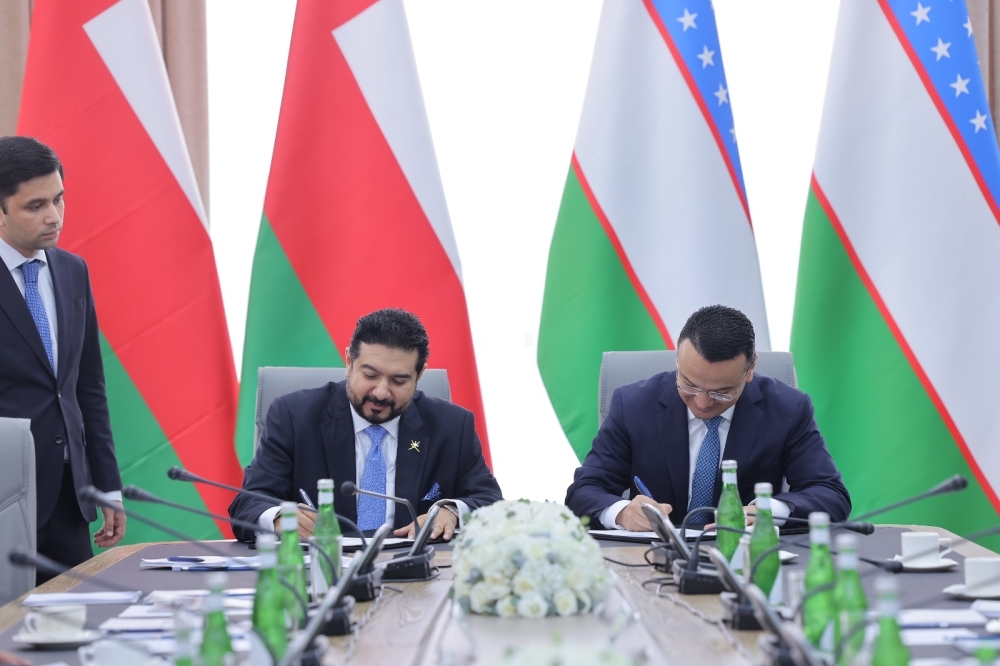
On October 15, 2024, Asyad Group and the Uzbek Ministry of Investment, Industry and Trade signed a memorandum of understanding to explore commercial opportunities in the logistics sector and to strengthen supply chains. This covers dry ports, railways, warehouses, air freight and e-commerce.
The Omani-Uzbek Joint Committee is one of the institutional mechanisms for developing cooperation between the two countries. Its sixth session is scheduled to be held in Muscat tomorrow, Sunday, after its fifth session was held in Tashkent in June 2025. At that session, the two sides agreed to increase operating rights in air transport and to enhance the re-export of Uzbek products through Omani ports.
Direct flights
In July 2026, Oman Air launched its first direct flights between Muscat and Tashkent, with two flights per week. This supports the movement of trade, investment and tourism between the two friendly countries.
Statistics issued by the National Centre for Statistics and Information show that total trade exchange between the Sultanate of Oman and the Republic of Uzbekistan rose from RO 28.6 thousand in 2024 to RO 1.186 million.
The statistics indicated that the volume of trade between the two friendly countries during the first eight months of 2026 reached RO 1.1543 million.
The most important Omani exports to the Republic of Uzbekistan in 2025 were household and musical instruments and personal luggage. Omani imports from Uzbekistan consisted of floor coverings, textile materials, clothing, fabrics, foodstuffs and cosmetics.
The statistics showed that the volume of Uzbek investments registered in the Sultanate of Oman rose from RO 2.564 million in 2024 to RO 2.909 million in 2025. The number of investing companies reached 57.
The most important sectors invested in during 2025 were wholesale and retail trade and repair of motor vehicles and motorcycles, construction, professional, scientific and technical activities, administrative and support service activities, and manufacturing industries.
Anwar bin Hilal Al Jabri, Minister of Commerce, Industry and Investment Promotion and Head of the Omani side in the Omani-Uzbek Joint Committee, said that the state visit of President Shavkat Mirziyoyev of the Republic of Uzbekistan, to the Sultanate of Oman embodies an important milestone in the path of bilateral relations between the two friendly countries. It reflects the mutual interest these relations enjoy and the shared keenness to expand areas of cooperation and elevate them to broader levels across various sectors, foremost among them trade, investment, industry and logistics.
He said that the visit represents an opportunity to affirm the shared will to benefit from the economic assets and available potentials of both countries and to employ them in building qualitative partnerships that achieve mutual interests and open new horizons for the public and private sectors.
The minister noted that Omani-Uzbek economic relations are based on the friendship, understanding and shared aspirations that bind the two countries towards diversifying economic partnerships and enhancing openness to regional and international markets. In this context, the Sultanate of Oman views the Republic of Uzbekistan as a promising economic partner in Central Asia, given its industrial and productive assets, natural resources and geographical location, which offers important opportunities for commercial and logistical connectivity with surrounding markets. The Sultanate of Oman, meanwhile, offers an attractive investment environment, advanced infrastructure, and ports and economic and free zones with competitive advantages, providing integrated opportunities for cooperation between the two sides.
He said that, amid the transformations witnessed by the global economy and the importance they impose on diversifying trading partners, enhancing supply chain resilience and opening new markets for products and investments, the importance of developing economic relations between the Sultanate of Oman and Uzbekistan on more diverse and integrated foundations is becoming evident. Such relations should not be limited to trade exchange but should extend to productive and industrial cooperation, the establishment of joint projects, the exchange of expertise, and the expansion of companies' presence in the markets of both countries and neighbouring markets.
He added that stimulating trade movement and expanding the base of exchanged products represents one of the main tracks for developing economic cooperation between the two countries. The two sides are working to create conditions that allow Omani products to reach the Uzbek market and, in return, to benefit from the diversity of Uzbek products and their competitive potential in the Omani market. This is in addition to enhancing direct communication between exporters and importers and facilitating procedures related to the access of goods, including standard specifications requirements, certificates and customs procedures.
The minister affirmed that the next stage requires a transition to building investment partnerships based on specific opportunities and economically viable projects, while enhancing communication between investors, companies and relevant institutions in both countries. He explained that the Sultanate of Oman is working to provide a stable and stimulating investment environment, supported by a system of legislation, facilities and advantages aimed at attracting qualitative investments and expanding the private sector's contribution to economic activity. Industrial cooperation also constitutes a wide field for developing economic relations between the two sides, particularly in manufacturing industries and industries linked to natural resources, food products and other productive activities.
He explained that the Omani-Uzbek Joint Committee plays an important role in organizing the course of economic, trade and investment cooperation, following up on relevant topics and agreements, identifying priority areas of work, and translating bilateral understandings into practical programmes and initiatives. Through the committee's work, the two sides are keen to enhance coordination between relevant government units in both countries, remove obstacles that investors and exporters may face, and develop regulatory frameworks that support the smooth flow of trade and investment transactions.
He affirmed that the friendship and cooperation relations binding the Sultanate of Oman and the Republic of Uzbekistan constitute a solid foundation for moving towards a broader stage in economic partnership. “We look forward to this visit carrying new horizons for cooperation and to the shared desire of the leaderships of both countries being translated into tangible initiatives and projects that benefit the two countries and the two friendly peoples and contribute to building a more interconnected and prosperous economic future,” he concluded.
or his part, Laziz Kudratov, Minister of Investment, Industry and Trade of the Republic of Uzbekistan, affirmed that economic and investment relations between the Sultanate of Oman and the Republic of Uzbekistan are witnessing accelerated development. This is driven by the shared political will of His Majesty Sultan Haitham bin Tarik and President Shavkat Mirziyoyev of the Republic of Uzbekistan, to enhance aspects of economic cooperation and open broader horizons for partnership between the two friendly countries.
He said that Omani-Uzbek relations are based on deep-rooted friendship and mutual respect and are currently witnessing an advanced stage of activity and cooperation. He noted that the past two years have seen intensified communications and efforts aimed at strengthening economic and trade partnership between the two sides.
He added that the Omani-Uzbek Joint Committee for Economic and Trade Cooperation held its fifth session in the capital, Tashkent, in June 2025. The current year has witnessed important developments, including Asyad Group, in cooperation with its partners, acquiring a majority stake in two leading logistics operating companies in Tashkent, alongside Oman Air launching direct flights between Muscat and Tashkent last July.
The Uzbek minister noted that the two sides are currently preparing to organize a business forum and to hold the Uzbek national exhibition "Made in Uzbekistan" in Muscat. He expressed confidence that these events will provide a direct platform for meeting Uzbek producers and Omani companies and will contribute to opening new horizons for trade and investment cooperation.
On the volume of trade exchange and investments between the two countries, he explained that the volume of trade exchange remains below the available potential but is recording accelerated growth. It exceeded $3 million during the first eight months of 2026, an increase of more than three and a half times compared with the same period last year, thereby surpassing the total value of trade exchange recorded during the whole of 2025.
He explained that investment cooperation between the two countries is witnessing remarkable progress. He noted that the Omani Uzbek Investment Company "UzOman", established in 2009 and currently owned by Oman Investment Authority and the Fund for Reconstruction and Development of Uzbekistan, has invested more than $256 million in a number of sectors, including building materials, logistics, retail, hospitality, education and agricultural chemicals.
The Uzbek minister affirmed that there is a direction to increase the volume of trade exchange between the two countries several times over the coming years. Work is also under way to convert the joint project portfolio, which includes about 35 projects worth more than USD 5 billion, into investment and operational projects on the ground.
On the investment assets provided by the Sultanate of Oman to Uzbek companies, he said that the strategic location of the Sultanate of Oman and its advanced ports in Sohar, Duqm and Salalah, alongside free and economic zones, provide important competitive advantages for companies seeking to expand towards regional and international markets.
He added that the Sultanate of Oman's membership in the Gulf Cooperation Council, alongside free trade agreements signed with a number of countries, including the United States and India, enhances its attractiveness as a regional centre for business and investment. It also gives companies access to the markets of the Gulf, South Asia, East Africa and other markets.
He noted that the Sultanate of Oman can represent a strategic gateway for Uzbek companies towards the region's markets through the establishment of distribution centres and warehouses for storing goods, assembling products intended for export and re-export, and processing and packaging Uzbek products in line with the needs of consumers in GCC markets.
The Uzbek Minister identified food products, textiles, building materials and electrical equipment as promising areas for advancing this cooperation, citing the complementary productive and commercial capabilities of both countries.
Regarding the economic sectors prioritized for partnership, he explained that the most prominent investment opportunities lie in sectors where the competitive advantages of the two countries complement each other, foremost among them food security and agro-industries, chemicals and petrochemicals, transport and logistics, and the banking and financial sector.
He added that there are also promising opportunities in the pharmaceuticals, healthcare, tourism, hospitality, building materials, electrical engineering and critical minerals sectors. He pointed out that Uzbekistan possesses assets including raw materials, skilled human resources and access to Central Asian markets, while Omani partners offer capital and expertise in implementing major industrial projects and access to Gulf markets.
He affirmed that the joint project portfolio between the two countries is based on this complementarity of capabilities and expertise, which enhances opportunities for establishing projects with added value for the Omani and Uzbek economies.
On the legislative environment and investment incentives, the Uzbek Minister of Investment, Industry and Trade said that Oman Vision 2040 and the Uzbekistan 2030 Strategy agree in their approaches towards building a diversified, sustainable and export-oriented economy. This provides common ground for developing investment projects that achieve mutual interests.
He noted that investment legislation in both countries provides guarantees and incentives for foreign investors. These include freedom to transfer profits abroad, protection from nationalization, and legal guarantees against adverse legislative changes for a period of up to ten years in key areas, as well as the possibility of resorting to international arbitration in accordance with relevant treaties and investment agreements.
He added that Uzbekistan provides investors with integrated infrastructure including 34 special economic zones, more than 400 small industrial zones and 27 technology parks. He explained that companies operating in special economic zones benefit from tax exemptions covering property, land and water taxes, alongside exemption from customs duties on equipment, raw materials and components, as well as the possibility of benefiting from accelerated depreciation for periods ranging between three and ten years depending on the size of the investment.
He explained that Uzbekistan also provides a single window for investor services and allows major projects to be implemented through direct investment agreements with the government or through the public-private partnership system.
The Uzbek minister affirmed that these incentives have contributed to enhancing the attractiveness of the investment environment in his country. Uzbekistan attracted foreign investments exceeding USD 43 billion during 2025, recording growth of 24 per cent compared with 2024. He noted that Omani citizens can visit Uzbekistan without a visa for up to 30 days.
On models of existing investment cooperation between the two countries, he explained that partnerships between Omani and Uzbek companies have begun to translate into practical projects in a number of sectors. He noted the participation of "UzOman" in financing the establishment of a plant for the production of crop protection materials and fertilizers, worth $75 million, in the Tashkent region.
In the logistics sector, he noted that the two dry ports in Tashkent, in which Asyad Group and its partners acquired a majority stake, handle about a quarter of rail freight container traffic in Uzbekistan. This reflects the importance of the partnership in developing the transport and logistics system and enhancing commercial connectivity between the two countries.
In the agriculture and food industries sectors, he said that Uzbekistan possesses diverse export potential including fresh and dried fruits, vegetables and processed foods, while Omani products, including fish, seafood and dates, have promising opportunities to enter the Uzbek market.
He added that the two sides are currently discussing the establishment of joint projects in the food industries sector. He noted that the launch of direct flights between Muscat and Tashkent would enhance tourism and exchange between the two countries and open opportunities for joint investment in the hospitality and hotels sector.
He explained that historic Uzbek cities such as Samarkand, Bukhara and Khiva, alongside mountain resorts near the capital, Tashkent, represent attractive tourist destinations for Omani visitors and provide additional areas for tourism cooperation and investment.
On the economic agreements and memoranda of understanding signed between the two countries, he affirmed that Omani-Uzbek economic relations are based on a legal framework and agreements regulating cooperation in the areas of investment promotion and protection, avoidance of double taxation, trade and economic cooperation, and air services. These agreements were signed in 2009.
The Uzbek minister noted that the two countries are currently preparing a preferential trade agreement and an updated investment protection agreement, which would contribute to strengthening the regulatory framework for trade exchange and providing further guarantees for investors.
He added that current efforts focus on converting agreements and memoranda of understanding into an executive roadmap that includes specific projects, timelines and agencies responsible for implementation, with periodic follow-up of progress, including during the meetings of the Omani-Uzbek Joint Committee, whose next session is scheduled to be held in Muscat.
In concluding his statement, the Uzbek minister reaffirmed his country's commitment to a partnership with the Sultanate of Oman grounded in generating added value for both economies. This would be achieved by deploying Omani capital, technology and expertise to develop industries and process raw materials in Uzbekistan, while enabling Uzbek companies to expand their investments in Oman's free zones and leverage the Sultanate of Oman’s ports and logistics infrastructure to access regional and international markets.
On the political side, consultations between the Sultanate of Oman and the Republic of Uzbekistan have continued. The eighth round was held in Tashkent in September 2025 and focused on expanding economic, trade and investment cooperation. It witnessed the signing of a joint action plan between the foreign ministries of the two countries.
In June 2026, Muscat hosted the ninth round, which discussed stimulating trade exchange and supporting joint investments. During the session, the two sides welcomed the launch of the direct flight route between Muscat and Tashkent.
In October of the same year, the Foreign Minister discussed with his Uzbek counterpart ways to expand economic, trade and tourism cooperation and to develop investment projects and areas of transport and logistics.
Oman Observer is now on the WhatsApp channel. Click here