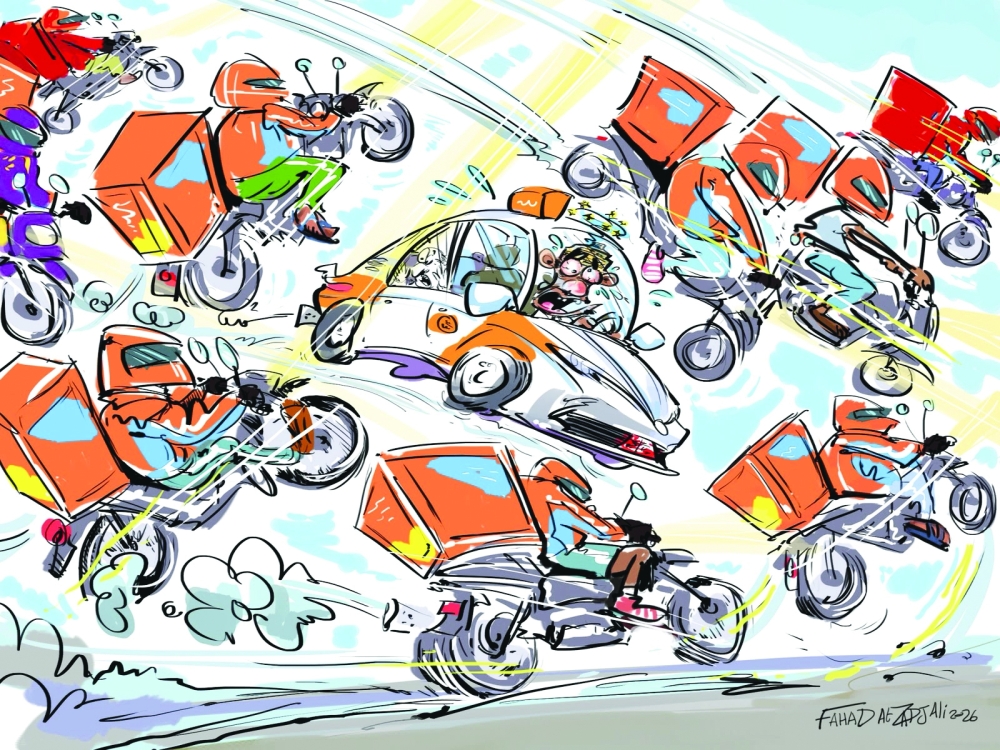


Food delivery services have become an increasingly visible part of everyday life in Oman, bringing meals and other essentials to people's doorsteps. However, the growing presence of delivery motorcycles on the country's roads has raised concerns over unsafe riding practices, traffic violations and indiscriminate parking.
While these services have made daily life more convenient and potentially reduced some journeys by private vehicles, road users say greater attention is needed to rider safety and compliance with traffic regulations.
Concerns include sudden lane changes, motorcycles travelling on road shoulders, mobile phone use while riding, random parking outside restaurants and slow-moving motorcycles using overtaking lanes. Addressing these issues requires better rider training, closer company supervision, organised parking facilities and greater awareness among all road users.
Ali al Shukaili, a resident of Al Khoudh, said that despite the decision prohibiting food delivery motorcycles from using expressways, he had repeatedly seen riders travelling along Muscat Expressway over several days.
He stressed the need for stronger enforcement to prevent violations that could endanger both motorcyclists and other road users.
Salim al Mandhari, a resident of Al Maabela, highlighted several risky practices, including riders using road shoulders before suddenly merging into traffic. He also pointed to motorcycles weaving between lanes at traffic signals to bypass queues and speeding in residential neighbourhoods.
Such behaviour, he said, could take motorists by surprise and increase the risk of accidents, making compliance with traffic regulations essential for everyone's safety.
Salma al Balushi raised concerns about some riders failing to wear company uniforms and observe basic safety requirements, including appropriate footwear and functioning lights on delivery boxes to improve visibility, particularly at night.
She recalled seeing a rider wearing clothing that did not identify his employer and riding without shoes, highlighting the need for delivery companies to exercise closer supervision.
Saleh bin Amer al Hajri, Projects Expert at the Technical Office for Monitoring Employment Initiatives at the Ministry of Transport, Communications and Information Technology, said the growing use of food delivery motorcycles reflected a wider social and economic shift.
Increasing reliance on delivery services had made it easier for people to obtain goods and meals from their homes or workplaces while potentially reducing dependence on private vehicles and easing traffic congestion.
Al Hajri stressed that riders must wear approved helmets, reflective protective clothing, thick gloves and footwear covering the ankles. He also urged motorists to remain alert to motorcycles, wear seat belts and avoid distractions, particularly mobile phone use while driving.
"The ministry was implementing measures to improve service quality, promote Omanisation, prevent unlicensed operations and protect workers’ rights. Unlicensed activity could create risks related to medical checks and the proper storage of food and medicines," he said. Without approved equipment, temperature-sensitive products could deteriorate. The absence of formal employment contracts could also complicate accountability and leave workers without adequate protection in the event of accidents or financial disputes.
Al Hajri said the ministry, in cooperation with the Ministry of Labour and the Royal Oman Police, had introduced measures requiring expatriates engaged in food delivery to use motorcycles, while allowing Omanis to use vehicles for delivery services.
These measures include the Naql digital platform for issuing activity licences and requiring delivery representatives to obtain permits through the Sectoral Skills Unit.
The regulations also require riders to use secondary roads instead of main roads, wear company uniforms, carry approved food storage containers and undergo preventive training covering motorcycle safety and proper delivery practices.
Delivery companies are also required to install electronic tracking systems to monitor riders' safety, ensure compliance with speed limits on secondary roads, identify congested areas and peak hours, and respond to emergencies.
The ministry has also introduced Omanisation of the food delivery supervisor position, with each supervisor responsible for monitoring five riders and following up on their performance.
Al Hajri said allowing expatriates to use motorcycles for food delivery had helped reduce congestion in several busy areas and minimise traffic obstruction.
However, he emphasised that the convenience and speed of delivery services must go hand in hand with compliance with safety requirements and regulations to protect all road users.
Oman Observer is now on the WhatsApp channel. Click here