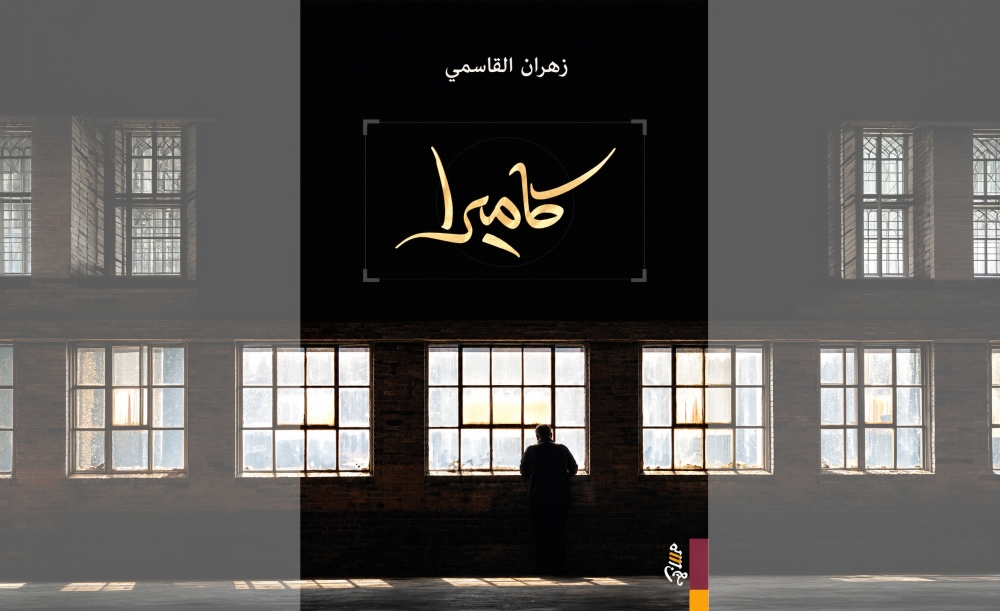





In his poetry collection Camera, published by Masaa Publishing in 2015, Omani poet Zahran al Qasmi draws on the techniques of photography and cinema to create a distinctive poetic language. Across 145 short poems, the camera becomes a means of exploring both the visible world and the poet’s deeper thoughts about life and existence.
One brief poem captures the central idea of the collection:
How vast the image,
How narrow the space.
Here, Al Qasmi favours the openness of the image over the limitations of physical space and language. His poetry moves away from excessive abstraction and dense metaphor towards visual scenes that readers can almost see unfolding before them.
The camera therefore becomes more than an object. It is a poetic device through which reality can be examined, enlarged and transformed:
I stretch my hand before the camera.
The lens moves closer to the wrinkles.
My fingers become veins of sand.
I see a caravan of Bedouins moving on,
I see ghaf and sidr trees.
The lens moves closer still,
until everything appears
to exist beyond the hand.
The camera begins with something ordinary — a hand — but magnification turns its lines into a landscape. The familiar becomes unfamiliar, allowing the poet to discover another reality hidden within what the eye normally sees.
Al Qasmi also uses the camera as a metaphor for poetry itself. Both photography and poetry recreate reality rather than simply reproduce it:
The camera deceives us,
showing the image unlike what it is.
The camera deceives us.
We know that it does,
yet still we believe.
Elsewhere, the camera declares:
Everything I see
in its true form
is upside down.
This apparent deception is part of artistic creation. Art does not merely copy the world; it changes our perspective and reveals possibilities that ordinary perception may overlook. The poet expresses this idea even more directly when he writes:
I see you now.
I see your face and your intentions.
The camera speaks to the unknown.
Photography also becomes a way of giving beauty and hope to damaged things. In one poem, the camera transforms the fate of an injured butterfly:
To a coloured butterfly
with a broken wing,
the camera gives
a rainbow and a field of rivers.
The image does not deny suffering, but creates another possibility beyond it. Through art, the broken can briefly enter a more beautiful world.
The camera also enables Al Qasmi to explore larger questions of existence. A falling drop of water becomes an image of the short journey from life to disappearance:
A drop of water falls.
The camera catches it unaware.
I see its joy,
its dance,
its disappearance.
A fleeting physical moment is transformed into a meditation on human existence. Life, like the drop, has movement and brilliance, but is ultimately temporary.
The poet develops this idea through another striking image:
“I am the illusion of this life,
and its fleeting gleam”,
says the rainbow
to the weeping cloud on the horizon.
Cinematic techniques are equally important in the collection. Camera angles, movement, lighting and close-ups allow the poet to transform small scenes into wider emotional experiences. In one poem, he invites the reader to become a photographer:
Bring all your weariness.
Turn your camera towards the branch
of this flourishing tree.
There, in the shade,
beneath a yellowing leaf,
slowly, slowly,
a tiny creature moves,
quiet and unhurried,
climbing its difficult path without fatigue.
The scene resembles a cinematic close-up. Attention moves from the tree to the leaf and finally to the tiny creature. Its slow journey becomes much larger than itself. The yellowing leaf suggests ageing and passing time, while the creature’s continued movement evokes persistence and the struggle for life.
The reader is therefore not simply asked to interpret the poem, but to watch it. Language begins to function like a screen on which movement, light, colour and perspective create meaning.
This is perhaps the most distinctive achievement of Camera. By incorporating photography and cinematic techniques into poetry, Al Qasmi expands what poetic language can do. Light, colour, movement, framing and perspective work alongside words, freeing the poem from excessive abstraction.
In this way, poetry moves beyond the narrow limits of expression and enters the wider world of the visual image. The poem is no longer something merely to be read or heard; it becomes something to be seen, experienced and lived.
Translated by Badr al Dhafri
This is an adapted translation of the original Arabic article published in the print edition of the cultural supplement of the Oman Daily newspaper on April 30, 2026.
Jassim Jameel al Tarshi
The writer is an Omani poet
Oman Observer is now on the WhatsApp channel. Click here