




MUSCAT, OCT 6
Award winning Omani climate tech 44.01 is expanding into industrial carbon storage and European markets as it seeks customers and investment to scale up a process that turns carbon dioxide into rock, its co-founders said during the EO forum on The Energy Transition.
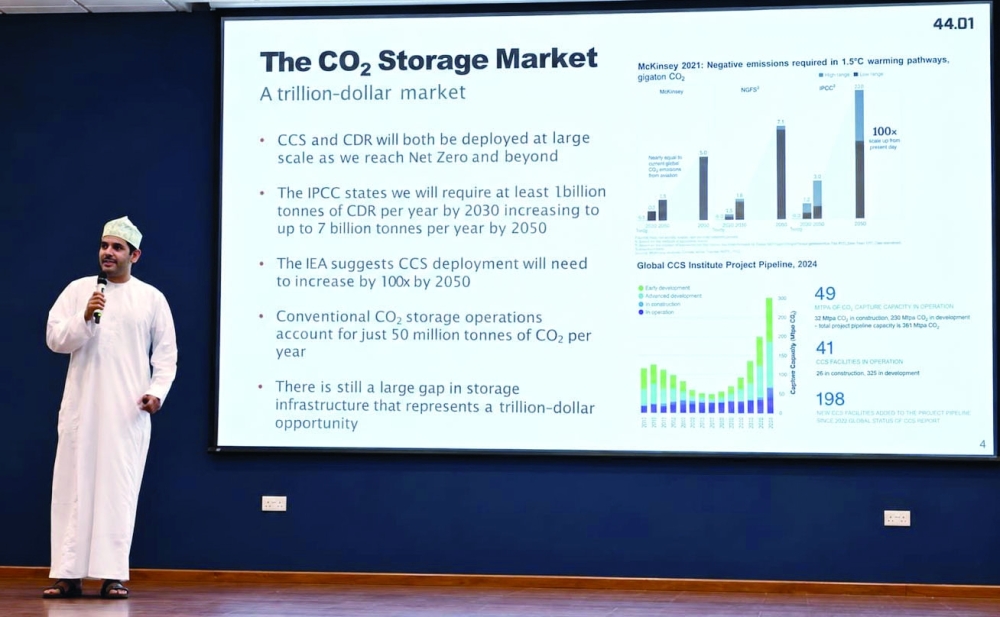
The company has begun working with a Holcim-owned cement plant in Fujairah and is extending its business into Norway and the Faroe Islands, building on pilot projects in Oman and the UAE, Talal Hasan, Founder and CEO of 44.01 and Karan Khimji, Chief Commercial Officer of 44.01, said during a presentation.
The expansion marks a move towards commercial applications for technology developed in Oman, where suitable rock formations allow carbon dioxide to react with minerals and become permanently stored.
Hasan said Oman remains the company’s largest operational base, employing about 35 people out of a workforce exceeding 65 across five territories.
“Oman is actually one of the best places to build a deep tech company,” Hasan said. “If we can do it, others can do it too.”
The company has around 25 granted patents and another 40 patent filings, alongside technology licensed from other organisations, he said.
Hasan named Breakthrough Energy, Apollo and Equinor among its largest investors, with Air Liquide and Sumitomo among its strategic backers. The company continues to seek investment to support its expansion.
He said carbon storage could also strengthen the commercial appeal of industrial products, citing an unnamed Omani company whose captured carbon dioxide was purchased through a third party and mineralised by 44.01.
After the storage project was publicised, the producer received offers at prices 30 to 40 per cent higher for its product, Hasan said.
“Selling a decarbonised product can be valuable,” he said.
Meanwhile, Karan Khimji said 44.01’s first pilot drew on years of academic research into the Samayil Ophiolite, a geological formation in Oman containing rocks capable of absorbing carbon dioxide through natural mineralisation.
After securing an initial permit from the energy ministry, the founders used an existing well at a previously studied site, giving their small team access to extensive geological data.
Carbon dioxide was mixed with water and injected into the well. Subsequent testing indicated that it had mineralised within 45 days, Khimji said, accelerating a process that takes much longer in nature.
The results helped 44.01 secure a concession for the site, where it continues to operate.
ADNOC became its first paying customer through a demonstration project in Fujairah ahead of COP28. The site was developed in nine months, with around 10 tonnes of carbon dioxide injected over four weeks, he said.
The project provided an early commercial demonstration outside Oman and led to further development in the UAE.
“We can take the technology that we’ve developed here and export that to the world,” Khimji said.
The Holcim-owned cement plant project involves capturing carbon dioxide from its flue stack, liquefying it and transporting it by truck to an injection site in Fujairah.
About 60 tonnes had already been injected, Khimji said. The project demonstrates an industrial decarbonisation chain linking capture, transport and mineral storage, helping the producer offer cement with a lower emissions footprint.
44.01 is also developing carbon credit projects in Fujairah, adding another potential revenue stream alongside industrial storage services.
In Norway, the company is seeking to build on established carbon storage expertise. Khimji said Equinor, which led its Series A funding round, viewed mineralisation as complementary to conventional storage.
“If you have CO2, we can help you get rid of it, especially if you’re in Oman or the UAE,” Khimji said.
The company is compiling geological information from partners and investors to identify suitable rock formations overseas and support deployment in additional markets.
Oman Observer is now on the WhatsApp channel. Click here