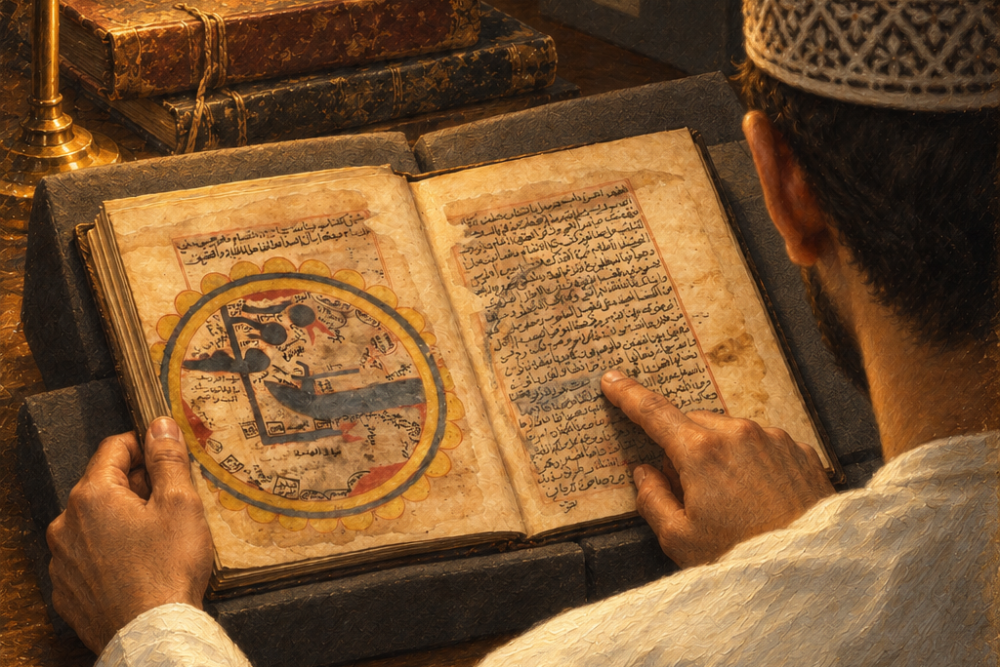





There are moments in a researcher’s life that quietly reshape the way history is understood. They arrive without ceremony, revealing themselves only through experience. One such moment came when I entered the Bristol Archives expecting to consult only a handful of documents relating to the history of the Sultanate of Oman.
Several minutes later, the archivist returned pushing a trolley loaded with twelve large archival boxes containing official correspondence, administrative records, shipping reports and documents relating to the Omani presence in Somalia and across East Africa. I paused before opening the first box. It was not their number that held me still, but the realisation that I was looking at voices that had travelled farther than the people who had written them.
As I unfolded the first document, history ceased to be an abstract discipline. It became immediate, tangible and deeply human. Those pages preserved more than information; they preserved memory. In the silence of the reading room, I realised that I was not merely examining historical records, I was encountering my nation’s past through the words of those who had lived it.
That morning transformed my understanding of archives. I had once regarded them simply as repositories of evidence. I came to see them instead as places where civilisations continue their conversation with future generations. Every unopened file preserves a forgotten voice and every manuscript carries questions that later generations have yet to ask.
A nation’s memory, however, rarely remains within the borders of a modern state. Documents travel with merchants, diplomats, scholars and governments. Some remain where they were created, while others eventually find homes in libraries and archives thousands of kilometres away. Their location changes, but the history to which they belong does not.
Few countries illustrate this reality more clearly than the Sultanate of Oman. For centuries, Oman occupied a central position in the Indian Ocean world, linking Arabia with East Africa, India and beyond through trade, diplomacy and scholarship. Such a civilisation naturally produced an extraordinary documentary legacy. Letters, treaties, judicial records, commercial ledgers, navigational manuals, maps, manuscripts and personal correspondence together recorded the life of a society whose influence extended far beyond its shores.
As Oman’s political, commercial and intellectual networks expanded, many of these records found their way into collections across the world. Their presence abroad should not be viewed simply as a story of dispersal, but as evidence of Oman’s historical reach. Every Omani document preserved overseas reflects a relationship once forged between Oman and another society. In this sense, archives become not only repositories of records but also maps of historical connections.
For historians, the challenge is not merely to discover individual documents but to reconnect scattered fragments until they reveal a coherent historical landscape. Historical truth rarely resides within a single archive. More often, it emerges when documents preserved in different countries illuminate one another across centuries. A report in one repository may explain a decision recorded in another, while a merchant’s letter or overlooked register may restore names, places and events that later histories reduced to passing references.
Archives teach patience before they teach conclusions. Every accepted interpretation remains open to revision whenever new evidence appears. A single document can reshape long-established assumptions because it speaks directly from the moment history unfolded.
Books are indispensable, yet they represent only the final stage of a much longer journey. Before history becomes narrative, it exists as evidence in letters, treaties, registers, maps, seals and manuscripts created by people who never imagined that their everyday work would one day become the foundation of historical scholarship. Every published history ultimately begins as a document.
The value of a document lies not only in the information it contains but also in the moment it preserves. It captures events before memory softens them and before later generations reinterpret their meaning. Unlike recollection, which naturally evolves, the document remains anchored to the circumstances of its creation, allowing historians to approach the original voices of the past as closely as possible.
This lesson became even clearer as my research extended beyond Bristol to other repositories preserving Oman’s documentary heritage. Whether in the British Library, the Bodleian Library at the University of Oxford, Qatar’s archives or other specialised collections, I encountered the same reality: no single institution possesses the whole story. Each preserves only one fragment of a much larger historical mosaic and only by bringing those fragments together can a fuller picture of Oman’s past emerge.
The deeper I progressed into archival research, the more I realised that documents preserve far more than political events. They record the rhythm of everyday life. A merchant’s ledger reveals patterns of trade and economic confidence, a judicial register reflects the legal culture of its society and a personal letter preserves emotions and relationships that official reports seldom capture. Even the smallest administrative note may contain details capable of reshaping a much broader historical narrative.
This richness is especially evident in Oman’s documentary heritage. Its history cannot be understood solely through chronicles of rulers or political events. It also survives in the correspondence of merchants who crossed the Indian Ocean, the legal records that governed daily life, the maritime manuals compiled by experienced navigators and the manuscripts copied and preserved by generations of scholars. Together, these sources reveal a civilisation that was intellectually vibrant, commercially confident and deeply connected to the wider world. They also remind us that history is rarely built upon extraordinary events alone, but upon countless ordinary moments faithfully recorded by individuals who never imagined that their work would one day become historical evidence.
One of the greatest misconceptions in historical research is to equate documentary heritage solely with manuscripts or official papers. Human societies have always documented themselves in many forms. A document may be written in ink, engraved in stone, impressed upon a seal, drawn on a map, captured in a photograph or printed on a banknote. Each preserves evidence of its own time and deserves the same scholarly attention.
This broader understanding gradually transformed my own research. For many years, I studied the history of Omani banknotes from a numismatic perspective. Over time, however, I came to recognise that currency is far more than an economic instrument. Every banknote is an official statement issued by the state about itself, reflecting political authority, economic confidence, artistic identity, technological achievement and the image a nation chooses to present to its people and to the wider world.
Unlike many historical objects, a banknote is designed with remarkable deliberation. Every portrait, architectural landmark, national emblem, colour and security feature is carefully selected. Nothing appears by accident. A fort, a mosque, a sailing vessel or a national symbol is never merely decorative; each contributes to a visual narrative through which a country expresses its history, identity and aspirations.
For that reason, I gradually came to regard banknotes as documentary evidence in their own right. Although they do not communicate through paragraphs of text, they speak through carefully chosen symbols whose historical value is equally significant. Studied alongside manuscripts, correspondence, maps and official records, they offer historians another perspective from which to understand the priorities and identity of a nation at a particular moment in time.
The same principle applies to historical maps. At first glance, they appear to be geographical representations, yet they reveal far more than coastlines and distances. Every map reflects the knowledge available to its creator, the interests of those who commissioned it and the political realities of its age. The naming of ports, the depiction of maritime routes and even the omission of certain places often reveal as much about history as written reports.
Photographs deserve similar attention. Since the nineteenth century, they have become indispensable historical sources, preserving details that written descriptions frequently overlook. A single image may reveal the architecture of a marketplace, the construction of a harbour, the uniforms of officials or the everyday lives of ordinary people. Like every historical source, photographs require careful interpretation, but when read alongside documentary evidence they add depth, context and immediacy to our understanding of the past.
The historian, therefore, is not merely a reader of manuscripts but an interpreter of evidence in all its forms. Manuscripts preserve ideas, official records document decisions, maps locate events, photographs capture their setting and banknotes reflect the identity of the state that produced them. Only when these different voices are brought together does history begin to reveal its full richness.
The digital age has transformed historical research in ways previous generations could scarcely have imagined. Materials that once required months of preparation, international travel and lengthy administrative procedures can now often be consulted through digital catalogues and high-resolution collections. Digitisation has safeguarded fragile manuscripts, expanded scholarly access and encouraged collaboration between institutions separated by thousands of kilometres. For researchers of Oman’s history, it has opened doors once accessible only to a fortunate few.
Yet digital technology should never be mistaken for a replacement for the original document. There remains something profoundly meaningful about encountering history in its physical form. The texture of the paper, the colour of the ink, the impression of a seal and the marks left by centuries of handling all convey information that no digital image can fully reproduce. The original document reminds us that history is not merely recorded, it is experienced, preserved and passed from one generation to the next.
These experiences have strengthened my conviction that Oman should continue building stronger institutional partnerships with the libraries and archives that preserve parts of its documentary heritage abroad. The objective is not necessarily the physical return of every manuscript or document. Many of these collections have been preserved with exemplary professionalism for generations. The greater priority is accessibility, scholarly cooperation and the exchange of knowledge.
One of the most valuable long-term ambitions would be the creation of a unified national catalogue bringing together every known Omani manuscript, archival collection, historical map and documentary source, whether preserved inside the Sultanate of Oman or abroad. Such a project would allow researchers to trace dispersed materials through a single integrated system, reconnecting historical evidence long scattered across institutions and continents.
Equally important is the continued development of a comprehensive national library serving not only as a repository of books but also as the intellectual centre of the nation’s documentary heritage. Through cataloguing, preservation, digitisation and international cooperation, such an institution would strengthen historical research while ensuring that future generations encounter their history through original sources rather than fragmented narratives.
Looking back on my journeys through archives and libraries, I have come to realise that the greatest discovery is rarely a single document. It is the understanding that the memory of Oman cannot be confined to one archive, one institution or even one country. It survives across continents in manuscripts, correspondence, maps, registers, photographs, banknotes and countless other records that together tell the story of a civilisation whose horizons extended far beyond its shores.
For that reason, the work of today’s historian extends beyond interpreting the collections of a single repository. It requires following the documentary trail wherever it leads, patiently reconnecting scattered evidence until the broader historical landscape begins to emerge.
This responsibility is more than academic. It is cultural, national and profoundly human. Nations preserve their identity not only through monuments or borders, but also through memory. Documents remain among the most enduring expressions of that memory because they preserve the voices of those who came before us, allowing each generation to encounter the past through authentic evidence rather than imagination alone.
Whenever I think back to that morning in the Bristol Archives, I no longer remember only the twelve boxes waiting on the trolley. I remember the silence that surrounded them — the silence of voices that had endured the passage of centuries, waiting patiently for someone willing to listen.
When I closed the final box that day, I realised that my journey had not reached its conclusion. It had only begun. Beyond those shelves lay countless collections still unexplored, documents still unread and connections still waiting to be discovered. That, perhaps, is the greatest lesson archives teach us: history is never complete. Every generation inherits the responsibility to ask new questions, discover new evidence and continue the conversation between the past and the present.
If there is one lesson that has remained with me throughout every archive I have visited, it is this: a nation’s strength is measured not only by the future it builds, but also by the memory it preserves.
A country may rebuild its cities, restore its monuments and even redraw its borders. However, if it loses the record of who it has been, it risks losing its understanding of who it is. That is why the search for documents is far more than a scholarly pursuit. It is, ultimately, the search for the memory of a nation.
Oman Observer is now on the WhatsApp channel. Click here