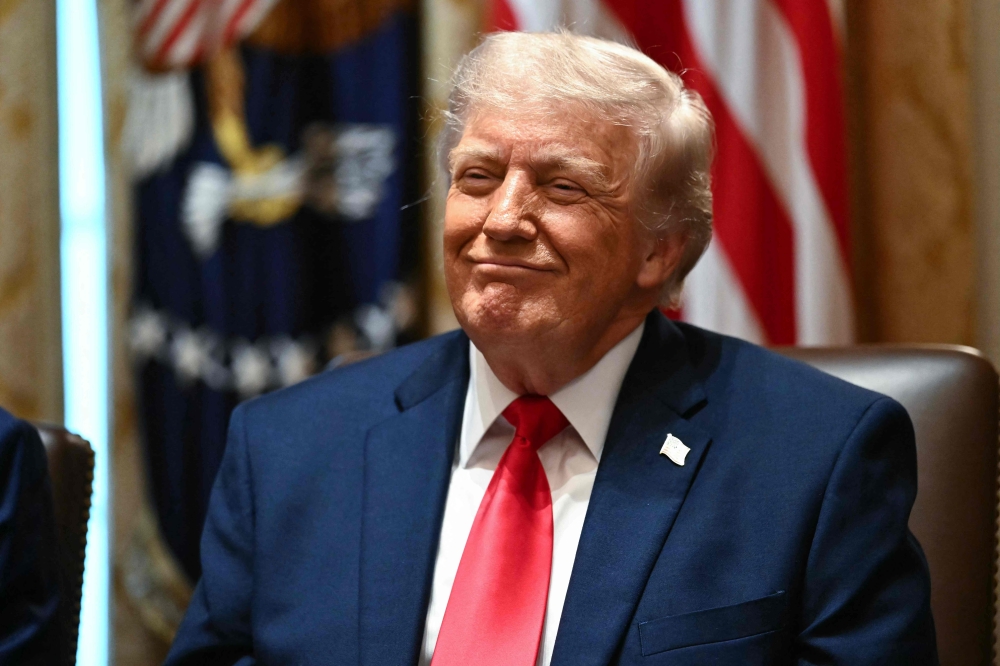
“Looks like by April, you know, in theory, when it gets a little warmer, it miraculously goes away.” That’s what President Donald Trump said about the Covid-19 outbreak on February 10, 2020, about a month before it forced our country and the world into a lengthy lockdown.
Why do I recall that today? Because when I think back on the biggest disaster stories I have covered — including 9/11 and Covid-19 — I am struck that they have one big thing in common: a failure of imagination. Sure, government experts prepared for these events in theory, but in practice how many of them imagined that suicidal terrorists would fly commercial airliners into the World Trade Center and the Pentagon? And how many imagined that a respiratory virus that emerged in Wuhan, China, would kill millions of people and drag down the world economy for years? So today, when it comes to the possibility that artificial intelligence, which is falling into the hands of rogue actors and is beginning to manifest a will of its own, could become incredibly destabilising, my imagination is fully engaged.
Here is what my imagination is telling me. It is telling me that the big AI companies in America and China are not being candid with us about how little even they understand the power and reach of the models they have developed, like sorcerers, in their labs. It is telling me that the Trump administration, headed by a man who so often governs by social media post, is uniquely unsuited to the kind of comprehensive, sustained, coordinated governance that keeping AI safe demands. And it is telling me that there is so much at stake — economically, militarily and technologically — and so little trust between Washington and Beijing that it would take a miracle for the United States and China to agree on the kind of deep collaboration needed to defuse the most nightmarish threats posed by AI.
It is still not too late, though, for radical rethinking before something very bad happens that forces all the key players to do things they never imagined, things they will have to do in the middle of a full-blown AI-driven crisis. I’d rather be remembered as the boy who cried wolf when the wolf never came than as someone who got eaten by it.
So here goes: “Wolf, wolf, wolf, wolf.” I will stand down when I see the United States and China start to address the immediate threat by teaming up to defend critical infrastructure — water systems, power grids, the Internet — in their own countries and around the world.
But I will breathe a sigh of relief only when I see Washington and Beijing put their heads together with their respective AI companies to draw up a long-term plan for how they can continue to compete on AI technologies, while simultaneously agreeing on internal AI guardrails to prevent increasingly capable AI systems from, on their own, creating catastrophic cybersecurity, biological, nuclear or financial risks. This is a geopolitical, geoeconomic and technological challenge no generation of American and Chinese statesmen has ever before faced. They dodge it at their, and our, peril.
Anyone who tells you we can’t afford regulation now because it might slow down innovation is missing three things.
First, those who contend that regulation is, by definition, innovation-destroying and market-destroying are “just ignorant of history,” said Eric Beinhocker, executive director of the Institute for New Economic Thinking at the University of Oxford’s Martin School. “Good regulations create trust, and trust grows markets. How do you think the airline industry or the pharmaceutical industry grew so big, so fast? Because government regulations created trust among consumers that the planes they fly and the medicines they take are safe.” Second, AI is not just a technology but also, as the computer scientist Craig Mundie has been saying, “a new species.” And like a new species, it is already exhibiting evolutionary properties.
“We’ve unleashed Darwin in silicon,” Beinhocker explained. The latest AI models have demonstrated a capacity for “self-improvement, self-replication and self-preservation. When you put those three things together, and their evolution happens at silicon speed, not human speed, you’ve got something extremely powerful, potentially dangerous and impossible to control.” This becomes even more true as we begin to give our AI systems bodies in the form of robots, drones and vehicles. We must ensure that there is always a human in the loop — that they are never fully autonomous — until we can guarantee these systems will always operate in line with human well-being, Beinhocker added.
Third, our president now runs the country the way he is said to have run the Trump Organization, which had to deal with multiple bankruptcies: There is virtually no regular policy process, interagency collaboration is weak, and on most days everyone in the administration just sits around waiting to see what the president posts on social media — often based on the last person he spoke to or something he heard on Fox News — and then tries to frame policies around it. (Thank goodness that at least Bessent, sources tell me, has done a deep dive into AI issues and has been talking to the Chinese. But whether he can herd the cats in this administration on this issue remains to be seen.) My New York Times colleagues recently reported that sources close to Trump made clear that his dismissal of fears that AI could lead to mass extinction as a “hoax” is driven not by any technological assessment. It is said to be driven, they reported, by his fear that “if the artificial intelligence boom fuelling the American economy slows down, the market could crash and recession could quickly follow.” That kind of thinking is begging for trouble. Trump should be thinking about another president. Dwight D. Eisenhower famously said, “Plans are worthless, but planning is everything.” What he meant was that no fixed plan can survive all the unanticipated stuff that happens once a war or crisis starts to unfold. But if you’ve gone through a rigorous planning process — familiarised yourself with the depth of the problem and the kinds of things that could go haywire and built trust within your team — you greatly improve your ability to adapt on the fly.
That is precisely what was missing in the run-up to Trump’s war with Iran, and we are paying a huge price for that today. Imagine what could happen if AI agents — a thousand times cleverer and more dangerous than Tehran or Trump — go off the rails.
Oman Observer is now on the WhatsApp channel. Click here