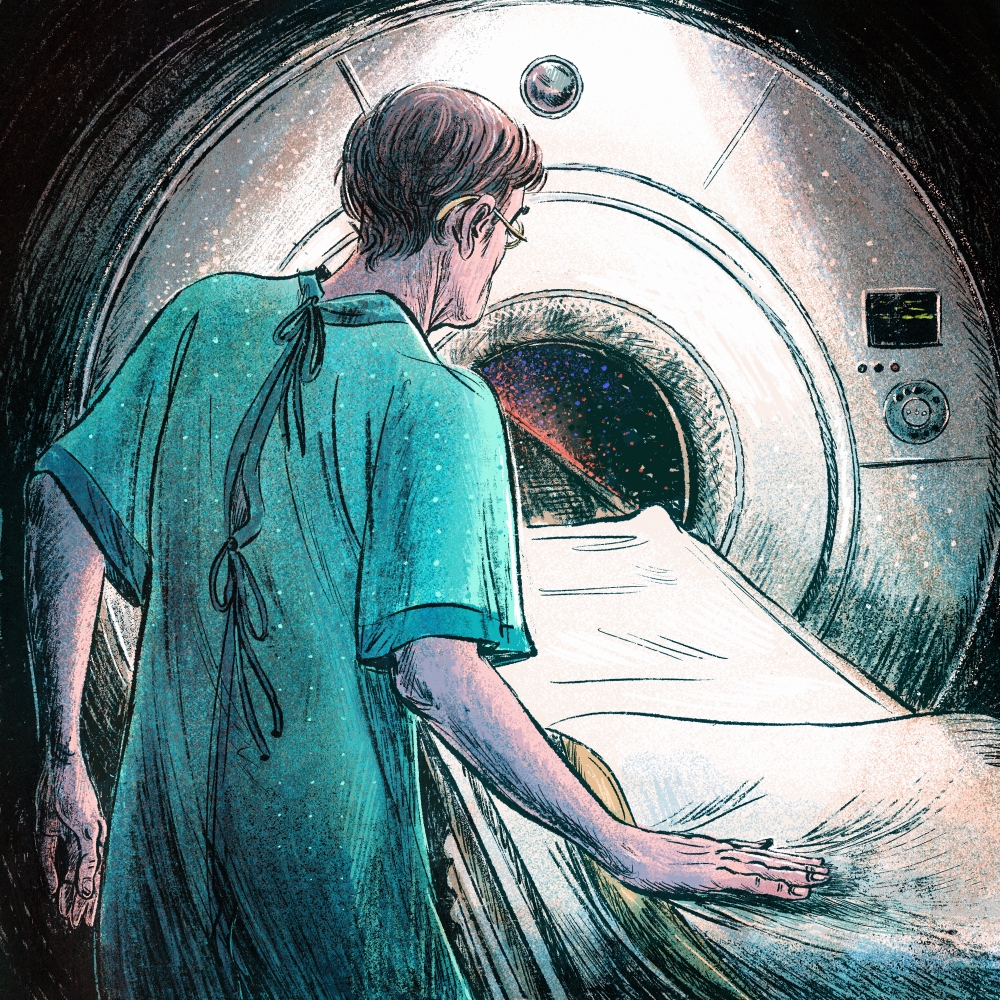





NEW YORK — I closed my eyes as the MRI scanner slowly encased me. I had reached a point that I had been dreading, yet one that had become inevitable after my younger brother died of pancreatic cancer in April 2023.
He would be the first. About 16 months later, an older brother died of the disease. And 18 months after that, a third brother, also older, suffered the same fate.
With three siblings dying of the same cancer — a family history that one doctor called extraordinary — getting tested seemed essential.
Yet I kept dragging my feet, in part because it was less painful to ignore the danger. Over time I would put aside my reluctance, encouraged by my wife and something one of my brothers said shortly before he died. “Don’t get sick,” he told me.
Pancreatic cancer is among the worst of the worst. It’s hard to detect and by the time the disease is found, a quick and painful death seems the likely outcome. Only recently have treatment advances given patients some hope for extending their lives.
In the United States, pancreatic cancer is the third-leading cause of cancer-related deaths, after lung cancer and colorectal cancers. The American Cancer Society estimates about 67,530 Americans will be diagnosed with it this year, and about 52,740 will die from it.
As a family, we were aware of the dangers of cancer. Our father died of colon and lung cancer in the early 1970s. One brother survived colon cancer in the 1990s, and another beat both skin and throat cancer.
The colon cancer diagnosis prompted us to begin routine screening, and my brother’s skin cancer got me to a dermatologist, who removed a cancerous growth near my lip.
We were a family of seven boys, raised in Elgin, Nebraska, a town of about 900 that’s 2 1/2 hours northwest of Omaha, on the edge of the Nebraska Sandhills. Our father spent most of his life working at the grain elevator; our mother cooked and cleaned — the post office, the bowling alley. She eventually took a job at a hospital in nearby Neligh.
Of the brothers, I was No. 6. My older brothers — Bob, Larry, Jim, Bill and Ron — all joined the Navy. Bill made the rank of commander. Larry made captain, and died in the Pentagon on Sept. 11.
Darrell, the youngest, and I would take different paths. I spent 47 years covering the news, before retiring this year from The New York Times. Darrell stayed close to home and eventually took a job building subway cars for Kawasaki.
Before I found myself having the MRI, I started with a genetic test.
My doctor, Dr. Michael Murray, the clinical director for the Institute for Genomic Health at Mount Sinai Health System, cast a wide net for the genes he examined, in part to possibly explain my family history.
The tests found no indication of a genetic relationship to pancreatic cancer. One gene had an alteration, but its effect isn’t yet understood, so it wasn’t considered a risk by today’s guidelines.
This certainly seemed like good news, and it brought me a moment of optimism.
But Murray cautioned that the lack of a clear genetic result did not mean the cancer wasn’t familial. Instead, it pointed to the need for more medical tests.
As he explained, my parents were both dead, so they couldn’t be tested, and my brothers’ results weren’t available or weren’t comparable.
“One of the things we really don’t want people to come away with is that a negative result rules out your hereditary cancer risk,” said Danielle Hoffman, the genetic counselor who reviewed my results.
Next up was the MRI, part of a monitoring regimen initiated by Dr. Aimee Lucas, chief of gastroenterology and hepatology at Mount Sinai Morningside and Mount Sinai West Hospitals. Her expertise includes early detection in patients like myself, with a family history of the cancer.
I was relieved when they pulled me out of the scanner after some 40 minutes, and not just because my nose itched and my left arm was falling asleep. Later I had a jolt of panic when the scan revealed a benign lesion on my pancreas, a finding that Lucas said was not unusual in families like mine.
The plan going forward, Lucas said, would be to monitor the pancreas closely. In a few months, I will have an endoscopic ultrasound, which examines the pancreas and other organs from the inside.
Each of my three brothers fought the disease differently.
Darrell, who died at 62, learned of his cancer after it had spread beyond the pancreas. Working two jobs, he had little time for monitoring his health.
Chemotherapy served to extend his life by a few months. With each report that the cancer was spreading, his hope drained away. He gathered with family on Easter Sunday and died the next day, in April 2023.
Jim, 77, handled his diagnosis with the same dignity he showed throughout his life. Darrell’s death had been hard — Jim had been a surrogate father to him after Dad died, when Darrell was 13. Already dealing with Alzheimer’s, Jim chose to bypass any treatments.
He died peacefully at home with his wife and two daughters around him, in August 2024.
Bill, 74, and the last to die, battled the hardest; he was sure that he could beat cancer with the same tenacity that had propelled him for 30 years in the Navy.
He had surgery to remove cancerous tumors from his pancreas and endured round after round of radiation and chemotherapy. He died at home about 10 days after entering hospice, in February.
Watching my brothers suffer was hard, even from a distance. I found myself anxiously waiting for test results, searching for any hint of good news, only to come away with a sense of dread.
Since their deaths, advances in treatment have created reasons for some optimism.
Two recent developments have the potential to be game changers, said Dr. Anna Berkenblit, chief scientific and medical officer of the Pancreatic Cancer Action Network.
One treatment, daraxonrasib, which just received approval from the Food and Drug Administration, doubled life expectancy in a clinical trial of patients who had previously been treated with chemotherapy for metastatic pancreatic cancer, giving them more than 13 months to live, compared to fewer than seven months for those who received chemotherapy.
The other new treatment involves a vaccine using mRNA technology in patients with pancreatic cancer who had their tumors removed, but were at high risk of the cancer coming back.
“It does feel that there is more momentum in targeting all aspects of pancreatic cancer,” Lucas said.
But, she added, because pancreatic cancer patients are often diagnosed when the disease is well advanced, there are fewer long-term survivors who can help raise awareness of the disease.
Complicating detection is the fact that, in most cases, pancreatic cancer doesn’t manifest itself before age 50, Lucas said, so testing before then isn’t usually recommended and has the potential to do more harm than good. A patient might come away with a false sense of security.
My test results, and the confidence exuded by Lucas, have helped shift my attitude a bit; no longer do I see the disease as an inevitability.
The doctors also drove home a point: Stick with the monitoring program. Together the tests will provide a more complete picture.
The testing also reinforced a practice I’ve always tried to follow, to know my body and watch for small but unexplained changes. Subtle shifts starting two to three years before diagnosis can be clues to pancreatic disease, Lucas reminded me, like changes in blood glucose or unexplained weight loss.
Since I live in New York and my family lives in Nebraska, I found myself making trips home during my brothers’ illnesses.
At times, I felt like the Grim Reaper, appearing just before death comes to the door. I went home to visit Darrell and he died about a week later. I went home to spend time with Jim and watched, and prayed, as he died. About two weeks after visiting Bill, we were at his funeral.
Two of us remain: me and Ron, who is 71. He’s retired and spends much of his day working in his oversized garden outside Lincoln.
You start to wonder who will be the last Getzfred standing.
I can still hear Bill urging me not to get sick.
I’m trying not to disappoint.
This article originally appeared in The New York Times.
Oman Observer is now on the WhatsApp channel. Click here