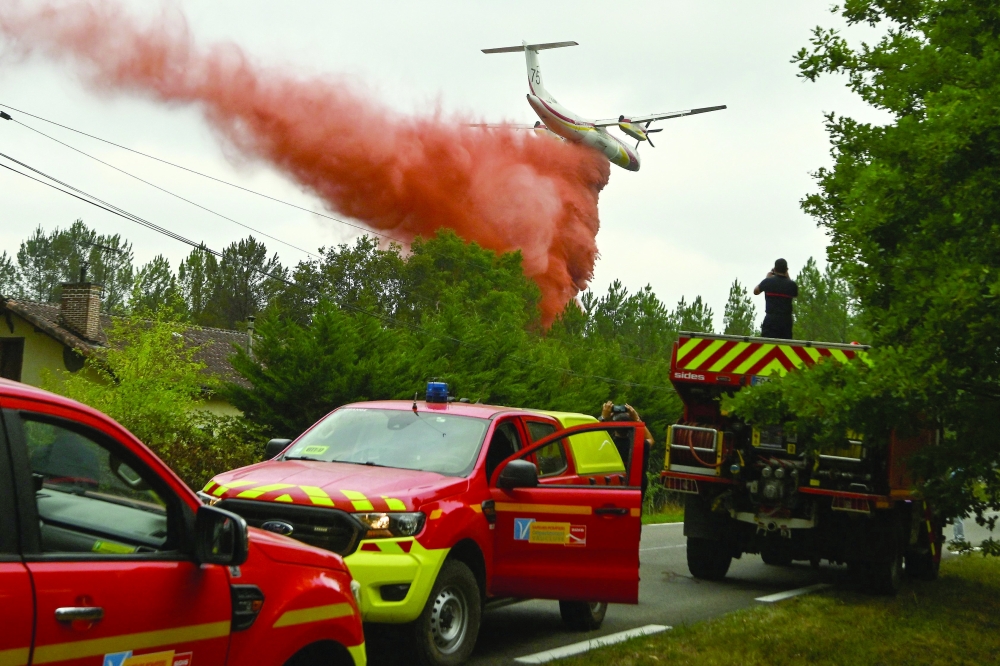





BRUSSELS: The European Union deployed three helicopters and two water bomber aircraft to tackle a wildfire raging in eastern Belgium on Saturday, the bloc's crisis commissioner said, after Belgium requested emergency reinforcements to control its biggest blaze in decades. The wildfire in the High Fens, Belgium's largest nature reserve, has been burning since Friday, with local firefighters, farmers and the army deployed to battle the blaze. By early Saturday afternoon, it had burned 1,600 hectares, local media reported, citing statistics from the governor of Liege, the local province. That would make the fire the biggest on record in Belgium, surpassing a blaze in 2011 which burned nearly 1,400 hectares, data from the European Forest Fire Information System showed.
European countries including Belgium suffered their fifth heatwave of the summer this week, fuelling the hot and dry conditions that support wildfires. Scientists have confirmed human-caused climate change is increasing the "fire-prone" weather conditions that allow wildfires to spread faster and burn longer. The EU coordinates the deployment of extra resources pooled from European countries, when a country requests emergency help.
The aircraft sent to Belgium on Saturday were from the Czech Republic, Sweden and the Netherlands, EU Crisis Commissioner Hadja Lahbib said in a post on X. Firefighters and farmers were pumping water from local lakes to battle the blaze, a spokesperson for the infrastructure department for the region of Wallonia said on Saturday.
Meanwhile, water levels on the Rhine river fell to record lows overnight as a heatwave across Europe continued, data from Germany's inland navigation agency WSV showed on Saturday, meaning most transport was shifted to trucks and trains. WSV data showed the water level gauge at the chokepoint of Kaub near Koblenz fell to 6 centimetres late on Friday and was 8 cm early on Saturday. WSV data had shown 10 cm for Kaub early on Friday, which was also below the previous record level of 25 cm recorded in 2018.
The river is about 1 metre deeper than the gauge, which has been traditionally used as an indicator to measure local levels. Kaub levels were last above the 78 cm level in mid-July. As a rule of thumb, if the water level gauge at Kaub falls below 78 centimetres for 30 straight days, as was the case in 2022 and 2018, industrial production falls by 1%, according to the Kiel Institute for the World Economy.
The Rhine is one of Europe's most important transport arteries, needed to ship chemicals, commodities, fuel and other goods. German companies have started to report disruption from low Rhine water levels. Chemical producers, utilities, steelmakers and agricultural traders have warned of higher costs, transport bottlenecks and reduced production.
Separately, wildfires in England and Wales have hit a record level, fire chiefs said on Friday, warning that rescue services were battling to keep up with rising risks a day after fires raced from tinder-dry fields to engulf houses on the hottest day of the year. Britain has not faced anything like the devastation wrought across Spain, France and elsewhere in Europe this year, but as the country endures the fifth heatwave of what is expected to be its hottest summerever, it is dealing with more outbreaks of fire than ever before.
Phil Garrigan, chair of the National Fire Chiefs Council, said the number of wildfires had now exceeded last year's total of 1,017. "We've well surpassed the figures from the previous high of 2025," Garrigan said, without detailing this year's latest figure. "We're only in the middle of August, and the wildfire season seems to extend way into November at this moment in time. So, we're anticipating this being not just a record-breaking year, but a considerable increase on the number of wildfires previously experienced."
Prime Minister Andy Burnham urged the public to take extra care during a visit to the town of Stourbridge in central England, one of several locations where on Thursday homes were destroyed and hundreds of people were evacuated. "Britain is a tinderbox right now," he warned. "This is not over by any means. We've got 37 fires smouldering around the country." Burnham said fire services were working alongside the military in some areas and that he would hold a summit with emergency services to make sure they had the resources they needed. — Reuters
Oman Observer is now on the WhatsApp channel. Click here