




SALALAH: Port of Salalah reduced the energy used for each unit of container traffic by 12.7 per cent in 2025 while cargo volumes grew sharply, linking operational efficiency at one of the world’s leading terminals with reporting under the Muscat Stock Exchange (MSX) sustainability framework.
The port handled 4.3 million twenty-foot equivalent units during the year, an increase of 31 per cent, while general cargo volumes rose 17 per cent to 26.4 million tonnes. It was also ranked third worldwide in the World Bank and S&P Global Market Intelligence’s Container Port Performance Index 2025, which measures the time container vessels spend in port.
Energy intensity fell to 9.05 kilowatt-hours per TEU from 10.37 kWh a year earlier, according to the port’s Sustainability Report 2025. Total electricity consumption increased 11.1 per cent to 47.24 million kWh as terminal capacity, equipment use and operating hours expanded, meaning throughput grew faster than power demand.
The port used 4.28 million litres of biodiesel, equivalent to 23.2 per cent of its liquid-fuel consumption and said 70 per cent of terminal lighting had been converted to LED technology.
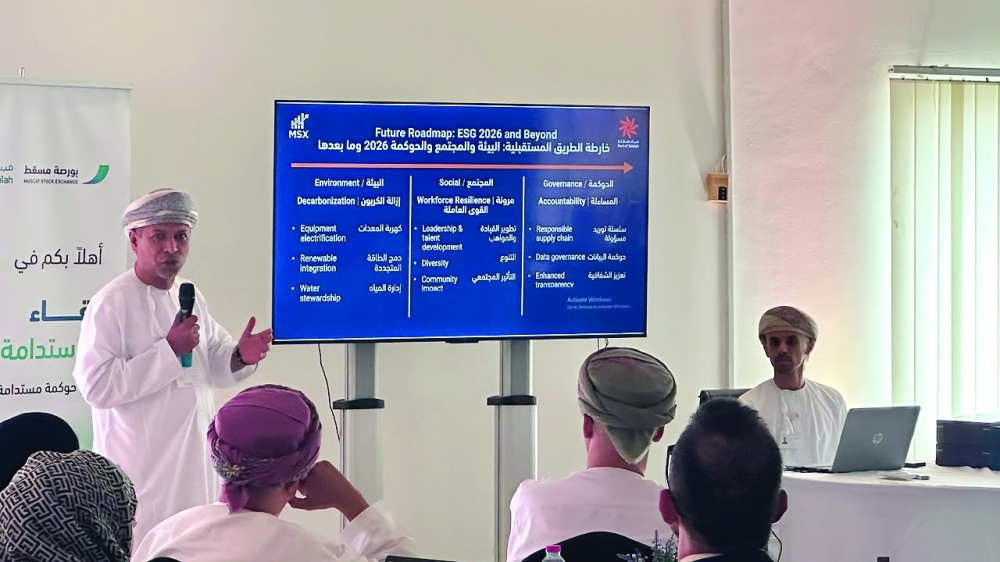
Abdul Fattah al Amri, Sustainability Manager at Port of Salalah, presented the company’s experience at the Sustainability Forum 2026, organised by the Muscat Stock Exchange and hosted by the port on Thursday.
Al Amri said the port used the 2024 voluntary reporting phase to test its measurement and disclosure processes before reporting became compulsory. Environmental, social and governance indicators were then integrated into the company’s wider strategy, aligned with Oman Vision 2040, the United Nations Sustainable Development Goals and Global Reporting Initiative standards.
“We treat sustainability as an enabler, not merely as a report at the end of the year”, he said.
The figures illustrate MSX’s effort to move sustainability reporting beyond year-end compliance by linking non-financial indicators with operating performance. Listed companies report against 30 environmental, social and governance metrics intended to make risks more visible and performance more comparable for investors.
Port of Salalah has set a net-zero operational target for 2040. Its next phase includes electrifying cargo-handling equipment, increasing renewable electricity, developing on-site solar generation, improving water management and preparing shore-power infrastructure for vessels at berth.
The measures have relevance beyond Oman. Ports sit at the intersection of maritime trade, landside logistics and national power systems, giving terminal operators a practical role in lowering the carbon footprint of global supply chains even though most shipping emissions originate from vessels.
Expansion nevertheless raised the port’s combined Scope 1 and Scope 2 emissions to 52.69 million kilogrammes of carbon dioxide in 2025 from 50.36 million kilogrammes a year earlier, a 4.6 per cent increase. The next test is therefore to convert the efficiency gain into a sustained reduction in total emissions as volumes continue to grow.
The port says it aims to reduce absolute emissions by 70 per cent over the 2020–2030 period without relying on carbon offsets. The report does not place the corresponding 2020 baseline alongside the latest figures, however, making a consistent baseline an important requirement for tracking progress towards that interim goal.
The 2040 operational target is separate from the International Maritime Organisation’s ambition for international shipping to reach net-zero greenhouse-gas emissions by or around 2050. Electrified equipment, renewable power and shore connections can still help reduce emissions generated while ships and cargo are in port.
For investors, Salalah’s results show the value of MSX disclosure when it connects sustainability indicators with throughput, energy demand and capital planning. For the port, they provide a measurable foundation for maintaining growth while progressively lowering its environmental impact.
Oman Observer is now on the WhatsApp channel. Click here