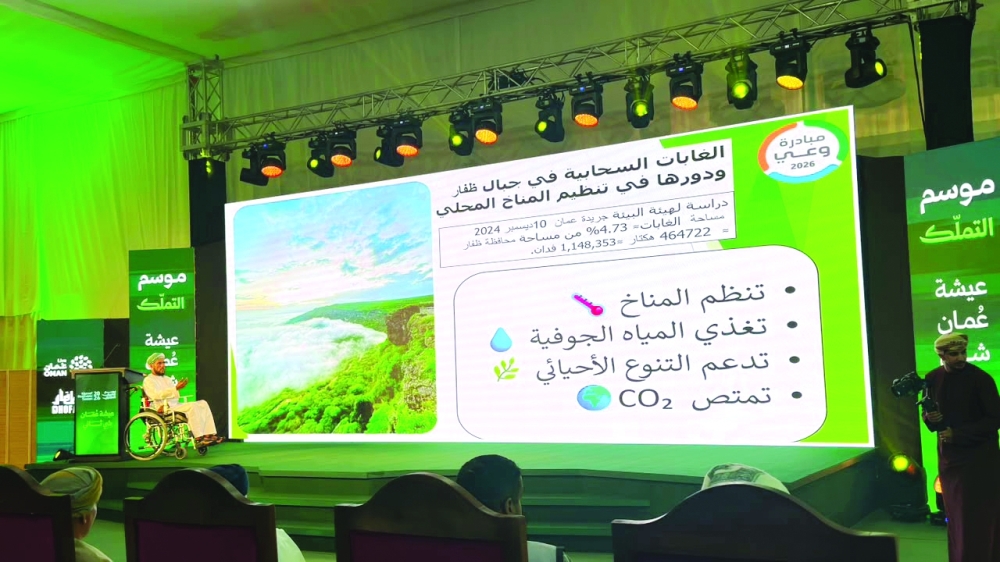





SALALAH: The cloud forests on the seaward slopes of the Dhofar Mountains do more than create the lush landscape associated with khareef. Research shows that these forests enhance groundwater recharge across the mountain range by about 20 per cent compared with estimates based only on rainfall.
As moisture-laden clouds move in from the Arabian Sea, fine droplets settle on leaves, branches and tree trunks before dripping through the canopy or flowing down bark to the soil. Known as fog interception, this process allows forests to capture water that arrives horizontally rather than through rainfall.
The phenomenon is particularly significant because the Dhofar Mountains serve as the main recharge zone for the groundwater resources supporting the Salalah coastal plain, home to much of the governorate’s population, agriculture and industry.
The 20 per cent estimate comes from a 2018 study published in the Journal of Hydrology: Regional Studies by researchers from Germany’s Helmholtz Centre for Environmental Research. The study recorded recharge-to-precipitation ratios of up to 24 per cent beneath heavily forested areas, a notable figure for a semi-arid region.
Not all intercepted moisture reaches underground reserves, as some is absorbed by vegetation, retained in soil or lost through evaporation. However, the forest canopy plays a crucial role in increasing the amount of water reaching the ground and influencing how it moves through the landscape.
Eng Ali bin Mohammed Rafeet, a member of the nature conservation initiative in Dhofar Governorate, said the forests should be viewed as essential natural infrastructure rather than merely seasonal attractions.
“The value of these forests cannot be measured only by counting trees or assessing the beauty of the landscape. Their services include moisture collection, soil protection, biodiversity, grazing and support for the tourism economy,” he said.

Studies using satellite imagery have presented varying assessments of forest conditions. A 2020 analysis of three decades of Landsat data found no significant decline across most of the mountain range, while earlier research covering 1988 to 2013 reported degradation in some areas, with grazing identified as a possible factor.
According to Rafeet, the greater long-term concern may be the inability of young trees and seedlings to regenerate.
“The greater danger may not be the immediate disappearance of mature trees, but the failure of the next generation to survive,” he said.
Research from Jabal Al Qamar in western Dhofar has linked intensive grazing by camels, cattle and goats to reduced plant density and biodiversity, with young vegetation particularly vulnerable.
Rafeet stressed that the solution is not a complete ban on grazing but better management based on the ecological sensitivity and carrying capacity of individual areas.
Other pressures include vehicles damaging wet terrain, infrastructure development, fires, invasive species and concentrated visitor activity. He said conservation should focus on controlled access and designated routes rather than restricting public enjoyment of the mountains.
The growing discussion around natural-capital accounting highlights the need to recognise the economic value of ecosystem services, including water security, erosion control, biodiversity conservation, carbon storage and tourism.
“Protecting the cloud forest is not only an environmental responsibility. It is an investment in water security, tourism, livestock resources and the long-term resilience of Dhofar’s economy,” Rafeet said.
For decades, khareef has been measured through visitor numbers, rainfall and tourism indicators. The next important measure may be understanding how much water these forests capture from the clouds — and the cost of replacing a service nature currently provides for free.
Oman Observer is now on the WhatsApp channel. Click here