





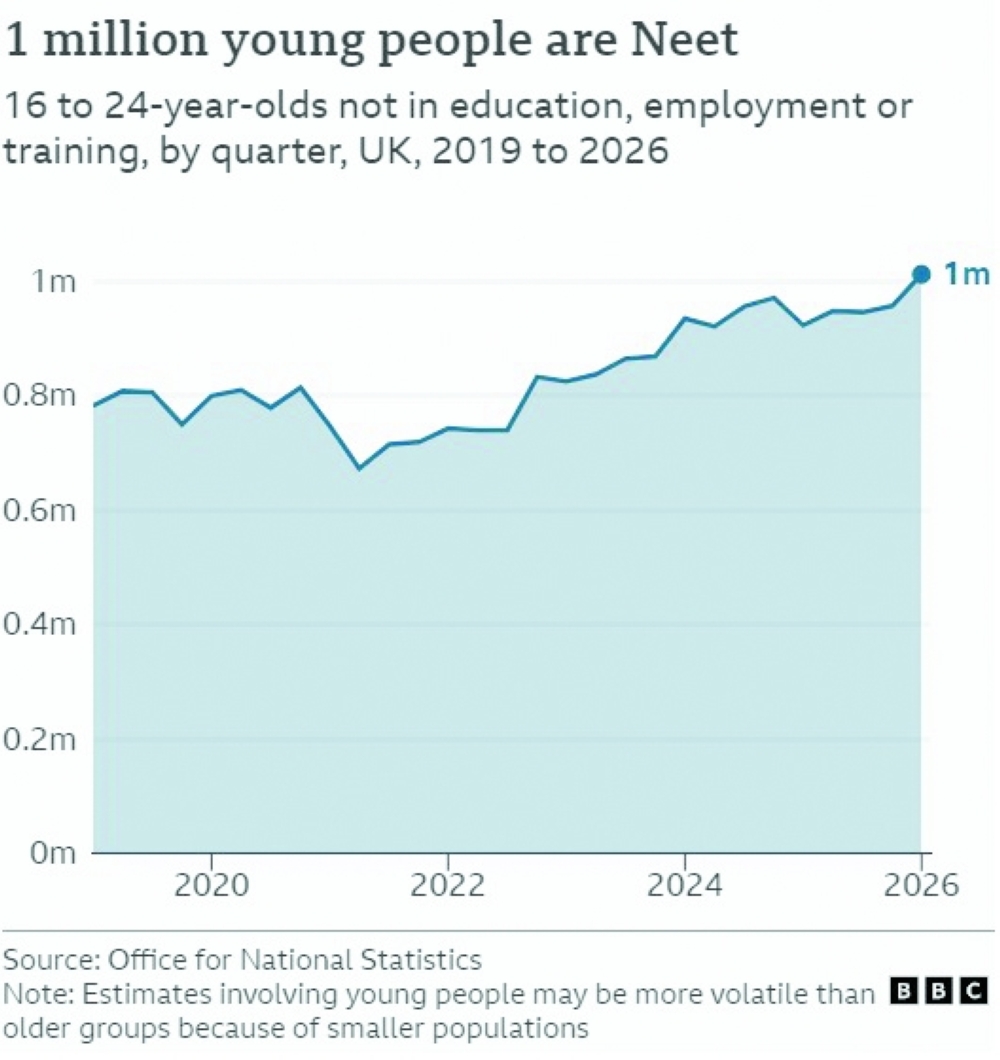
One in six young people in Britain may find themselves not in employment, education or training (NEETs) within five years, up from one in eight now, according to a new government-commissioned report that warns of a "lost generation". In recent decades Britain has had fairly low youth unemployment by European standards. But since the Covid-19 pandemic, the proportion of 16-24 year-olds outside the job market or education has risen to one of the highest in Europe. The number of NEETs reached its highest since late 2013 in the first quarter of this year at just over 1 million, or 13.5 per cent of the age group, up from 12.5 per cent a year earlier, new official figures on Thursday showed.
"Detachment is no longer temporary. For too many young people it is becoming permanent. We are at risk of a lost generation", said former health minister Alan Milburn, who led the report.
Speaking at a press conference, Milburn said the issue was "probably the most significant challenge facing our country today" and public concern about the issue was the most visceral of any topic he had dealt with in his career.
Prime Minister Keir Starmer's government is struggling in opinion polls — with Starmer's own future under threat from party rivals — and cost of living pressures have pushed the economy to the top of voters' concerns.
Milburn's report blamed the welfare system for "exacerbating inactivity". But it also highlighted a sharp drop in the number of low- and medium-skilled entry-level jobs — including part-time Saturday jobs for schoolchildren — despite buoyancy in the broader labour market for much of the past decade.
Six in 10 NEETs have never had a job, up from four in 10 two decades ago. Over 70 per cent lack good school grades — though 15 per cent have a university degree — and 44 per cent say poor health limits their ability to work, up from 26 per cent 10 years ago, driven by a rise in mental health problems, learning difficulties and neurodiversity.
While the direct cost of NEETs in terms of welfare benefits is £3.2 billion a year, getting them all into full-time work would boost the economy by £38 billion while the annual cost of foregone growth could be as high as £125 billion if it marked the start of a lifetime of joblessness.
Milburn, who served in a Labour government led by Prime Minister Tony Blair, plans to set out detailed policy proposals later this year.
Work and pensions minister Pat McFadden said the report showed "the scale of the challenge and the root causes of youth unemployment we now need to confront".
While 84 per cent of NEETs wanted a job or training, only £1 was spent on employment support for every £25 in welfare payments for that age group, the report said.
Work experience opportunities have narrowed or vanished and entry-level roles are more demanding than in the past, it added.
British governments have sought to expand apprenticeships, which play a much smaller role than in countries such as Germany or the Netherlands.
The chief executive of retailer Marks & Spencer, Stuart Machin, said the report's findings were "shocking but not surprising" and matched the concerns of his staff and customers.
Many employers blame higher employment costs including a minimum wage which has risen sharply as successive governments sought to lift it to two thirds of median earnings, with the biggest rises for younger workers.
"When the cost of entry-level labour rises, the case for taking on someone inexperienced becomes harder unless employers are given support to offset the risk", the report said.
However, the report said there was a lack of clear evidence of overall harm to employment from the higher minimum wage and that the root causes of high NEET levels were much longer-term.
Milburn said policymakers needed to avoid measures that might exacerbate these but dismissed the idea that the main cause was the higher minimum wage or other increases to tax and regulation since Labour came to power in 2024.
"Let's not pretend that's the root cause of the problem", he said. — Reuters
Oman Observer is now on the WhatsApp channel. Click here