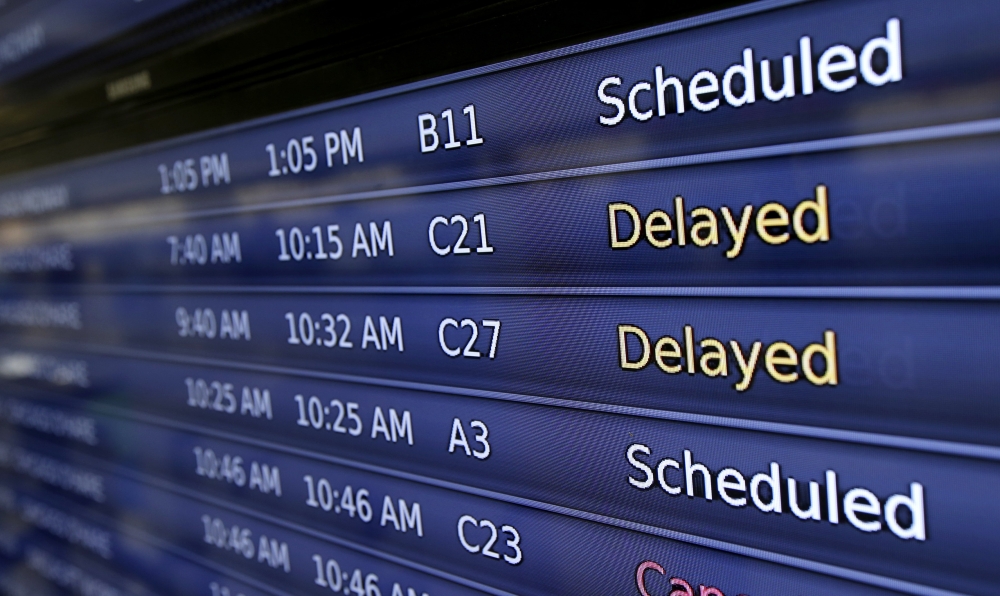





Muscat: The ongoing conflict in the Gulf involving the United States, Israel, and Iran has disrupted air travel like never before due to surging aviation fuel prices and the possibility of airspace closures.
Speaking to the Observer, Monica Eaton, Founder and CEO, Chargebacks911, said, "The conditions for widespread last-minute cancellations are already in place. Airlines across Europe and the US have cut around 13,000 flights from May schedules alone, and the fuel supply situation has not stabilised. Spirit Airlines in the US has wound down entirely, cancelling all remaining flights. Lufthansa has cancelled approximately 20,000 flights.
Turkish Airlines, KLM, and others have suspended routes. As we head into the summer peak, passengers who have already booked are right to be asking what their options are if their flight is cancelled at short notice."She added, "The short answer is that consumers do have protections. Under EU and UK regulations, passengers are entitled to a full cash refund for a cancelled flight. In the US, the Department of Transportation requires airlines to provide prompt refunds for cancellations.
"The challenge is that airlines under financial pressure are often slow to process those refunds, and that is exactly when consumers reach for their most powerful alternative: contacting their bank and filing a chargeback. We are going to see significant volumes of that this summer."
According to Eaton, "Hotels face this problem from two directions. On one side, guests whose flights have been cancelled will cancel their hotel bookings at short notice, often demanding full refunds regardless of the cancellation policy in place. On the other hand, guests who cannot get a satisfactory response from an airline will sometimes dispute their hotel charge as well, even where the hotel delivered everything it promised, simply because the overall trip did not happen.
"Both situations create chargeback risk for hotels that had nothing to do with the original disruption. The best protection for hotels is clear, documented communication with every guest - confirmation of what was booked, what the cancellation policy states, and what the hotel's response was when the guest made contact."A hotel that can show it communicated clearly and responded promptly is in a much stronger position to defend a chargeback than one that cannot produce that evidence trail.
For guests, the advice is equally straightforward: Contact the hotel directly before filing a chargeback. Most hotels would rather resolve a dispute directly than go through the chargeback process, which is costly and time-consuming for everyone involved.
She said, "Banks are technically equipped to handle chargeback requests. The process is well established, and the rules are clear. The question is whether they can handle a significant surge in volume without delays. If the summer disruption generates the kind of dispute spike we are anticipating, processing times at some banks and card issuers could extend, which means consumers may have to wait longer than usual for resolutions."Travel agencies and Online Travel Agencies (OTAs) are in a more complicated position. When a consumer books a flight through a third-party platform and that flight is cancelled, the OTA sits between the airline and the consumer, and the question of who owes the refund, and on what timeline, can become genuinely complicated.
Many OTAs have their own refund policies that differ from the airline's, and consumers are not always aware of that distinction until something goes wrong. The practical advice for consumers is to check directly whether they booked with the airline or with an intermediary, because that determines to whom their first call should be, according to Eaton.
Chargeback System
The chargeback system assigns clear roles, even if the experience for consumers does not always feel that way. When a consumer disputes a charge, their bank, the card issuer, is the first point of contact and the entity with the obligation to investigate. The bank then contacts the merchant's bank, which contacts the merchant and asks them to respond with evidence that the charge was valid.
In a travel dispute, the merchant is whoever took the payment. If the consumer paid the airline directly, the airline is the merchant.
If they paid an OTA, the OTA is the merchant. The hotel, car hire company, or tour operator is a separate merchant and is only drawn into the dispute if the consumer files a separate claim against each of them.
Ultimately, the card issuer is answerable to the consumer. It is the card issuer's obligation to investigate and reach a finding. But the merchant has the right to contest a chargeback they believe is unjustified. The system is designed to be fair to both sides, though in practice it favours consumers when merchants cannot produce adequate evidence.
That is why the quality of documentation at the point of transaction matters so much. What is the chargeback system, and how does it work?
A chargeback is essentially a transaction reversal initiated by a consumer's bank on the consumer's behalf. Here is how it works in simple steps.
A consumer purchases with a credit or debit card. Something goes wrong, for example, the flight is cancelled, the hotel does not deliver what was promised, the consumer does not recognise the charge, or they believe they were misled. The consumer contacts their bank and disputes the charge.
The bank reviews the claim and, if it appears valid, provisionally reverses the payment – the money goes back to the consumer while the investigation continues. The bank then notifies the merchant through the card network, Visa, Mastercard, or American Express, and allows the merchant to respond with evidence that the charge was legitimate.
If the merchant can prove the transaction was valid and properly fulfilled, they can win the dispute and recover the funds. If they cannot, the reversal stands, and the merchant absorbs the loss, plus a chargeback fee, which typically ranges from $20 to $100 per dispute.
The system exists to protect consumers from fraud and from merchants who do not deliver what they promise. It is a powerful consumer protection tool. The problem is that it is increasingly being used in situations where the consumer received exactly what they paid for but simply changed their mind, which the industry calls friendly fraud.
That misuse is costly for merchants, and it is a growing problem in travel precisely because the transactions are high-value and the disruption environment gives consumers a plausible reason to dispute charges that are actually legitimate.
Oman Observer is now on the WhatsApp channel. Click here