




MUSCAT: Oman has built one of the Gulf’s strongest digital and cybersecurity foundations, but it now faces a more difficult challenge: turning that infrastructure into a competitive artificial intelligence (AI) economy capable of generating jobs, attracting investment and reducing long-term dependence on hydrocarbons.
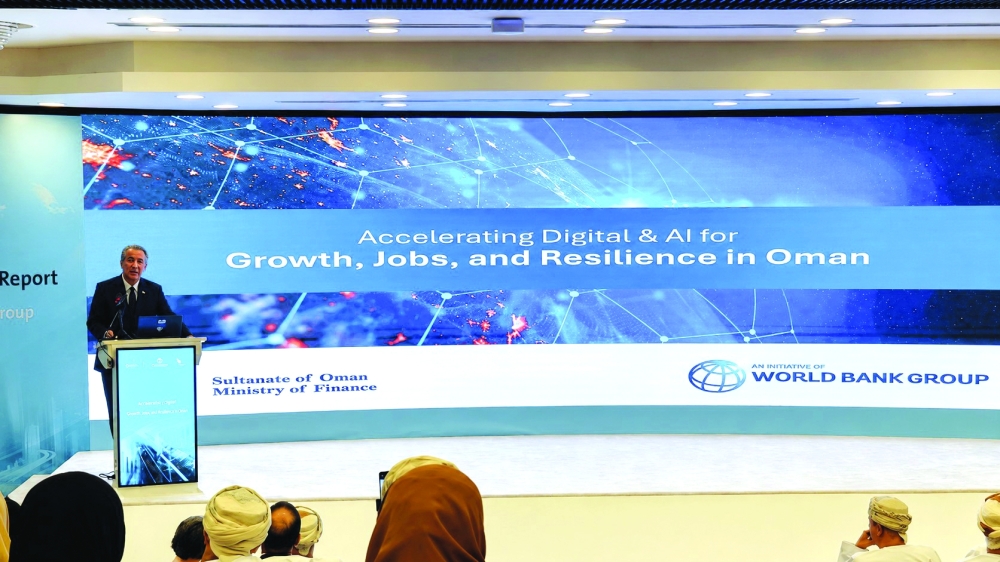
That was the central message delivered last Thursday by Zaki Badie Khoury, Senior Digital Specialist at the World Bank Group, during a presentation in Muscat examining digital transformation trends across the GCC and Oman’s readiness for the AI era.
Khoury said Oman had made major advances over the past decade in broadband connectivity, digital government services, regulation and cybersecurity, placing the country among the stronger performers regionally in institutional digital readiness.
“The picture is extremely positive when it comes to the foundation”, Khoury said. “We do have all the foundational elements that we can build on”.
The presentation showed Oman achieving near-universal 4G coverage and high levels of 5G deployment, while government digital services and cybersecurity capabilities have advanced significantly in recent years.
Khoury described Oman as one of the GCC’s more advanced countries in terms of regulatory and institutional frameworks supporting digital transformation.
“Oman is one of the most prominent when it comes to cybersecurity capabilities”, he said, describing it as an important safeguard for accelerating digital economic activity.
Yet despite that progress, the World Bank specialist warned that the next phase of economic competition in the Gulf would depend less on basic digital infrastructure and more on artificial intelligence capabilities, advanced skills, private-sector innovation and large-scale investment.
“Oman is still on the emerging side compared to the rest of the GCC when it comes to preparing the public sector and government to fully take advantage of AI”, Khoury said.
The presentation highlighted widening investment gaps between Oman and regional competitors such as the UAE and Saudi Arabia, which are aggressively expanding AI ecosystems, data centres and advanced digital industries as part of broader economic diversification strategies.
Khoury said Oman’s challenge now is not simply digitalisation, but converting digital infrastructure into measurable economic growth and employment.
“It’s time really to capitalise on this in order to transform them into more growth and jobs”, he said.
According to the presentation, Oman’s digital economy currently contributes between 2.4 and 2.8 per cent of GDP, well below Oman Vision 2040’s target of 10 per cent by the end of the strategy period.
The presentation argued that stronger AI adoption and digital investment could help Oman generate new non-oil growth sectors at a time when Gulf economies are seeking to reduce long-term hydrocarbon dependence.
Khoury noted that neighbouring countries are investing at significantly higher levels in AI and digital technologies, while Oman still has substantial room to increase investment and attract foreign direct investment into advanced technology sectors.
The presentation also identified Oman’s young population as one of its strongest long-term competitive advantages. Around 64 per cent of the population is under the age of 30, creating what Khoury described as significant potential for developing advanced digital and AI skills if linked to education reform and specialised training.
The World Bank specialist said progress had already been made through digital education initiatives, e-government reforms and early AI adoption efforts within some sectors.
However, he stressed that future success would depend heavily on execution speed and private-sector participation.
“The factor that will make Oman move into the era of AI is the agility in moving forwards”, he said.
One of the strongest messages in the presentation focused on data itself becoming a strategic economic asset.
Khoury identified the health, education and energy sectors as major sources of valuable national data that could support AI development, innovation and investment if made more accessible to the private sector.
“This type of data needs to be open for the private sector in order really to innovate more”, he said.
The presentation argued that stronger collaboration between government and business would be essential if Oman hopes to accelerate digital transformation beyond the public sector, where most GCC digital investment has traditionally been concentrated.
Khoury said even modest growth in the digital economy could have significant employment effects.
“Two per cent more contribution to GDP will allow us already to add 30,000 jobs to the market”, he said.
The presentation comes as Gulf countries intensify competition to position themselves as regional AI and technology hubs amidst a global race for digital infrastructure, cloud computing capacity, advanced semiconductor ecosystems and sovereign data capabilities.
Oman Observer is now on the WhatsApp channel. Click here