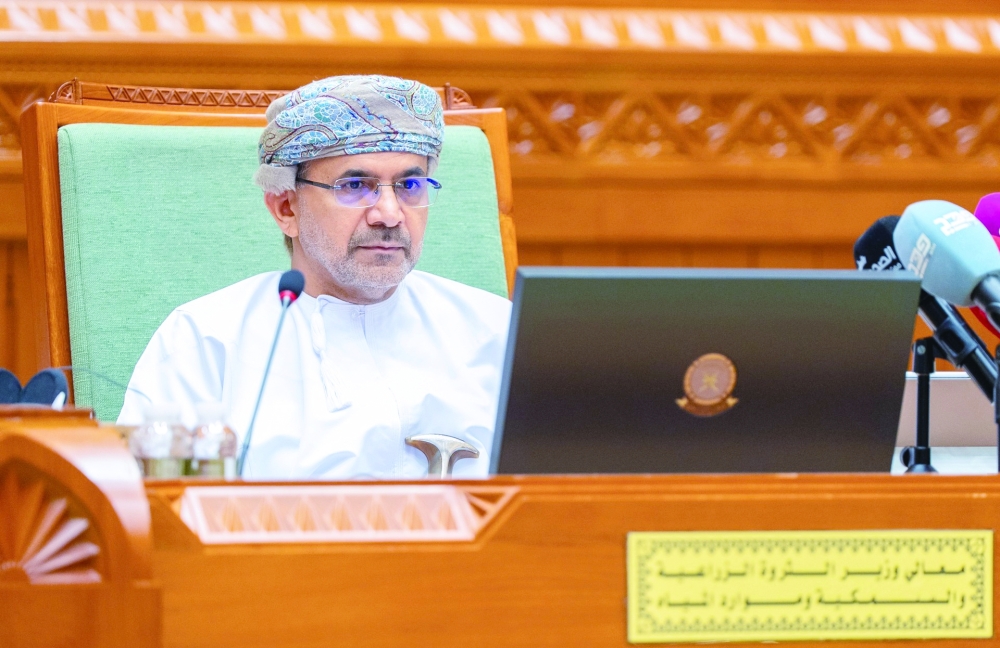





MUSCAT: The Majlis Ash'shura on Sunday hosted Dr Saud bin Hamoud al Habsi, Minister of Agriculture, Fisheries and Water Resources, during its regular session of the third annual sitting of the tenth term to discuss the ministry’s statement across several key axes related to strengthening Oman’s food and water security system, highlighting sector achievements, and outlining future strategic directions.
In his statement, the minister reviewed the performance of the agricultural, fisheries and water resources sectors during the Tenth Five‑Year Development Plan, the achievements and indicators realised, as well as the strategic directions, programmes and projects planned under the Eleventh Plan, in alignment with national targets.
Khalid bin Hilal al Maawali, Chairman of Majlis Ash'shura, said that the statement carries strategic significance given the pivotal role of the agriculture, fisheries and water resources sectors in supporting national development, strengthening food security and ensuring the sustainable management of natural resources for future generations.
Delivering his statement, the minister said agricultural and fisheries production increased from 4.3 million tonnes in 2020 to 5.6 million tonnes in 2025, while the sector’s contribution to gross domestic product (GDP) rose from RO 776 million to RO 1.132 billion, reflecting sustained growth in production and economic performance.
Food self-sufficiency reached 67.3 per cent, with self-sufficiency rates standing at 146 per cent in fish, 99 per cent in dates, 96 per cent in milk, 95 per cent in table eggs, and 79 per cent in vegetables, reinforcing Oman’s domestic food security base.
He also pointed to major advances in water infrastructure, including the establishment and operation of 85 groundwater recharge dams, 116 surface storage dams, and seven flood protection dams, supported by a national hydrometric monitoring network of 3,483 stations, including 672 remote-operated stations, alongside 14 cloud seeding stations aimed at improving long-term water sustainability.
In the fisheries sector, he noted that the sector is supported by more than 60,000 Omani fishermen, 119 fish processing factories, and 24 fish landing ports, reflecting the breadth of infrastructure supporting one of Oman’s key productive sectors.
On investments, the minister said 493 usufruct agreements valued at RO 1.870 billion were signed in support of food and water security sectors, while exports from food, fisheries and agricultural industries exceeded RO 1.2 billion in 2025.
The agricultural sector has extensive resources for expansion, the minister said. Cultivated land area stands at 312,000 acres, with more than 9.1 million palm trees. The livestock population is estimated at 4 million head, supported by 69 government veterinary clinics, 41 mobile clinics and a veterinary hospital.
He added that per capita water share reached 369 cubic metres, achieving 90 per cent of the target, while the wastewater treatment rate stood at 98 per cent. In employment, the sectors provided significant job opportunities. Omani workers in food security sectors stand at 51,283, those in technical and specialised positions 1,220, and self‑employed workers rose to 48,789, enhancing the sectors’ role in supporting the national labour market.
The minister said that under the Eleventh Five‑Year Plan, the ministry is moving into a new phase built on past achievements, focusing on maximising economic returns, raising the sectors’ contribution to GDP, expanding the investment base, creating jobs, developing strategic programmes for food security and sustainable resource management, accelerating technological transformation, and improving service quality through digital governance.
He also affirmed the vital role played by government companies, private sector enterprises and relevant associations as essential partners in supporting the food security system through investment, production, marketing and awareness‑raising. This reflects a participatory national approach that enhances the integration of roles and the achievement of goals. He expressed his gratitude to all partners from various government and private entities, associations, farmers, livestock breeders and fishermen who have contributed to strengthening the food security system in all its components.
During the discussion, the members of the Majlis Ash'shura called for clear timelines to achieve higher self-sufficiency in key commodities, stronger field inspection measures to safeguard food quality, wider use of scientific research to address sector challenges and greater attention to employment pathways linked to food security, fisheries and food processing sectors.
Oman Observer is now on the WhatsApp channel. Click here