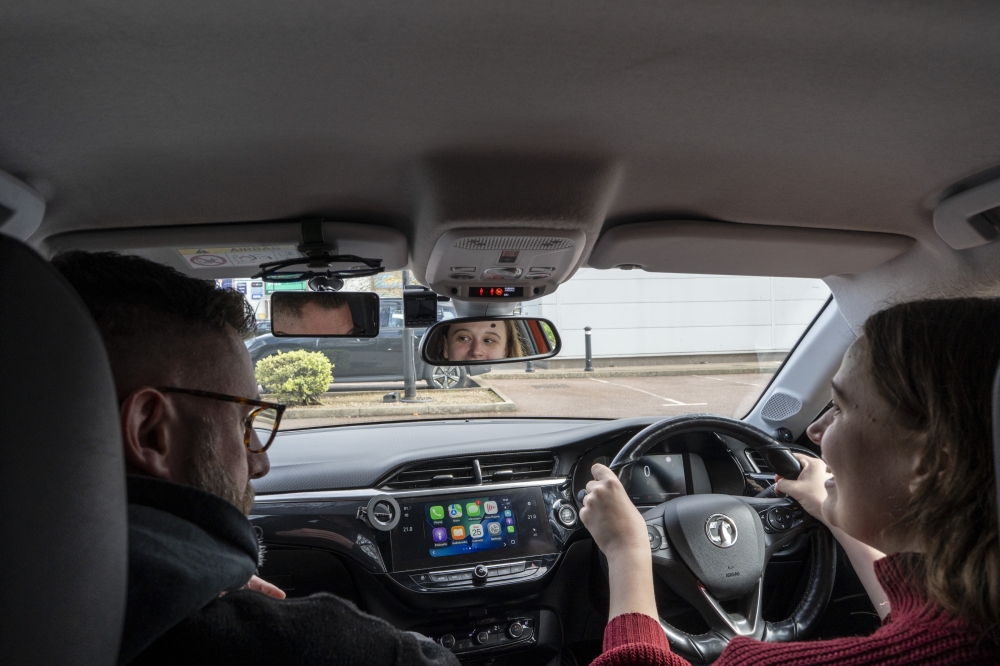





LONDON — Grace Reynolds eased the car smoothly away from traffic lights, overtook a stopped double-decker bus, then deftly navigated a street narrowed by vehicles parked on either side.
During her lesson in north London in March, Reynolds, 29, drove well enough to pass a test for her driver’s license, according to her instructor, Dean Batchelor, who was sitting alongside her.
Yet Reynolds is on edge, knowing that if she has a bad day and fails her practical test later this month (as she has once before), she will rejoin a backlog of tens of thousands of Britons who need to book a slot.
The likely wait time? Five to six months.
“It makes the test feel like it’s your absolute one chance,” said Reynolds, a mental health therapist for Britain’s National Health Service. “It’s the anxiety in the buildup to it, it feels like I’ve got to pass — otherwise Christmas will be probably the next time.”
The driving test, a rite of passage for young people around the world, has always carried a degree of stress, especially if you struggle with something the local test requires (parallel parking, say).
And driving testing and licensing agencies often take flak: In many states in the United States, the Department of Motor Vehicles is a perennial source of jokes over its reputation for long lines and complex paperwork. But in Britain today, the challenge starts months earlier as would-be drivers battle just to secure a date with an examiner.
The problem began in the pandemic, when lockdowns and social distancing meant more than 1 million tests did not take place. The ensuing backlog, plus a shortage of examiners and a creaking application process prone to abuse, has made simply booking an appointment a modern endurance test. Reynolds only managed to book hers after logging onto the system at 5:30 a.m. last November, 30 minutes before it opened.
“It’s easier to get Glastonbury tickets, I think,” joked Batchelor, referring to a British music festival that typically sells out within half an hour.
22 Weeks to Wait
In February 2020, the month before lockdowns were imposed in Britain, the average wait for a driving test was five weeks.
Today, the wait is 22 weeks in England and Scotland and almost 17 in Wales.
To understand why the 1.1 million tests missed during the pandemic had such an impact, there are a few things worth knowing about the British driving test. Most people still learn to drive manual, rather than automatic, cars (although the advent of electric vehicles is changing this). The test is meant to take 40 minutes, and it is normal for half of all candidates to fail.
Additional pressure comes from the fact that all learner drivers in Britain must first pass a separate, roughly hourlong theory test, following which they have two years to take the practical — or start the whole process again.
The logjam disproportionately affects young people. Some experts think the problem has festered because policymakers are based in London, which has extensive public transport, though the driving licensing agency is in another city. In rural Britain, a car can be a lifeline.
The pent-up demand after the pandemic led to some individuals exploiting the rickety 18-year-old online booking system to buy test slots and resell them at a premium. Some have been offered at eight times the official cost of 62 pounds (about $73).
Desperate would-be drivers have been grabbing what they can, with some paying to jump the line using third-party operators online. Some book tests before they start lessons. Others reserve appointments in cities hundreds of miles away, then either travel to an unfamiliar location for a test, or try to swap their appointments for canceled ones closer to home.
Foreigners living in Britain are affected, too. Drivers from the European Union and some other nations including Canada can trade their licenses for British ones. But many other nationalities — including Americans — must take a British test to keep driving after a year of residency.
Critics see the problem as evidence of a “broken Britain” — where basic services are failing, narrowing opportunities. Last year the government drafted in military test examiners to help tackle the problem.
Until recently, slots could be changed six times both in date and location. Under new rules introduced in March by the Driver and Vehicle Standards Agency, the government body overseeing tests, appointments can be booked only by learners, and changed only twice.
Previously, driving school businesses as well as individuals could book tests, as long as they entered a learner’s license details. If learners shared their information, bookings could be made without their knowledge. Test slots could then be swapped between drivers.
A report from the National Audit Office, an official watchdog, said that 880 “business accounts” were closed between January and September last year for breaking the rules.
‘You Are Told, “No, Nothing Available”’
Batchelor discourages his students from paying an unofficial broker — “a dodgy Dave,” as he puts it — to skip the line for a test.
“You’ve got to have some morals as a driving instructor,” he said. But he says he understands why some learners pay to jump the queue, worried that if they wait another six months they will lose their skills.
The Driving and Vehicle Standards Agency said in a statement that it had conducted more that 1.8 million tests in the year to March 2026 — almost 150,000 more than the previous year. “We know there’s still more to be done,” it said. “That’s why we’re making changes to the way driving tests are booked, making the process fairer and clamping down on businesses that resell tests at inflated prices.”
(BEGIN OPTIONAL TRIM.)
The agency said that in February 2026 it had 108 more examiners than the year before, and said that additional payments had helped retention.
They may not be enough, however. Batchelor said he once looked into becoming an examiner but stopped when he saw the detail.
“You could probably make more money being a barista,” he said, referring to the salary. It is now higher than when Batchelor investigated, but is advertised at just over 28,000 pounds (about $38,000), well below the median British full-time salary. Little wonder, Batchelor added, that in his area, a former examiner recently quit to become an instructor, calculating he could easily earn more.
The agency’s target is to reduce average wait times to seven weeks, but it now says that will not happen until 2027.
That means that many Britons are likely to face the same situation as Lee Mills, who managed to book a test for May after setting his alarm for 5 a.m. one Monday last October, and making sure he was online exactly an hour later — the time when the official website releases new test slots.
An elected council member in Dundee, his hometown in Scotland, Mills, 28, wants to drive to work events and take his mother to hospital appointments.
Staring at the screen in front of him, he discovered more than 20,000 others were in the system, too, scrabbling for the same thing.
“You are told, ‘No, nothing available,’” he recalled. “It just seems like an unbelievable task when you are logging on at 6 in the morning.”
He is feeling the pressure before his test in the next few weeks. “It crosses my mind all the time that you’ve got to pass first time,” he said, “or you are back to square one.”
This article originally appeared in The New York Times.
Oman Observer is now on the WhatsApp channel. Click here