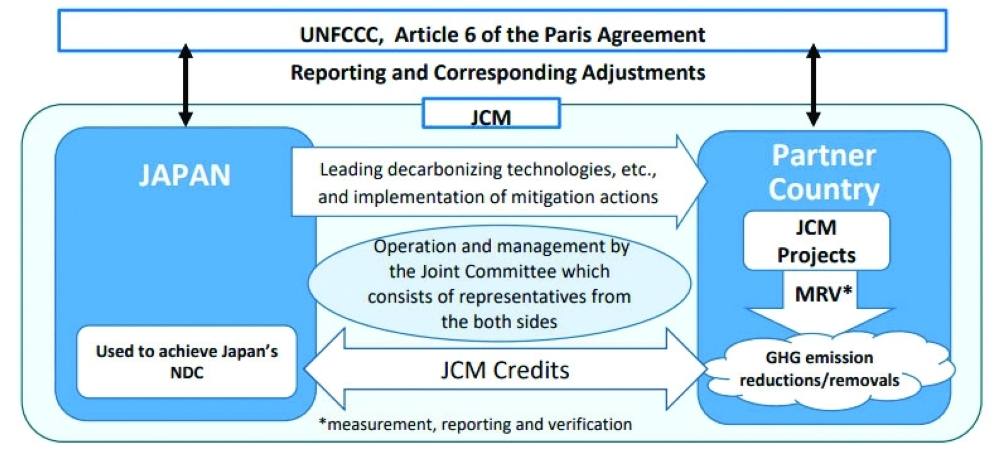





Oman and Japan signed a cooperation memorandum on Thursday to launch a Joint Crediting Mechanism (JCM), creating a formal framework for low-emission projects in the Sultanate and opening the way for Japanese technology and capacity-building support in carbon reduction efforts.
The memorandum was signed by Eng Salim bin Nasser Al Aufi, Minister of Energy and Minerals of the Sultanate of Oman, and Kiyoshi Serizawa, Ambassador Extraordinary and Plenipotentiary of Japan to the Sultanate of Oman.
The mechanism is aimed at helping Oman cut or remove greenhouse gas emissions, support sustainable development and contribute to the Sultanate’s climate commitments under the Paris Agreement, while also allowing Japan to count part of the resulting credits towards its own nationally determined contribution.
The agreement gives Oman a new institutional platform to attract decarbonisation-related projects, products, systems, services and infrastructure, with the memorandum explicitly referring to the diffusion of leading low-carbon technologies and the implementation of mitigation actions in the Sultanate.
A joint committee made up of representatives from both governments will be formed to oversee implementation. Its role will include preparing the rules and guidelines governing project procedures, methodologies, project design documents, monitoring, third-party validation and verification, as well as the distribution of carbon credits generated under the mechanism.
The memorandum states that credits issued from emissions reductions and removals under the mechanism will contribute to the climate targets of both countries, while avoiding double counting through corresponding adjustments in line with Article 6.2 guidance under the Paris Agreement.
Japan will also provide technological and capacity-building support needed for the administration of the mechanism by the Omani side, underlining the practical cooperation element of the deal beyond its climate policy dimension.
The two governments said the mechanism would be implemented in line with their national laws and regulations and would seek to maintain transparency, environmental integrity, simplicity and practicality in order to encourage concrete action on emissions reduction and removals.
As of March 2026, JCMs have been established with 32 countries, including Mongolia, Bangladesh, Ethiopia, Kenya, Maldives, Vietnam, Laos, Indonesia, Costa Rica, Palau, Cambodia, Mexico, Saudi Arabia, Chile, Myanmar, Thailand, the Philippines, Senegal, Tunisia, Azerbaijan, Moldova, Georgia, Sri Lanka, Uzbekistan,Papua New Guinea, the United Arab Emirates, Kyrgyzstan, Kazakhstan, Ukraine, Tanzania, and India with Oman becoming the 32nd country.
The Paris Agreement requires each country to outline and communicate their emissions reduction target every five years.
Oman Observer is now on the WhatsApp channel. Click here