




It was morning in the universe. On Earth, it was Christmas Eve of 1968, a time of renewal. So it was for Frank Borman, William Anders and James Lovell, the crew of Apollo 8, who were farther from home than any humans had ever been.
Their big job was to fly around the moon to scout the lunar terrain for potential future landing spots.
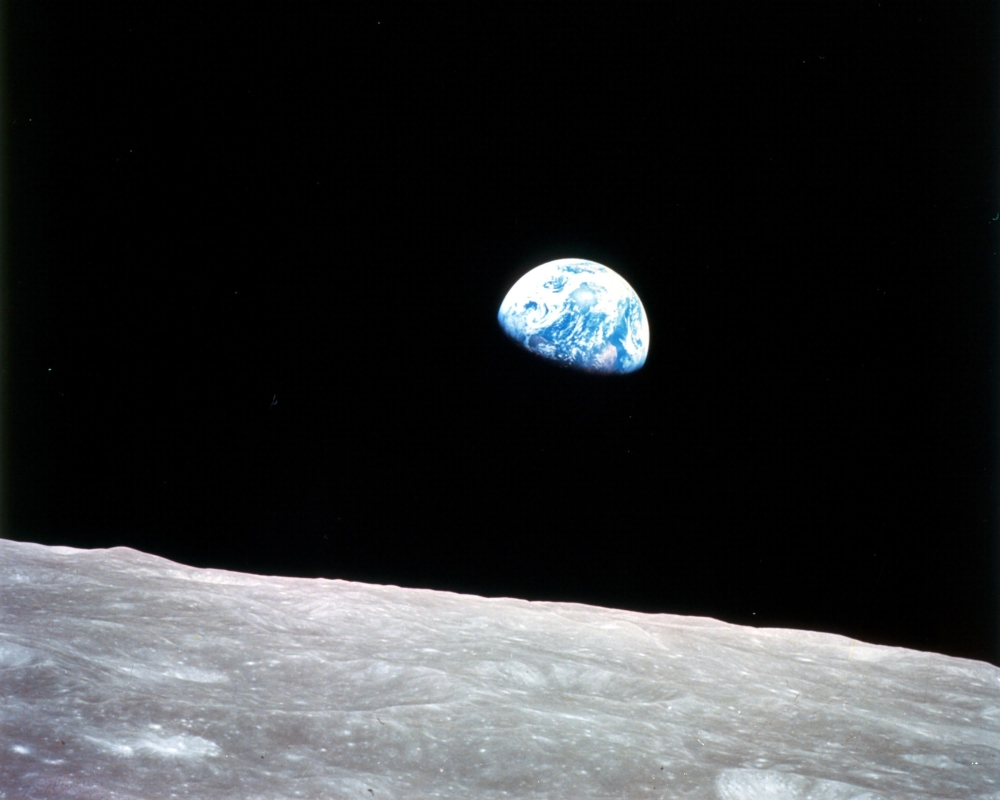
Suddenly, hovering over the ash-colored craters and mountains, bluer and more precious than a robin’s egg was the world, our world, huddled against the dark and cold inside its membrane of air.
They gaped and took the picture that would ever be known afterward as “Earthrise.” All the beauty and terror of the cosmos was compressed into that one image.
That night a billion Earthlings listened as down from the curve of the moon came the first verses of “The Book of Genesis.”
Grown men, hardened rocket scientists, stood at their consoles at the Johnson Space Center and cried like babies.
So did I, listening on the radio at home.
It had been a long dark decade, marked by soaring hopes and shattering disappointments.
The Russians had beaten us over and over again to space. Their rockets were bigger and more reliable than ours.
The history of the decade was a history of assassinations: Malcolm X, Medgar Evers, John F. Kennedy, his brother Robert, and Martin Luther King Jr.
Cities were burning with discontent over the war in Vietnam.
The culture was blossoming and fragmenting at the same time.
The Beatles were breaking up.
There is a time in any project — a football game, a novel, a scientific experiment, a medical procedure, politics — when you know you’ve figured out how to win. It’s in the bag if you don’t do something stupid.
So it was with Apollo 8 and the moon race. Suddenly, the way was clear. A psychological light dawned over realms as disparate as the cover of Time magazine and the Coke and pizza-littered rooms of sci-fi nerds.
Something to feel good about.
Apollo 8 was originally supposed to be just a trip around the Earth to test the command module that had been redesigned and rebuilt after the Apollo 1 fire that killed astronauts Gus Grissom, Edward White and Roger Chaffee on the launchpad. It would also be the first crewed flight of the Saturn V rocket that had been designed and built to take astronauts to the moon.
But in August of that year Borman was whisked away to a closed-door meeting with his NASA bosses. Would he and his crew like to go around the moon instead?
It was decided that Apollo 8 would orbit the moon 10 times, increasing the risk and excitement. What if they couldn’t refire the engines and break out of the moon’s orbit at the end?
Much of the hoopla that followed that trip around the moon has centered on that photograph, “Earthrise,” which symbolized a growing awareness of the fragility and preciousness of the environment on Earth. As Anders liked to say, the Apollo 8 crew had been sent to examine the moon but had instead discovered Earth.
Nobody dreamed during the Apollo era that it would be more than half a century before humans returned to the moon.
NASA is set to send four astronauts to the moon for the first time in 53 years. Reid Wiseman, Victor Glover, Christina Koch and Jeremy Hansen will fly a figure 8 around the moon as a preliminary event to landing a crew and eventually establishing a permanent base there.
The Artemis II crew includes the first Black man, the first woman and the first Canadian to journey to the moon, a display of diversity as well as talent and training that is going out of fashion in some circles.
When the Artemis II astronauts come around the moon, it’s hard to imagine it will have the same emotional impact on Earth as “Earthrise” had in 1968.
For the crew of Apollo 8, the sight was an act of discovery. Down here on Earth many decades beyond the moon race, we know these views of our planet well.
Still, we are free to wonder how many times we can rediscover Earth, and get to “know the place for the first time,” as T.S. Eliot put it.
This article originally appeared in The New York Times.
Oman Observer is now on the WhatsApp channel. Click here