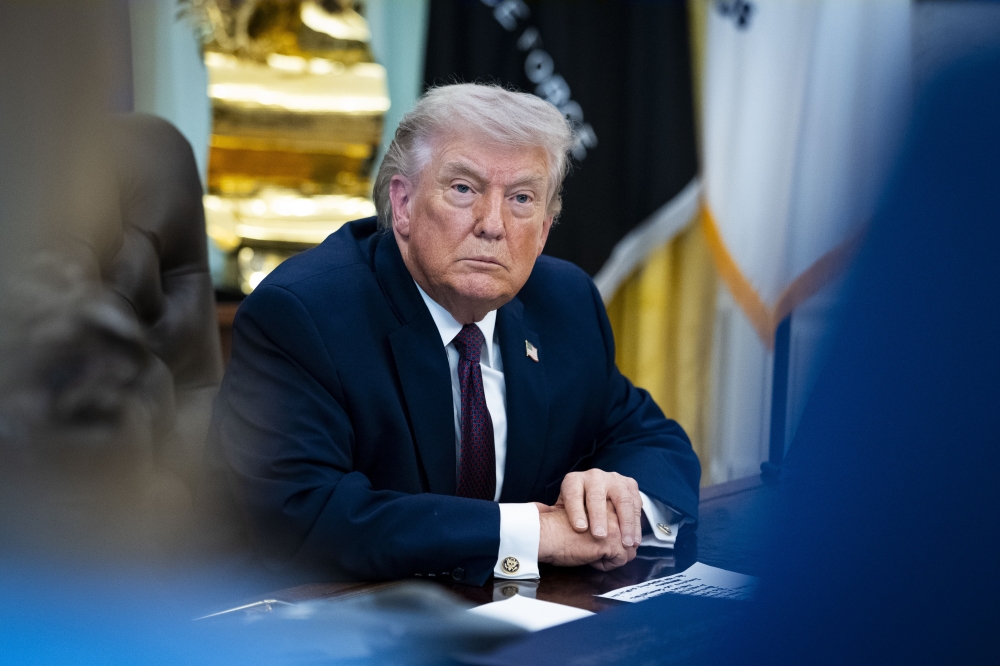





President Donald Trump said on Tuesday that the United States would wrap up its military campaign in Iran in two or three weeks, and the White House said he would address the nation about the war on Wednesday evening.
“We will be leaving very soon,” Trump told reporters in the Oval Office.
It was not immediately clear what message Trump intended to deliver in his national address, and he has left open the potential for escalating military action. But he and top aides have increasingly been suggesting that he sees justification for claiming to have achieved his main objectives and would like to extricate the United States from the conflict.
Karoline Leavitt, the White House press secretary, said Trump would be providing “an important update” on the war.
Trump told reporters that he had attained his goal of dealing with Iran’s nuclear program and that gasoline prices in the United States would come down as soon as it ended the conflict, which he said would be soon. Dealing with the effective closure of the Strait of Hormuz, choking off the global energy trade, was a problem for other countries to deal with, Trump said.
In a video published Tuesday, Secretary of State Marco Rubio sought to make the case that Trump had succeeded in his primary goal of keeping Iran from being able to build a nuclear weapon. But Rubio’s argument was built on the assertion that degrading Iran’s conventional weapons was enough to keep Tehran, the capital, from building a bomb.
“That is the goal of this operation, to destroy their conventional missiles and their drone program so they can’t hide behind it,” Rubio said.
But even as the administration sent signals of de-escalation, Trump has left open the possibility of military escalation as U.S. forces continue to reach the region.
While Trump has touted that the military has hit more than 11,000 targets, Iran still has near-bomb-grade nuclear material at the Isfahan site. The president is weighing whether to approve a risky operation to seize or destroy the material.
Trump has also floated the idea of invading or attacking Kharg Island, the heart of Iran’s oil export capacity in the Persian Gulf, or seizing other islands in the Gulf to help restore the flow of shipping through the Strait of Hormuz, which Iran has used as a choke point for Middle East oil shipments.
At the same time, Trump continues to suggest that a negotiated settlement with Tehran is possible, though not necessary for the United States to step back from the war that it has been waging alongside Israel for the past month.
But Trump has yet to fully achieve many of the goals he set out when he entered the conflict, including ousting the theocratic government in Iran and ensuring that it could never achieve a nuclear weapon. Nor has he resolved problems created by the war, including the effective closure of the Strait of Hormuz and the increased regional instability caused by Iran’s missile attacks on neighboring countries.
Rubio on Monday stated four goals for the war in interviews with ABC News and Al Jazeera. An official State Department account posted on social media a video clip from one of the interviews and a bullet-point list of the goals, saying: “You should write them down.”
The goals were the destruction of Iran’s air force, the destruction of its navy, the “severe diminishing” of its capability to launch missiles and the destruction of its factories.
Absent from the list are some of the goals that Trump has stated recently: “regime change,” seizing Iran’s oil, forcing the Iranian military to allow ships through the Strait of Hormuz, and completely eradicating Iran’s nuclear program, which includes stockpiles of highly enriched uranium buried in underground sites that were struck by U.S. bombs last summer.
Rubio’s list of four goals — all conventional and relatively modest — was similar to a list of three objectives he put out on March 9, in the second week of the war, with two notable differences: the addition of the destruction of Iran’s air force, and also a walking back of an earlier stated goal to “destroy their ability to launch missiles.” The new phrase, “severe diminishing” of that capability, indicates that U.S. officials no longer think it is feasible to destroy Iran’s missile program.
In laying out the four goals, Rubio appeared to be giving Trump an off-ramp that the president could decide to take. Trump could say the United States had achieved the goals and end U.S. combat operations, even if Israel, Saudi Arabia and some other Arab nations in the region are pressing him to continue the conflict until the violence forces a bigger structural change to Iran’s government and leadership.
“We will achieve those objectives,” Rubio said on Al Jazeera about the four goals. “We are well on our way or ahead of schedule. We will achieve them in weeks, not months.”
But White House officials, including Leavitt, have reiterated the president’s more expansive goals of dismantling Iran’s missile and drone production infrastructure, weakening their proxies, and preventing Iran from ever obtaining a nuclear weapon.
On Tuesday, Trump said the United States had accomplished “regime change,” even though a theocratic leadership that is authoritarian and anti-American remains in place.
“We’ve knocked out one regime, then we knocked out the second regime,” Trump said. “Now we have a group of people that are very different; they are much more reasonable, I think, much less radicalized. We have had regime change.”
If Trump does follow through on his threat to end the military campaign without reopening the strait, he will leave the global economy in disarray. Oil prices have skyrocketed around the world, including in the United States, and European officials are urging countries to cut back on energy use.
But Trump, who said Tuesday that “all I have to do is leave Iran” for oil prices to drop, has put the onus on other countries, including NATO allies, to reopen the strait.
“Build up some delayed courage, go to the Strait, and just TAKE IT,” he wrote on Truth Social on Tuesday morning. “You’ll have to start learning how to fight for yourself, the U.S.A. won’t be there to help you anymore, just like you weren’t there for us. Iran has been, essentially, decimated. The hard part is done. Go get your own oil!”
This article originally appeared in The New York Times.
Oman Observer is now on the WhatsApp channel. Click here