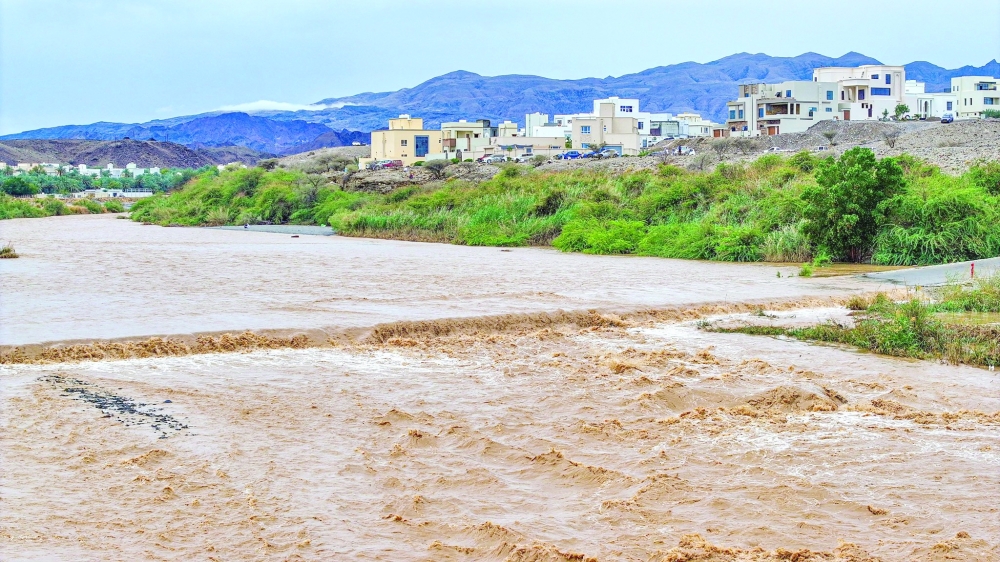





MUSCAT: As one more weather system is set to bring in rains, what could be the mindset of commuters if they were to come across a running wadi?
"Despite repeated alerts and message notifications, people still choose to venture out unnecessarily. In doing so, they risk their lives, leaving their families to suffer the consequences," said a concerned resident, Rita Samuel.
Mohammed al Riyami, another concerned citizen, said he was overwhelmed with water on the street in front of his house. "I did not have to approach a wadi."
According to senior psychiatrist, Dr Hamed al Sinawi, one of the most powerful forces at play, when it comes to the urge to cross a wadi, is what psychologists call optimism bias, the belief that negative outcomes are more likely to happen to others than to ourselves.
A driver may know that crossing flooded roads is dangerous, but still think, “It won’t happen to me.” This quiet confidence often overrides caution. "Driving is an activity most of us perform daily, and this familiarity makes us feel confident. We trust our skills, our vehicles and our judgment. Yet water is deceptive. Even a small depth can lift a car or disrupt traction. What feels like control is often an illusion," explained Dr Hamed.
Another explanation, he pointed out, is social influence. When drivers see others crossing successfully, the situation appears safer than it truly is. Psychologists refer to this as social proof. In uncertain situations, we look to others to guide our behaviour. “If they made it, I probably will too” becomes an unspoken assumption.
"Some of the decision-making process is altered, possibly because the driver is tired or in a hurry to reach their destination. When he decides to cross, his mind begins to justify the decision. “It doesn’t look that deep.”
“I’ve done this before.” In psychology, this is called cognitive dissonance, our tendency to align our thinking with our intended actions to reduce internal conflict.
According to Dr Hamed, public safety messages that rely solely on warnings may not be enough. People do not just need information; they need to feel the risk. Visual demonstrations, real-life stories and clear social norms (“most drivers turn back”) can be far more effective.
Oman Observer is now on the WhatsApp channel. Click here