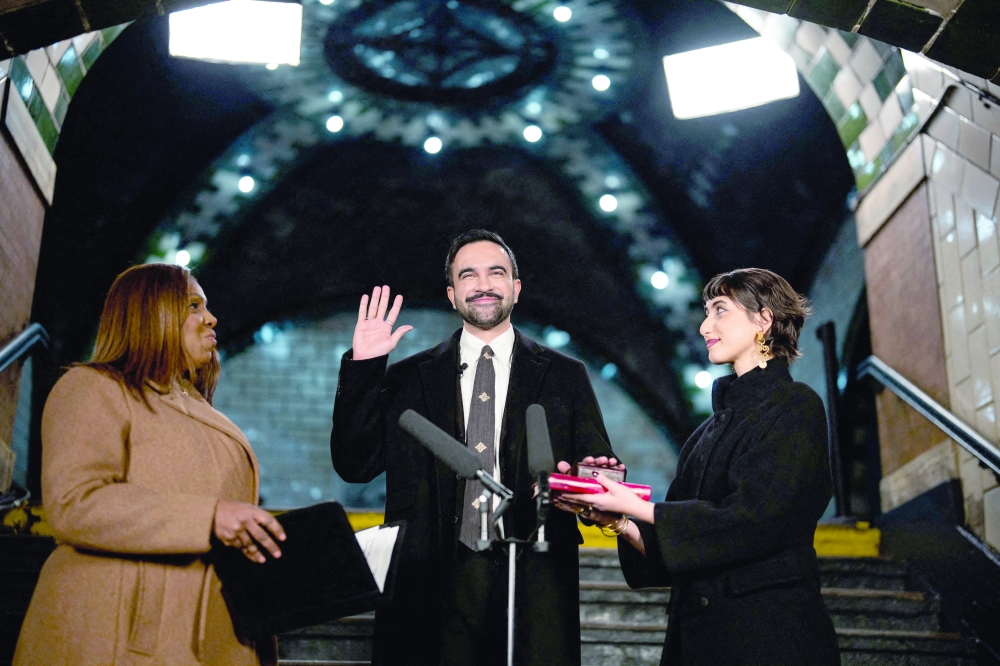
For decades, New York City has been held up as both the promise and the failure of American capitalism. It is a city of immense wealth and relentless inequality, where luxury towers rise beside overcrowded apartments and working families struggle to afford rent in the very neighbourhoods they sustain. But since Zohran Mamdani became mayor, something noticeable has begun to change, not only in policy, but in how New Yorkers understand what the government is supposed to do.
Perhaps the most striking development has been Mamdani’s willingness to treat public office as a tool for public good rather than corporate accommodation. One of his earliest achievements was reaching an agreement with President Donald Trump to expand affordable housing construction across the city. In a place where housing costs have pushed teachers, service workers and even middle-income professionals out of their communities, the commitment to building accessible housing marks a significant departure from decades of market-driven urban policy. Instead of waiting for private developers to solve the crisis, the city has stepped in directly.
Housing, however, is only one part of a broader vision. Mamdani has also proposed higher taxes on large corporations and ultra-wealthy residents, a move that immediately sparked criticism from business interests but resonated strongly with ordinary New Yorkers. The logic behind the policy is straightforward: cities function because of public infrastructure, workers and shared services, yet the greatest financial burden has long fallen on those with the least ability to pay. Redirecting resources from extreme wealth toward public programmes challenges a long-standing assumption in American politics that taxing the rich inevitably harms economic growth.
For many residents, the most tangible example of this shift has been the administration’s push toward free childcare to start in September. In a city where childcare costs often rival rent payments, working parents, particularly women, have historically faced impossible choices between employment and caregiving. By treating childcare as public infrastructure rather than a private luxury, Mamdani’s policies recognise something many European countries accepted long ago: economic participation depends on social support systems.
Critics predicted chaos. Instead, early indicators suggest stability. Crime rates have continued to decline. Mamdani’s approach emphasises prevention rather than punishment, investing in housing, services and community stability rather than relying exclusively on policing. The result challenges decades of fear-based messaging that framed social welfare policies as incompatible with public safety.
One moment that captured this change came during the recent snowstorm that paralysed parts of the city. Rather than relying solely on overstretched municipal crews, Mamdani called on New Yorkers themselves to help clear sidewalks and streets, and crucially, ensured that participants were paid $35 an hour, far above minimum wage, which is currently at $17 an hour. The response was immediate. Residents showed up not just because of the pay, but because the initiative felt participatory. The government was not outsourcing responsibility or demanding unpaid civic duty; it was investing directly in its people while solving a shared problem.
That decision symbolised something larger. For many New Yorkers, they felt tax dollars were visibly returning to communities instead of disappearing into bureaucracy or corporate subsidies. Public spending became something concrete: cleaner streets, paid workers, safer neighbourhoods and collective action.
This shift has also sparked a broader ideological reconsideration. Across the United States, socialism has long been treated as a political taboo, a word associated with economic collapse or government overreach. Generations of Americans have been taught that socialist policies inevitably undermine freedom or prosperity. Yet what New Yorkers are witnessing under Mamdani looks far less radical than advertised. Affordable housing, childcare support, fair wages and progressive taxation are not abstract ideological experiments; they are practical measures aimed at improving everyday life.
The resistance to such policies says as much about American political culture as it does about economics. The United States remains one of the most aggressively capitalist societies in the developed world, where economic success is often measured by corporate growth rather than collective wellbeing. Policies that redistribute resources are frequently portrayed as threats because they challenge a system that prioritises wealth accumulation at the top, even as working-class Americans face rising costs, stagnant wages and increasing insecurity.
New York now offers a counterexample. The city demonstrates that government intervention does not automatically stifle innovation or economic vitality. Instead, it can stabilise communities and make urban life sustainable for those who actually keep cities running. When workers can afford housing and childcare, they are less overworked, healthier and more economically productive. Social investment becomes not a burden, but a foundation.
If New York succeeds, it may prove something simple but powerful, that helping ordinary people thrive is not radical at all. It is simply good governance.
Oman al Yahyai
The author is a multilingual writer and media professional based in Paris. She specialises in human rights and immigration
Oman Observer is now on the WhatsApp channel. Click here