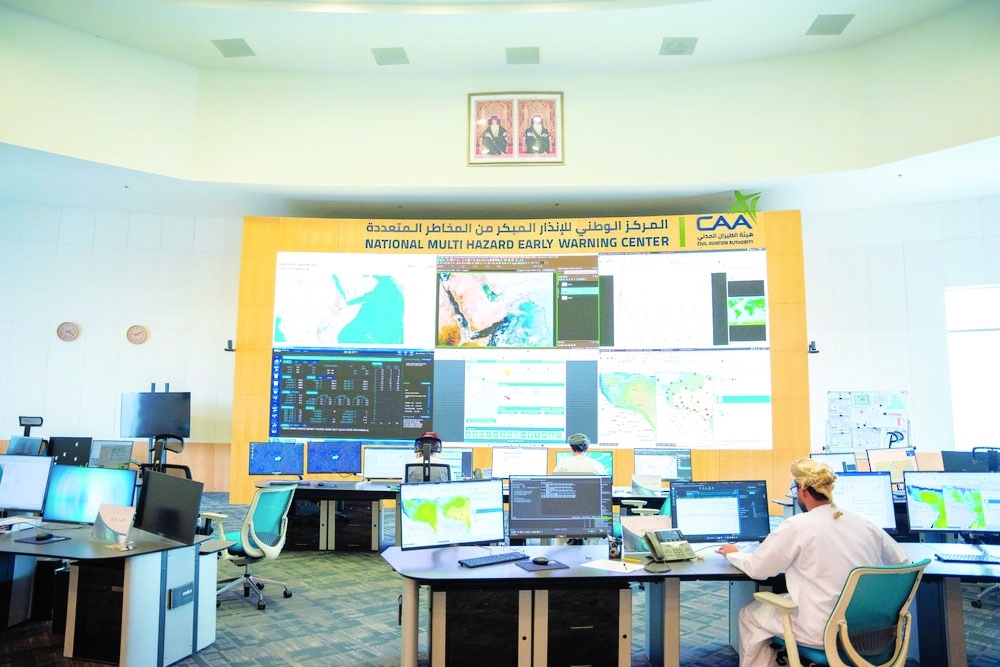





MUSCAT: The Sultanate of Oman, represented by the National Multi-Hazard Early Warning Centre at the Civil Aviation Authority (CAA), alongside the world countries, is marking World Meteorological Day, which falls on March 23 each year.
The Sultanate of Oman continues to develop its meteorological services through an integrated system for monitoring, forecasting, and early warning.
In 2025, the number of weather monitoring stations reached 83 in Oman. In addition, 2,850 special weather bulletins were issued, along with 10,950 weather forecasts for the Sultanate of Oman’s airports (TAF), 1,460 aviation weather maps, 82 warnings for Omani airspace, and 423 warnings related to runways.
The National Multi Hazard Early Warning Centre was established in 2004 and officially launched in 2015. It is one of the first specialised centres in the region providing comprehensive alerts and warnings for natural hazards including tropical cyclones, severe weather conditions, flash floods and the risk of tsunamis resulting from undersea earthquakes.
The country’s early warning system has witnessed significant development in recent years within the framework of the Muzn strategic programme launched by the Civil Aviation Authority (CAA) to develop the meteorological and early warning system during the period from 2023 to 2026. Several strategic projects were implemented, including upgrading the network of monitoring stations, enhancing weather radar capabilities, developing numerical forecasting systems and databases, and establishing advanced digital platforms for providing meteorological information.
Abdullah bin Rashid al Khadouri, Director-General of Meteorology at the CAA, said that the Authority’s efforts are part of a strategic vision aimed at improving the accuracy of weather forecasts and enhancing the efficiency of early warnings, thereby supporting public safety and the aviation sector and contributing to national development plans.
He added that the CAA employs modern technologies such as artificial intelligence and big data analytics to support weather forecasting and the analysis of complex weather phenomena. The CAA has enhanced its systems to track tropical cyclones in the Arabian Sea and predict heavy rainfall and flash floods.
The Sultanate of Oman, represented by the Civil Aviation Authority, also hosts the Centre of Excellence for Satellite Applications in Muscat, which operates under the supervision of the World Meteorological Organization and the European Organization for the Exploitation of Meteorological Satellites (EUMETSAT). It is a regional platform specialising in capacity building and providing training programmes in the using satellite of data in weather monitoring and forecasting, serving specialists in the countries of the Middle East, North Africa and West Asia. — ONA
Oman Observer is now on the WhatsApp channel. Click here