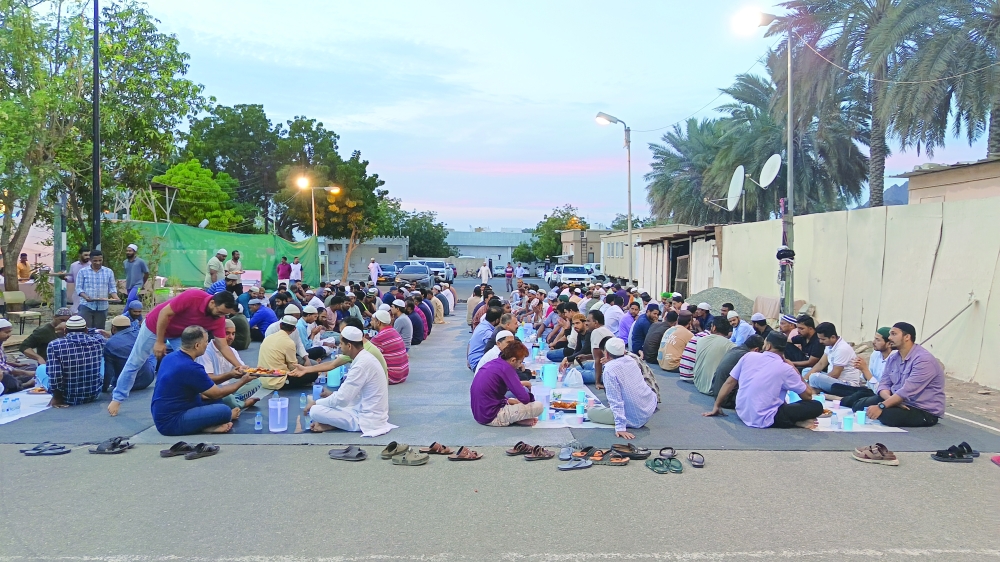





MUSCAT: Throughout the month of Ramadhan, a labour camp in Wadi Al Kabir has been creative in planning Iftar gatherings at their premises for about 350 people, and sometimes even 600 people.By 4 pm, the camp residents begin their preparations. They have 14 kitchens preparing snacks to break the fast, but the main meal, biryani, comes in huge containers from restaurants supported by others.
The interesting part is that many of the Iftar attendees are outsiders who work and reside nearby. This tradition has been ongoing for years. “They saw us spreading out the mats, preparing the food, and arranging seating, and slowly they began to join us regularly,” said Sharafat Bawadekar.
Everyone eats for free because, with growing numbers, supporters for the Iftar each day have also increased. People from at least five different nations gather at this place.
“We have our Omani colleagues on some days, and then we have others from India, Pakistan, Bangladesh and Iran,” he noted.
Despite speaking different languages, over the years, there has been a deep understanding between the attendees.
Despite language barriers, a ‘deep understanding’ has formed over shared iftar. They make sure no food is wasted.
They come, take their seats and break the fast in serenity. All you hear are the birds chirping. After breaking the fast, they quietly move towards the small mosque within the camp compound, where they have invited an Islamic scholar to lead the prayer each evening during the holy month.
Whoever can be accommodated prays inside the mosque, and others outside under the open sky and the shade of the trees.
The overflow from the camp’s small mosque onto the grass and under the trees symbolises a faith that isn’t confined by walls, but shared with the environment.
As Ramadhan comes to a close, they may not meet each other as frequently as they do now, but everyone is preparing for Eid Al Fitr.
They might be away from families, but they want to make sure they enjoy the holidays. They have come up with a new idea — cricket matches during the Eid holidays. Teams have already signed up, as have the supporters.
The concept of “New Family” becomes a reality: For many expatriates away from their biological families, the camp has become their home.
There is coordination and logistics required to prepare snacks and manage bulk biryani deliveries, showing a high level of self-organisation within these labour communities.
Then there is the cricket dialogue. The transition from Iftar meals to Eid cricket matches shows how the community wants to maintain its bond after Ramadhan. It’s a shift from spiritual reflection to joyful, physical celebration.
What started as a labour camp ritual grew simply because neighbours saw mats being spread. This reflects the Omani spirit, where an open door is an unspoken invitation.
Oman Observer is now on the WhatsApp channel. Click here