




MUSCAT, MAR 9
Oman ranks among the key desalination producers in the Middle East — a region that accounts for nearly half of global contracted desalination capacity, according to a peer-reviewed review published in npj Clean Water, a Nature Portfolio journal.
The study said the Middle East’s contracted desalination capacity reached 60.1 million cubic metres per day (m3/d) by the end of 2023, equal to 46.9 per cent of the global total. The region’s operational capacity stood at 28.96 million m3/d, or 41.8 per cent of global output, underlining desalination’s central role in water security across one of the world’s most water-stressed regions.
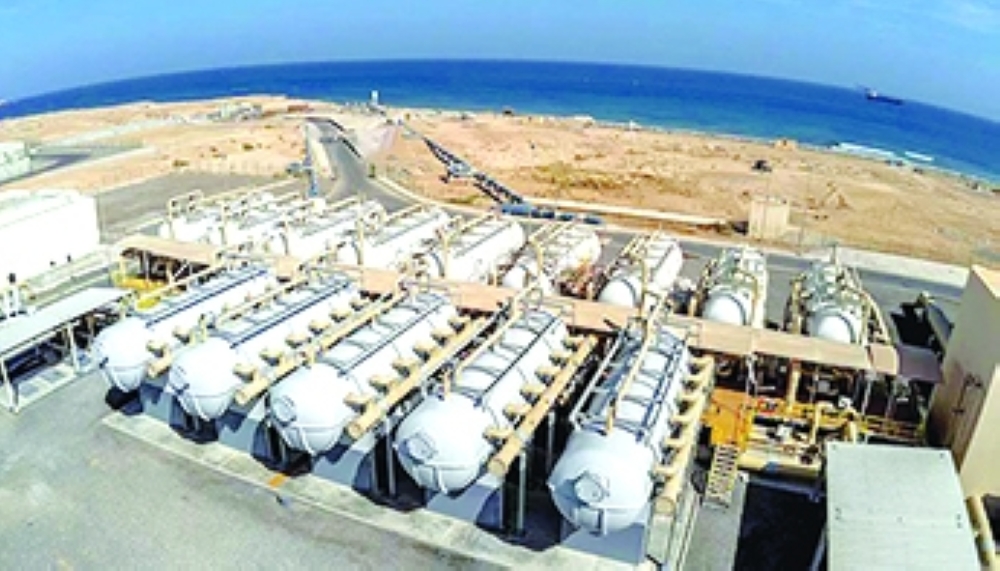
The paper places Oman among the major contributors to seawater desalination in the Middle East and highlights a broader regional shift towards seawater reverse osmosis (SWRO), which is increasingly preferred over older thermal technologies because of lower energy use. Researchers said SWRO typically consumes 4 to 6 kilowatt-hours per cubic metre, compared with 18.3 to 28.5 kWh/m3 for multi-stage flash and 14.2 to 21.6 kWh/m3 for multi-effect distillation.
That transition is already visible in Oman’s own project pipeline. Nama Power and Water Procurement Company said in its Water 7-Year Statement 2026–2032 that major desalinated water sources in the Main Interconnected System are dominated by RO-based plants, including Ghubrah II at 191,000 m3/d, Qurayyat at 200,000 m3/d, Barka IV at 281,000 m3/d, Barka V at 100,000 m3/d and Sohar IV at 250,000 m3/d. A new Ghubrah III plant is also under construction with planned capacity of 300,000 m3/d and expected commercial operation from February 2027.
The review said more than 70 per cent of desalinated water produced by the region’s top contributors goes to utility companies, mainly to supply municipalities and support industrial activity. It also found that while most desalination plants in the Middle East are small to medium in number, a smaller group of very large plants accounts for a substantial share of production.
The authors said desalination has become a strategic infrastructure pillar in the Middle East as climate pressure, drought risk, population growth and limited conventional freshwater resources continue to raise demand for reliable non-conventional water supplies. They added that the region is expected to contract an additional 20.9 million m3/d of seawater desalination capacity between 2024 and 2028, equivalent to 53.1 per cent of projected new global contracted capacity.
Oman Observer is now on the WhatsApp channel. Click here