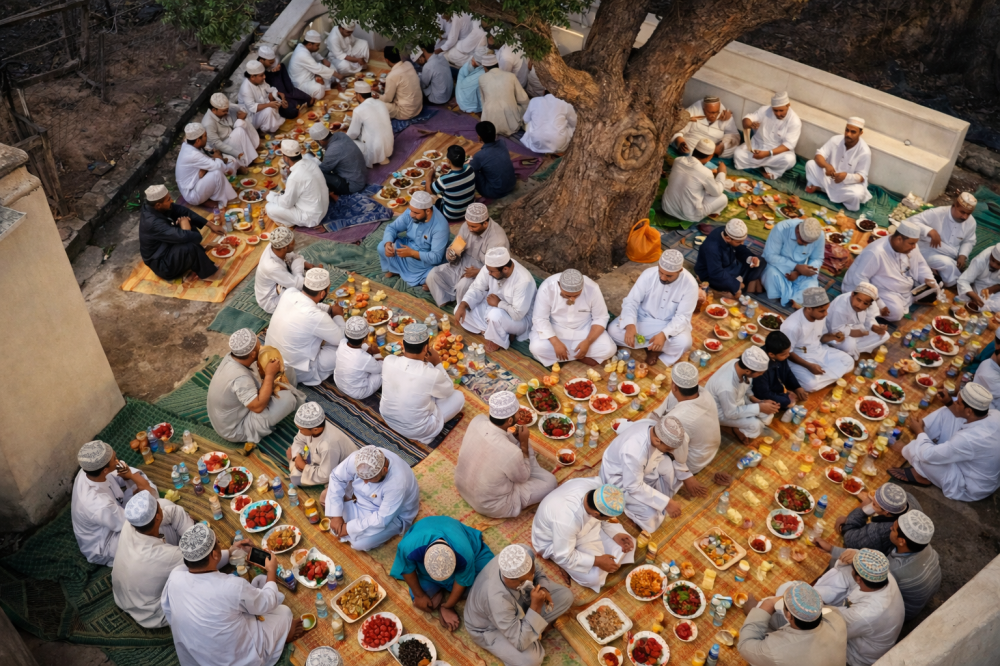





Just before sunset, outside a neighbourhood mosque in Oman, the lawn begins to transform. Carpets are rolled out in long, careful lines. Plastic bottles of water are stacked in neat rows. Small boxes of rice, dates and laban are placed one by one in front of where each person will sit. There is no ticketing system, no guest list, no hierarchy. By the time the light softens into gold, dozens of men are already seated shoulder to shoulder, an easy chatter rising and falling between them. Some are Omani. Many are not. All are waiting for the same sound.
For someone unfamiliar with Ramadhan, the scene can be quietly disarming.
Mass iftar, the communal breaking of the fast at sunset, has become a familiar sight across Oman during the holy month. While many families gather at home to break their fast, mosque lawns and open spaces across the country host large-scale public meals every evening. The numbers depend on the location and the organisers. In smaller towns, it may be a few dozen worshippers. In larger city mosques, the rows can stretch into the hundreds.
The mechanics are simple in concept, but carefully organised in practice. Funding usually comes from private donors, local businesses or families sponsoring an evening in memory of a loved one. Mosque committees oversee the coordination. Volunteers arrive well before Maghrib prayer to lay carpets, distribute food packs and make sure there is enough water and dates for everyone. The meals are often modest: dates, water, rice, perhaps a portion of meat or curry. The aim is not indulgence, but accessibility.
An organiser in Muscat was quoted in local media saying, “The goal is that no one breaks their fast alone. Feeding a fasting person carries great reward.” The sentiment surfaces repeatedly online. Each year, short videos of packed mosque courtyards circulate widely, accompanied by captions such as: “This is Ramadhan in Oman. All equal, all together.” In the comments, people speak of unity, humility and peace.
From the perspective of a non-Muslim observer, what stands out first is not the food, but the anticipation. The men seated on the carpets speak easily among themselves. There is laughter, small talk, the occasional glance at a watch or phone. Yet as the sun lowers, something shifts. The chatter softens. Faces turn towards the mosque loudspeakers. Everyone is waiting for the adhan, the call to prayer that signals the end of the day’s fast.
A recent tourist who joined a mass iftar for the first time described the experience online as “unexpectedly heartwarming”. He admitted he had little understanding of Ramadhan beyond knowing that Muslims abstain from food and drink during daylight hours. “Sitting there,” he wrote, “waiting with everyone for that call to prayer, I realised how disciplined and communal this month is. When the prayer sounded, it felt like a collective exhale.”
That shared moment is perhaps the defining feature of mass iftar. The instant the call to prayer begins, hands move almost in unison towards dates and water. There is no scramble, no rush. Just a quiet, collective acknowledgement that the fast, observed from dawn, has come to an end. For a few minutes, the act is focused and subdued. Afterwards, conversation resumes and the meal unfolds more freely.
At its core, mass iftar is rooted in religious principle. Charity and community sit at the heart of Islam, and feeding others during Ramadhan is regarded as both a spiritual act and a social responsibility. In a country as diverse as Oman, where expatriates form a significant part of the population, mass iftar becomes a visible expression of inclusion. Labourers, office workers, students, long-term residents and visitors sit in the same line, on the same carpet, eating the same meal.
Organisers often repeat a simple reassurance: everyone is welcome. There is no requirement to prove one’s faith or background. For some, it provides practical support after a long day of work. For others, it is about companionship. For a newcomer witnessing it for the first time, it can feel like stepping into a cultural rhythm that is structured, generous and deeply human.
Seen through unfamiliar eyes, the image lingers: dozens of men seated neatly on a mosque lawn, food carefully distributed before them, an endless murmur of conversation giving way to brief, collective stillness. What might appear at first glance to be a simple outdoor meal reveals itself as something more layered, not only kindness, but faith in practice.
Across Oman, night after night throughout Ramadhan, the carpets are laid out again. And as the sun sets, the same quiet anticipation returns.
Oman Observer is now on the WhatsApp channel. Click here