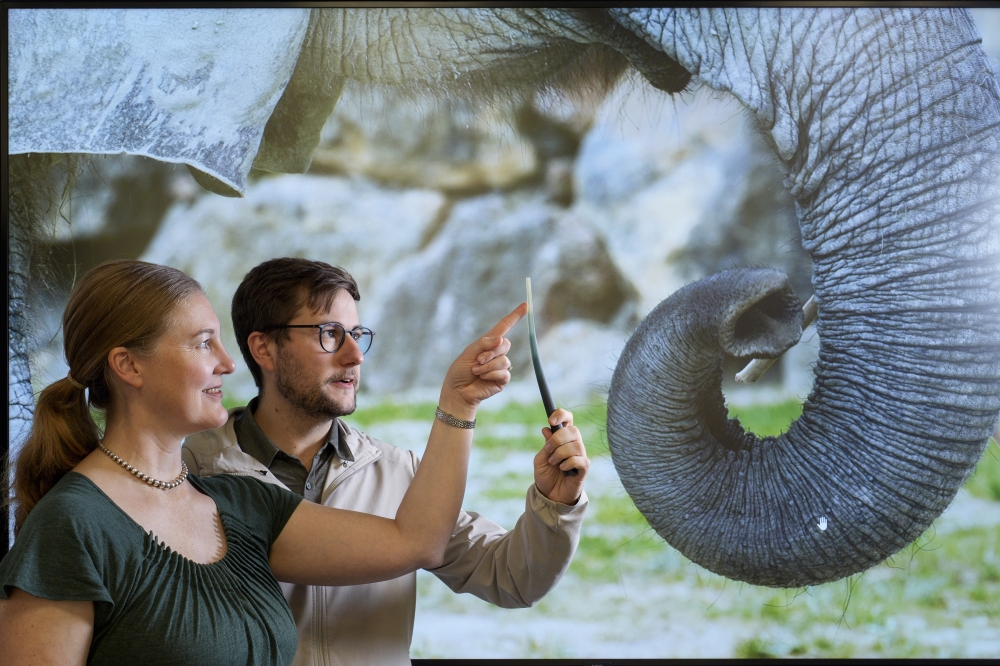





Every elephant has about 1,000 whiskers on its trunk. They play a crucial role for the animals, which have thick skin and poor eyesight. Elephants cannot regrow these hairs, meaning a lost one creates a permanent sensory blind spot on the trunk, which they use for almost everything in daily life.
And as such an important feature, they are also unique among mammalian facial hairs.
“Elephant whiskers are aliens,” said Andrew Schulz, a mechanical engineer at the Max Planck Institute for Intelligent Systems in Germany.
In a study in the journal Science, Schulz and his colleagues identified the structural features that give elephant whiskers a kind of “built-in” intelligence, providing the sensitivity that the mammals need to navigate their world.
While other animals like rats can move their whiskers around, elephants lack the necessary muscles. That leaves their whiskers essentially stationary, even if they protrude from the flexible trunk. This puzzled Schulz.
“If elephant trunk whiskers can’t move, there’s probably something built into them that allows them to function in a way similar to mammals that can move their whiskers, Schulz said.
To find out, Schulz gathered engineers, biologists, material scientists, and others to study whiskers from Asian elephants that died naturally.
Previous research on whiskers typically clamped both ends and examined the middle. Instead, the team studied changes along the entire length of each whisker, using electron microscopy, computer modeling, and other techniques.
After the scientists had gathered data about geometry, stiffness, and porosity, elephant whiskers looked unlike any other animal’s.
Geometrically, Schulz likened them to blades of grass. They are flat and have square-like sides at the base. Stiffness tests showed that whiskers gradually transition from thick, stiff roots to soft tips. Internally, their porosity was characterized by a network of holes. The tiny holes help the whiskers absorb impact, Schulz said, preventing damage across a lifetime of use.
These qualities allow each whisker to detect where along its length an object makes contact. Such sensitivity may give elephants an advantage.
Because the findings so surprised the scientists, they 3D-printed an enlarged replica of a whisker and tried to experience some of what an elephant perceives through its trunk hairs. When closing their eyes and tapping the replica against objects, they found that each contact point felt different.
Going from a stiff base to a soft tip might amplify the signal connected to the firing of sensory neurons, possibly helping the animal perceive the location of contact along each whisker. This would help elephants navigate despite their eyesight.
The study also found that when compared with other animals that have whiskers, elephants have more in common with a cat than a rat, though the shape and internal structure of cat whiskers differ.
The team “showed that really elegantly,” said John Hutchinson, an evolutionary biomechanist at the Royal Veterinary College who wasn’t involved with the research. “That impressed me,” he said. “I just always thought, ‘Whiskers — well, they’re just whiskers.’” — ALEXA ROBLES-GIL
This article originally appeared in The New York Times.
Oman Observer is now on the WhatsApp channel. Click here