




MUSCAT: The head of the Telecommunications Regulatory Authority (TRA) has urged private-sector companies in Oman to diversify investment and develop new revenue streams beyond traditional telecoms, arguing that broader digital services would strengthen company profitability while giving consumers more choice and better value.
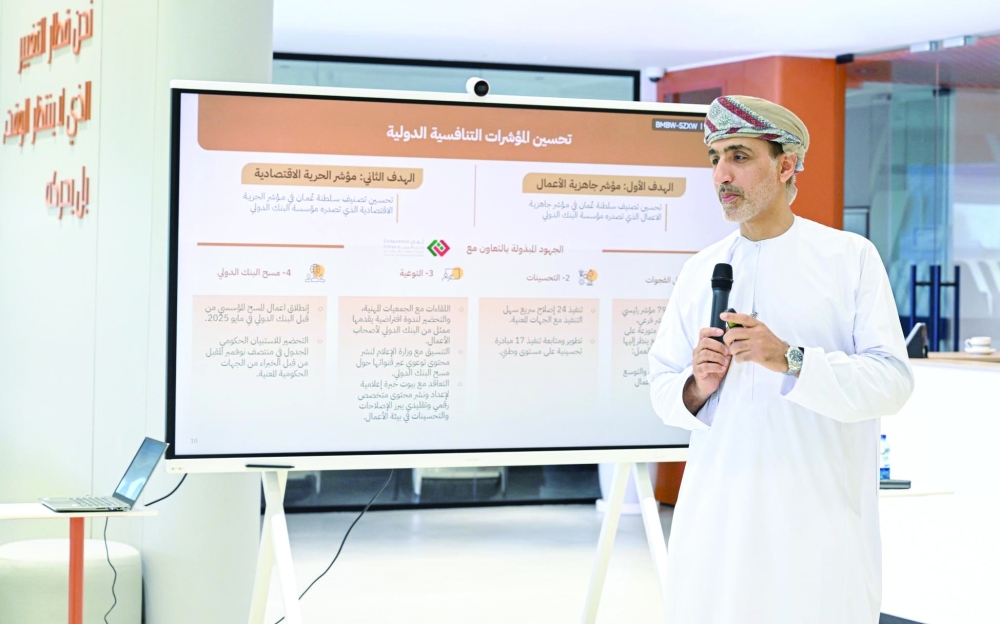
Eng Omar bin Hamdan al Ismaili, TRA Executive President, said companies should “look for alternative sources to grow revenues and profits”, with a stronger focus on innovation and new services that extend beyond core voice and data.
Briefing the media, he also called for faster adoption of automation across factories and sectors linked to manufacturing and exports, framing automation as a competitiveness and sustainability lever that can help firms reduce inefficiencies, raise productivity and keep pace with regional and global markets.
“The goal is not only stronger company performance,” he said, “but a market where consumers benefit from more diversified services — not limited to the traditional offerings that have dominated the sector for years.”
SHIFTING BEYOND ‘TRADITIONAL TELECOMS’
Figures presented at the media briefing show that Oman’s telecoms market is increasingly moving toward new digital use-cases, particularly connected devices and industrial applications.
Internet of Things (IoT) subscriptions rose to 1.632 million in 2025 from 356,000 in 2021, a cumulative increase of 358% over five years — a sign of rising demand for connectivity in logistics, utilities, and smart meter operations.
The expansion has been supported by continued investment in national digital infrastructure. Fibre subscriptions reached 356,000 in 2025, up from 184,000 in 2021. On 5G, fixed wireless subscriptions climbed to 220,000 in 2025 from 76,000 in 2021.
Sector revenues also increased. Licensed telecoms companies generated RO 961 million in 2025, compared with RO 768 million in 2021.
SERVICE OVERSIGHT
Al Ismaili’s remarks come as the regulator highlights both infrastructure progress and a stronger focus on consumer outcomes and service performance.
Data from field-visit results showed mobile download speeds rising to 113 Mbps in 2025 from 44 Mbps in 2021, while fixed download speeds reached 91 Mbps in 2025.
At the same time, complaints submitted to service providers declined to 240,212 in 2025 from 378,943 in 2021, while escalated complaints to the authority rose to 6,605 in 2025 from 1,369 in 2021 — a shift that can indicate higher consumer awareness and greater willin on routes.
In his call for automation, Al Ismaili positioned technology adoption as part of a broader sustainability agenda, saying the shift should be paired with skills development and workforce readiness.
He argued that automation does not have to mean fewer opportunities, but rather a transition toward new roles — in areas such as systems operation, maintenance, software, data analysis, cybersecurity, supply-chain management and tech-enabled industrial services — particularly as Oman pushes for a more resilient, sustainable economy aligned with national priorities.
The TRA’s regulatory track in recent years has also expanded to cover emerging areas linked to digital diversification, including IoT services, telecom service quality, consumer rights, telecom towers, and rules related to cloud computing and data centres — areas increasingly relevant to operators seeking new revenue lines.
Oman Observer is now on the WhatsApp channel. Click here